
Author: Rasim Belko
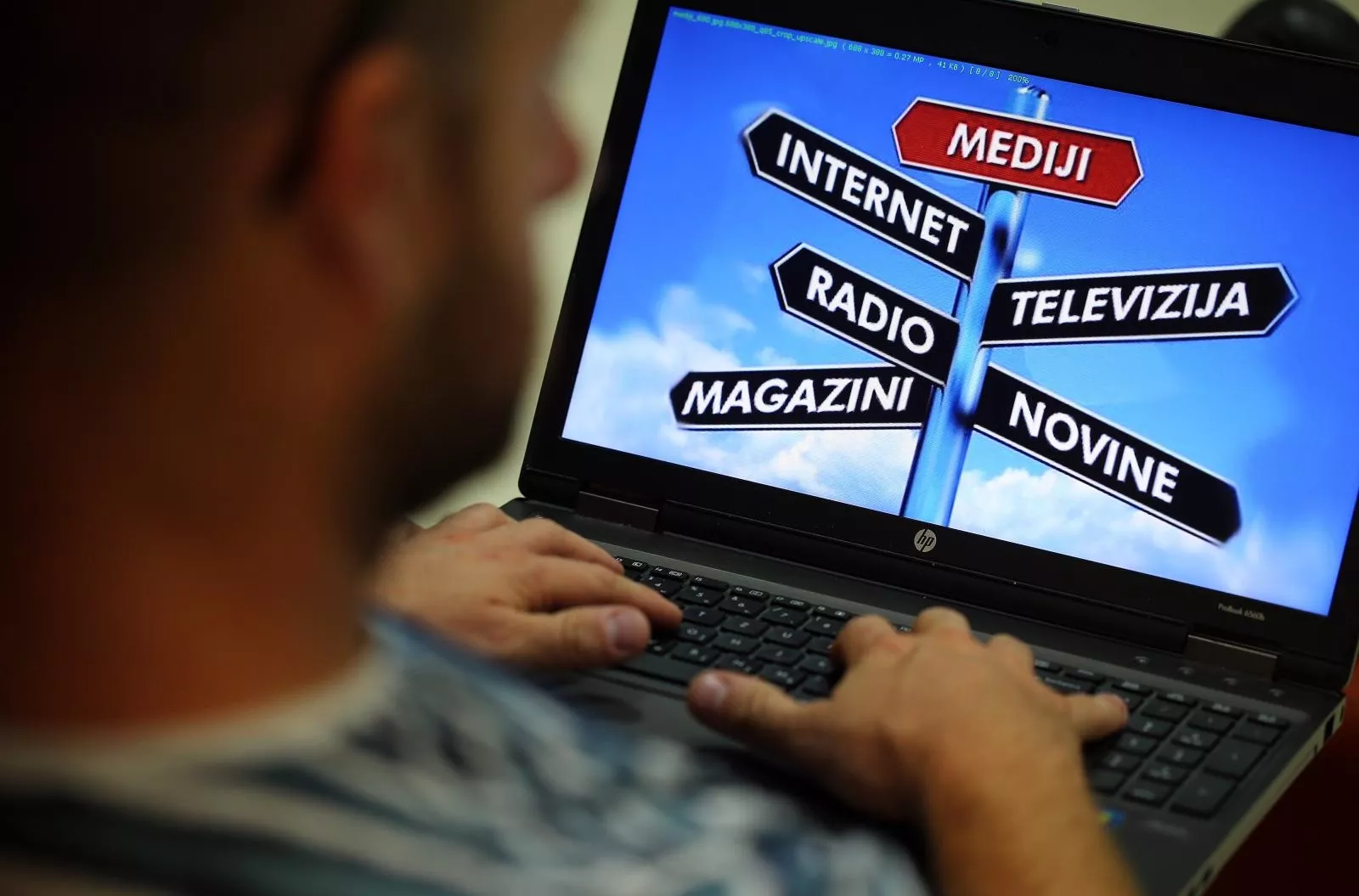
(Patria) - One of the problems in the work of most media in BiH is their insufficient capacity to act as active observers of current social and economic developments.
Mehmed Agović, a lawyer and media expert, told the Patria agency, commenting on the situation in BiH media and the fact that media have become mere conduits for nationalist, radical, and fascist messages.
"Public media services do nothing to educate and train their journalists for specific thematic areas about which they could competently and objectively write and speak about facts on the basis of which citizens could make correct judgments and conclusions about certain phenomena and events in society. In commercial media, this superficiality is even more pronounced, as they strive to maintain high readership and listenership by broadcasting content whose quality is often not the priority," Agović believes.
In such circumstances, he adds, "media most often reduce their role to relaying statements by certain political officials without critically examining their content and analyzing their significance."
"Thus, in the media space, we hear and read, for example, officials who rehabilitate convicted war criminals and justify their actions, or radical nationalist messages from certain politicians which, due to frequent repetition, become almost normal in social everyday life, and towards which the media do not have an appropriate critical attitude," states Agović.
An additional problem, he says, is the fragmentation of media space in BiH along ethnic, political, and territorial lines.
"In such circumstances, media and their journalists, including some public media services, have abandoned journalistic professionalism and accepted the role of an extended arm of the government or certain ethnopolitical options. Such media broadcast multiple truths and poison the public space, so we have, for example, the senseless situation where evident hate speech present in one part of the country has no meaning in another part of it," Agović told Patria.
Fedžad Forto, the general secretary of the BiH Journalists' Association, also sees hate speech in the media as a major problem.
"Unfortunately, hate speech is not new to us, and some media, partly out of ignorance and partly intentionally, have become its uncritical transmitters. The BiH Journalists' Association has recognized this problem and, with the support of the OSCE Mission to BiH and the Office of the BiH Council of Ministers Chairperson, has held a series of seminars and workshops with directors, editors, and journalists from the most important media in BiH over the past two years within the framework of the 'Media Against Hate Speech' project," says Forto.
He adds that the Journalists' Association soon expects to secure funds for the publication of a special publication that will include analyses by Association members on hate speech during the campaign for last year's General Elections.
"Also, before the General Elections, we adopted a special Declaration Against Hate Speech, which we handed over to representatives of some of the largest parties in BiH. In other words, the BiH Journalists' Association has shown that it is possible for the profession itself to try to oppose this scourge and suggests to colleagues not to be just passive 'microphone holders' who will uncritically relay everything said, including hate speech, but to maintain a critical attitude and avoid situations where, due to their ignorance or irresponsibility, they become those who spread hatred and contribute to the worsening of an already complex situation in the country," Forto believes.
He also states that it is a different matter if some media are so much in the service of the ruling elites that they consciously serve as spokespersons for hatred and a means to deepen the crisis in the country.
"I would also point out a particular problem of commenting on portals and social networks, and it seems to me that some media intentionally publish 'inflammatory' news without any moderation of comments, most often from anonymous readers and party bots, trying to ensure as many comments and 'likes' as possible, thus hate speech becomes a kind of media 'commodity'," Forto concluded.
Sociologist Srđan Vukadinović on media as mere conduits of radical, nationalist, and similar messages says: "Media today are mere executors of their financiers. This is essentially opening the eternal dilemma of media dependence or independence. There are no independent media at all. When one says independent media, one usually means independence from the state and government, but that is only one dimension. What about political parties, tycoons, and foreign media financiers? Because these foreigners do not finance media out of kindness; they do it so that these media become their megaphone for those intentions that they cannot officially express as a policy."
He adds that political parties that do not want to speak with war-mongering and inflammatory rhetoric, which does not captivate with kindness, empathy, and tolerance, each have their own media.
"These media are then just warmongering publications that incite intolerance. And the path from intolerance to armed conflict is short. I hope the situation in BiH is not like 30 years ago, because BiH society is more mature. However, the problem is that we do not have independent media today and we do not want to talk about it. Media do not think about their future. When they become megaphones for inflammatory ideas, warmongering politics, they are in someone's service. The story of incitement has a certain lifespan, so the media used for it will also be discarded like a worn-out rag, because there will be no more need for them," Vukadinović believes.
As he says, it would be good for dependent media to consider whether their future is to be short-lived and remembered in BiH society and beyond as someone who was in favor of intolerance, or to try to develop objectively, convey information, and not acquire such a label.
"The second option implies a worse material situation, struggling to survive, and even the closure of such objective media. Media that are megaphones for clerical-nationalist parties are doing very well, because they unconditionally fulfill the demands of their principals. Hiding behind investigative journalism always exists, but that is a facade and selling fog, but that won't work anywhere. These media are the biggest generators of hatred, which is produced in a narrow political, ideological, or clerical-nationalist circle. Today, rallies are not needed; it is enough to call one journalist from any media outlet and broadcast something inflammatory. And then it cannot be stopped," is Vukadinović's message.
He states that such media harm the entire media scene, especially professional journalists and media that strive to be objective. Vukadinović believes that commercialization that turns into tabloidization is also a problem.
"We see that some media, which were widely read, are becoming tabloids. Today, we see that a medium that boasted of being the most read in BiH is now turning into a tabloid with five or six pages of crime news, instead of dealing with serious problems. Reporting on crime is important, but it is something that borders on a kind of tabloidization. After a certain time, readers, viewers, or listeners get tired of it, and the question arises what happened. It often happens that journalists who oppose tabloidization have no place in that medium, even though they have long journalistic careers, because they do not want to be protagonists of tabloid journalism, for whom only tabloidization and commercialization matter, and certainly not the truth and certainly not research that would reveal the truth and point to it," concluded Vukadinović.
Komentari (0)
Prijavite se za komentiranje
PrijavaJos nema komentara. Budite prvi!
Minuta
Sve →Iz drugih kategorija

High Representative Not Elected: Germans, French and British Sabotaged Americans, New Attempt at End of June

ČOVIĆ WITHOUT MERCY: How Those Who Brought Ademović to Office Created a Political Hell for Him



Sunny Saturday, quite warm



Tragedy in Albanian resort: Two minors drown












