
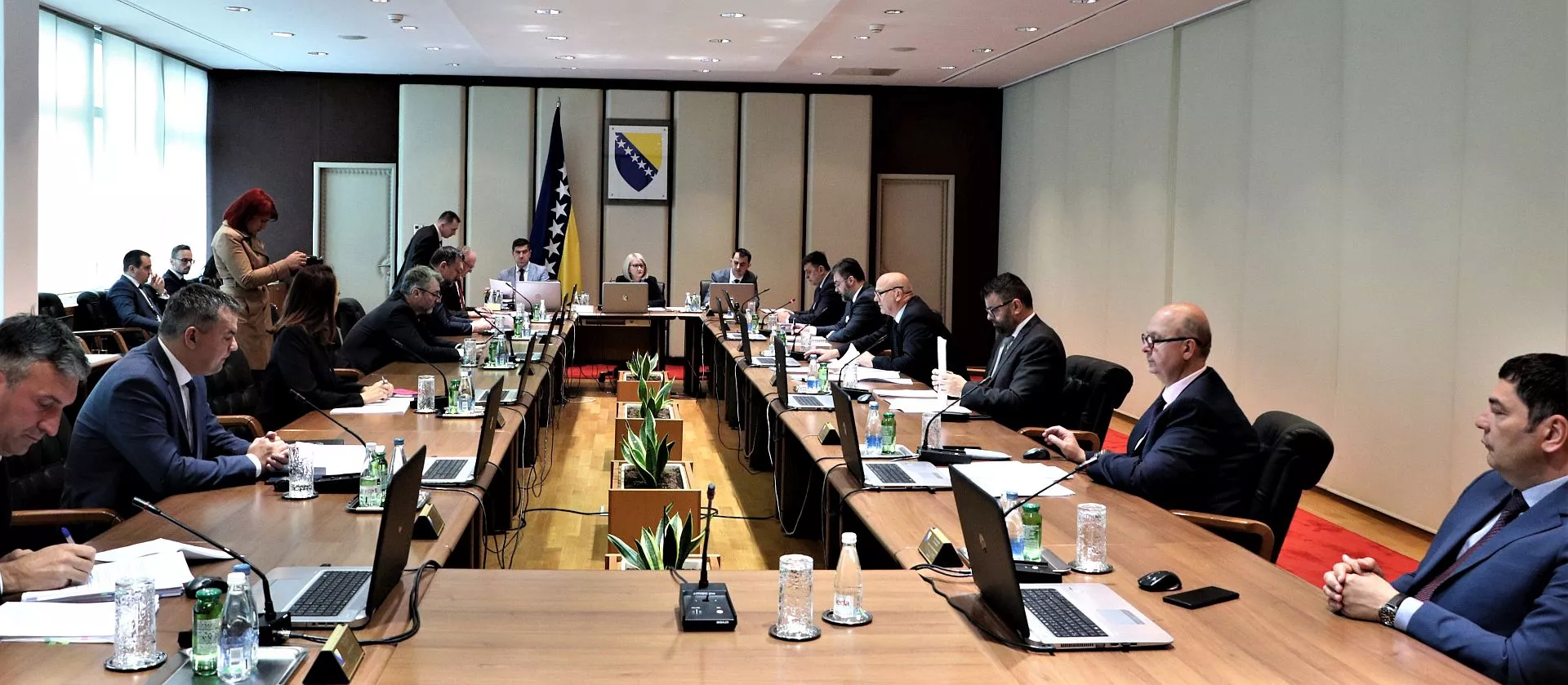
(Patrai) - No laws on the HJPC and the Court of BiH. Ministers from Republika Srpska again voted against the proposed agenda of the BiH Council of Ministers session, which included draft laws on the High Judicial and Prosecutorial Council of BiH and amendments to the Law on the Court of BiH.
Given that the agenda is a “final and executive decision”, without votes from RS, the agenda was not adopted, and without an agenda, there is no session. A total of 32 items were supposed to be on the proposed agenda, and in addition to the laws on the Court of BiH and the HJPC, ministers were also supposed to consider the Proposal of the Decision on the Establishment of the Office of the Chief Negotiator of Bosnia and Herzegovina with the European Union as a temporary body of the Council of Ministers of Bosnia and Herzegovina, writes istraga.ba.
The laws on the HJPC and the Court of BiH are part of a package of reforms that EU leaders have set for the institutions of Bosnia and Herzegovina. The proposed draft law on the HJPC has caused numerous controversies.
The Draft Law on the High Judicial and Prosecutorial Council (HJPC), which has been sent for public consultation, does not represent a step forward, but rather a risk of further erosion of judicial independence. Moreover, the Draft Law appeared on the Council of Ministers' agenda even before the consultations were concluded, indicating a circumvention of procedures and that public consultations are merely a farce, writes Transparency International BiH.
Regarding the content of the Draft, i.e., the version that is in public consultation, instead of eliminating previously identified problems, the draft further strengthens them through, among other things, consolidating ethnic quotas in the Council's membership, which become a permanent rule. In addition, the principle is maintained whereby the distribution of positions is predetermined in relation to ethnic affiliation and the institution from which judicial office holders are nominated, which has already led to manipulation in practice to rig positions.
Instead of ethnic quotas being a temporary corrective mechanism, as recommended by the Venice Commission, the draft permanently embeds them in the law, making them a permanent rule for the election of HJPC members. The transitional provisions even leave the possibility for quotas to remain in force until potential EU membership, and even after that, thereby consolidating the practice of electing members of the most important judicial body based on ethnic affiliation, rather than expertise, experience, and professionalism, in the long term. In addition to national affiliation being established as a permanent instrument of control over the Council's work, this form of political influence can have serious consequences for its independence and functionality in the years to come.
An additional problem is the fact that the Rulebook on the drawing of lots procedure under this draft is adopted by the HJPC and the ministries of justice at the state, entity, and Brčko District levels, giving the executive branch direct influence over a key part of the procedure for appointing Council members, and the application of all other provisions of the law depends on the composition of the Council.
On the other hand, key procedures are left to bylaws, and political influence on the election of Council members remains possible through non-transparent election procedures for members elected outside the judicial community, by the Council of Ministers, the Parliamentary Assembly, and the Bar Associations of FBiH and RS.
In addition to this, the HJPC would further regulate a series of substantive provisions concerning the election of election commissions, appointment and promotion procedures, and rules for deviating from ranking lists through its bylaws. Such a broad scope for arbitrary decision-making by HJPC members regarding their own obligations, oversight, and procedures, as well as the discretion created in terms of appointments, will not contribute to strengthening accountability and oversight. This weakens the already shaken public trust in the integrity of the judiciary and judicial office holders, considering the practice so far in which the HJPC has changed the meaning of legal norms through secondary regulations.
The integrity and accountability of Council members can be seriously weakened by allowing Council members to assume office before asset and interest checks are completed, which calls into question the legality of decisions in which they participated if a negative check finding is subsequently obtained. In addition, the draft does not introduce a mandatory “cooling-off period” after the expiry of the mandate, i.e., a ban on applying for certain positions, which means that Council members can immediately apply for judicial positions they previously decided on, and practically influence their own appointment.
In parallel with the draft law on the HJPC submitted by the BiH Ministry of Justice, the parties of the Trojka announced that their cadres also proposed their own draft law. According to the official positions of the HJPC, the proposed law of the Trojka parties also envisages the introduction of ethnic quotas in the HJPC, as well as provisions that contradict the BiH Criminal Procedure Code.
Regarding the proposed law amending the Law on the Court of BiH, it also does not meet the basic requirements of Brussels. Namely, this law does not provide for the establishment of an Appellate Court of BiH, but only amends the provisions related to the election of judges of the Appellate Division of the Court of BiH. Thus, according to the proposal, judges of that court would be elected by the HJPC, while the division would continue to operate within the framework of the Court of BiH.
According to Istraga's information, ministers from RS are now insisting that the original proposal for the law on the courts of BiH, according to which an Appellate Court would be formed with its seat in Pale, be returned to the agenda.
Komentari (0)
Prijavite se za komentiranje
PrijavaJos nema komentara. Budite prvi!
Minuta
Sve →Iz drugih kategorija

High Representative Not Elected: Germans, French and British Sabotaged Americans, New Attempt at End of June

ČOVIĆ WITHOUT MERCY: How Those Who Brought Ademović to Office Created a Political Hell for Him



Sunny Saturday, quite warm



Tragedy in Albanian resort: Two minors drown












