
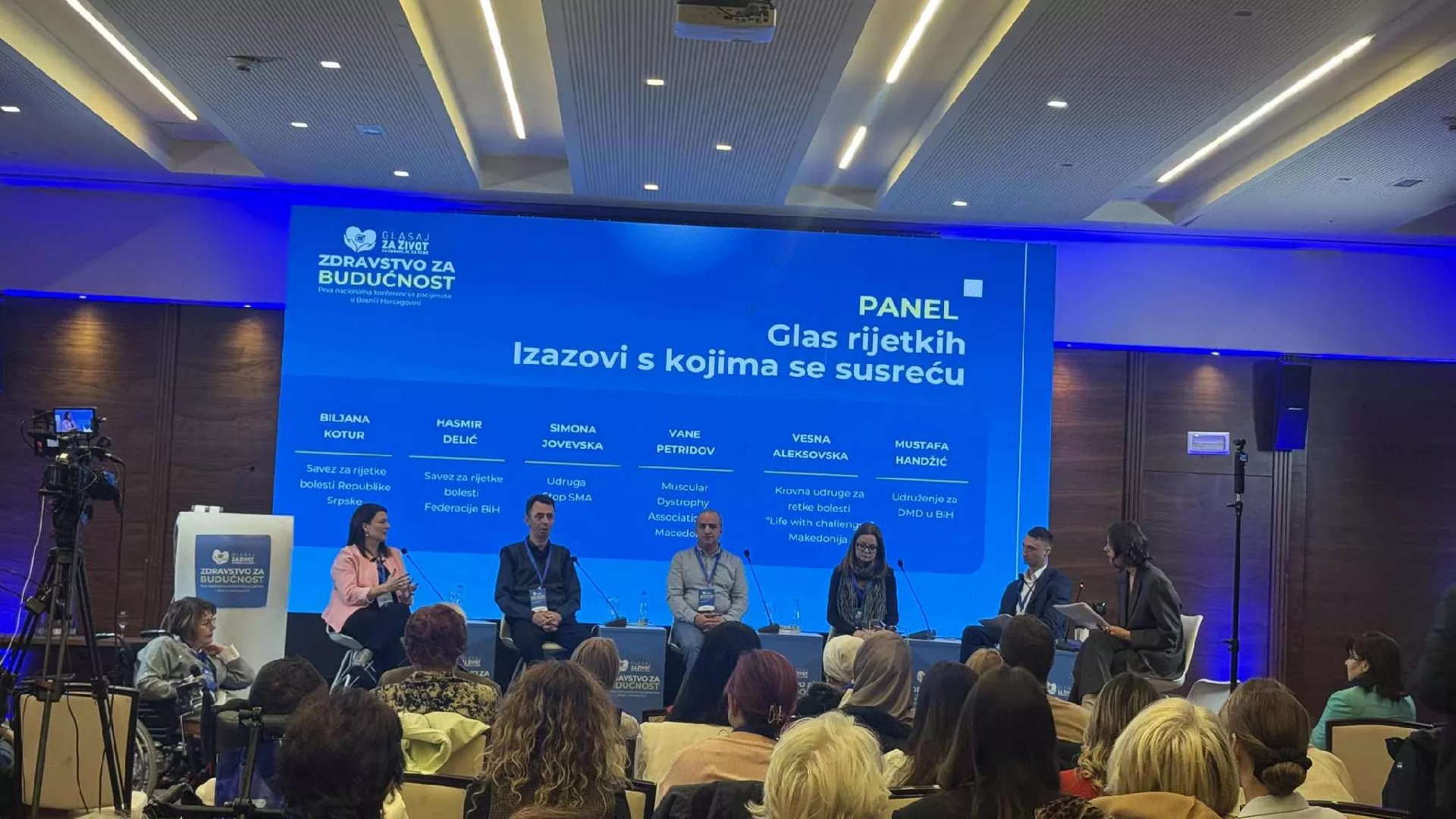
(Patria) - Around 1,500 people suffer from rare diseases in Bosnia and Herzegovina, according to data from the alliances for rare diseases of the Federation of Bosnia and Herzegovina and Republika Srpska.
These people exist, but are often invisible or unrecognized by the law, which makes it difficult for them to access therapies that, in their case, mean life. These patients need a systemic solution because the therapies that enable them to be equal members of society are expensive and they cannot afford them. Precisely these challenges faced by people with rare diseases were the topic of one of the panels at the Health for the Future Conference, the first national patient conference in BiH.
The president of the Alliance for Rare Diseases of Republika Srpska, Biljana Kotur, emphasized that 390 people with a total of 190 rare disease diagnoses are registered in Republika Srpska, and that they are recognized through several laws.
“This is how diagnoses are obtained, and waiting lists for innovative therapies are reduced, which is very important for all patients with rare diseases. That is why the unity of patients and the common struggle for one goal is important, and that is for every person to receive adequate therapy. Some patients use a drug that is not registered, and there are also registered drugs that are not available. Waiting lists for innovative therapies 'cost' 9.8 million KM, which is how much is needed for all patients in Republika Srpska to receive therapy. We have overcome some things legally, but there is a lack of will and money to increase the availability of medicines,” said Kotur.
She emphasized that the exchange of information is of great importance, as well as making the patients and their stories more visible. Simona Jovevska from the Stop SMA Association spoke about the experiences in North Macedonia, stating that their greatest achievement is the fact that in her country all patients with rare diseases have therapy.
“Our main mission is to improve the quality of life and inclusion in society. At a time when the public did not know what spinal muscular atrophy was, we could either pay for medicines or fight. Patient unity is the first and most important step in fighting the system. To become visible, we shed our shame, showed our names and faces through emotional videos and public testimonies, attended events, opened up to the media. We use social networks for mobilization, not just for promotion. Regular communication with the ministry and clinics is also important... It should be proactive, in terms of how to get the medicine, not just repeating that we don't have the medicine. We are building partnerships, not just protests, but the state must still feel the pressure when there is no progress,” Jovevska pointed out.
She added that openness, honesty, professionalism, persistence, dedication, and continuous and steady struggle are the path to success.
“Our argument is that if a child receives therapy on time, only therapy is needed, and if there is a delay, it will cost much more. You are the experts for your disease, and no doctor or minister knows how you feel. Build a team that believes in the mission and maintain dialogue with the public and institutions,” said the guest from North Macedonia.
The president of the Alliance for Rare Diseases of BiH, Hasmir Delić, emphasized that people with rare diseases exist in all segments of society, but they are not recognized in any law in the Federation of BiH.
“We draw strength from challenges, I deliberately will not say problems. The community that cannot adequately respond to our needs has a problem. In the Federation of BiH, we do not have laws that recognize rare diseases, nor a strategic document on rare diseases, and I will freely say that patients are currently victims of turbulence in the Ministry of Finance of the Federation of BiH. Because of all this, we have limited access to medicines and aids, because many rare diseases cause disability. In addition, we do not have a dialogue with the Ministry of Health of the Federation of BiH, and the lack of medical staff complicates the path to diagnoses,” Delić listed the challenges they face.
However, as he pointed out, there are also small victories. After two years of struggle, 28 children have access to medication for cystic fibrosis, and they function normally today and are included in everyday activities. “A Reference Center for Rare Diseases has been established in the Federation of BiH, and some things have started to be resolved. Progress is slow, but it is visible. The fact that dialogue is necessary is shown by the fact that during the period when it existed, we received three medicines, for hemophilia, cystic fibrosis, and spinal muscular atrophy. Much understanding is needed for rare diseases because patients and their families often remain invisible in the system.
By combining empathy and organized action, we can achieve significant changes for patients. For this, we need a patient pathway that would start in primary healthcare. The lives of patients depend on both therapy and aids. Aids and therapy should be a basic right, not a privilege. Having a life-saving medicine is not a privilege. And that's why we need to be part of the system, not humanitarian actions. We want to be partners, not a problem. There is no established path, everyone manages in their own way. To change this, I call on all patient organizations to apply all positive practices and insist on a law on rare diseases. Let's change everything to become visible,” said Delić.
Vane Petridov from the Muscular Dystrophy Association of Macedonia said that systemic change begins with information and understanding.
“We published the National Guide for Diagnosis and Treatment of Muscular Dystrophy, which contains information about therapies, treatment options, and the organization of a quality daily life. We managed to secure financial support for spa treatment, and from this year we have secured a scholarship program for people with muscular dystrophy who are enrolling in college. Behind each of us, behind each project, there is a personal story. Imagine parents who are faced with a diagnosis, imagine their fear, uncertainty, and unanswered questions. Then comes the moment of connecting with other parents, associations, and fear turns into power,” said Petridov.
He highlighted the documentary film as a good example of raising awareness about rare diseases, in which they showed the faces of people with muscular dystrophy, their daily lives, and the challenges they face.
“Patients with rare diseases need action, support, and genuine commitment. Our struggle must be common. No child should be left without therapy, because life has no price, everyone should fight for a dignified life and the rights that belong to them. I believe that hope has no limits,” he said.
Vesna Aleksovska from the Umbrella Association for Rare Diseases “Life With Challenges” from North Macedonia shared that in 2009, when they started working, there were no programs for treating rare diseases at all.
“We were told then that there are few of us. That's how politicians think. We are few and expensive. There were three of us then, and now there are 500 of us with 300 diagnoses. People have become empowered to talk. When the ministers of finance and health refused to meet with us, and since I worked as a journalist, I started going to every press conference or gathering of theirs and asking what we would do about rare diseases. We have to be 'annoying' because it's easier when the stories of patients come out to the public,” said Aleksovska, adding that they have created a future for other people and will continue to do so.
Mustafa Handžić from the Association of Duchenne Muscular Dystrophy in BiH spoke on behalf of parents and families who, as he said, wake up every morning with the same fear.
“They are different, but they must not be forgotten. Therapy for Duchenne muscular dystrophy exists, but it is not available in BiH. And we know that early multidisciplinary approach and innovative therapies change patients' lives. We must not waste time, and institutions must understand that a child's life has no price. We must stop fighting for mere survival and start fighting for a better life,” concluded Handžić.-
Komentari (0)
Prijavite se za komentiranje
PrijavaJos nema komentara. Budite prvi!
Minuta
Sve →Iz drugih kategorija

High Representative Not Elected: Germans, French and British Sabotaged Americans, New Attempt at End of June

ČOVIĆ WITHOUT MERCY: How Those Who Brought Ademović to Office Created a Political Hell for Him



Sunny Saturday, quite warm



Tragedy in Albanian resort: Two minors drown












