
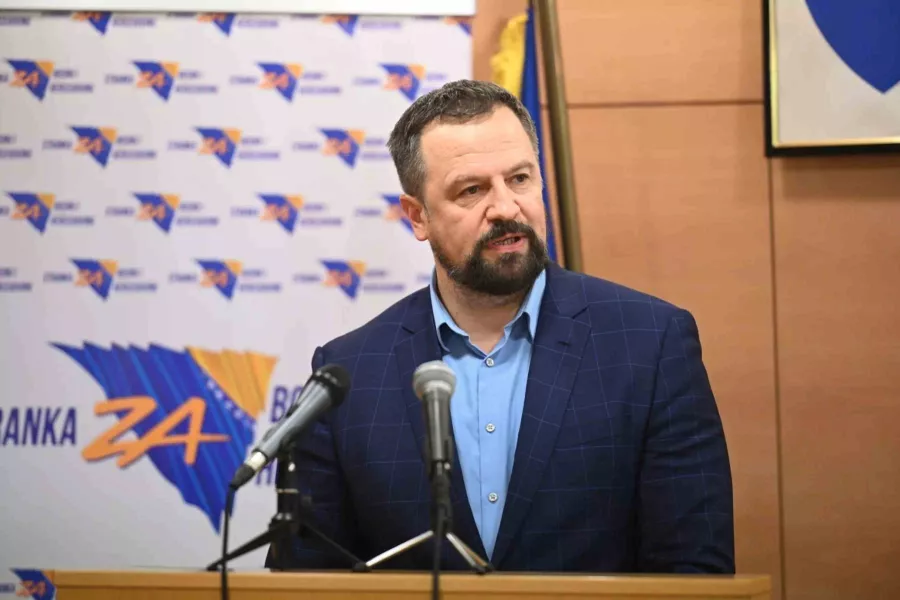
Written by: Muamer Bandić, representative in the Assembly of the Canton of Sarajevo
Education in the Canton of Sarajevo is often discussed in grand terms and even grander clichés: reform, investment in school facilities, quality, digitalization and the like. Behind these words, however, lies a system made up of people, education workers who work with our children every day, educating and raising them. Despite this, they are reduced to passive executors of decisions made behind closed doors, without their participation.
The values on which education must rest cannot and must not be defined in narrow circles of political and administrative structures, but must be generally accepted in society and built with broad participation of teachers, educators and experts. They are the ones who know best where the system is failing, where the problems are and where changes are truly needed.
A school is not a barracks where a minister, institute director or any holder of a public office, like an officer, has a monopoly on the best proposals. The function of a nominal manager is merely to open space for reasoned and professional debate in order to reach the best solution, not to make decisions behind closed doors that others will implement like soldiers. Only then can we talk about genuine reforms, not about the political destruction of an already fragile education system accompanied by empty phrases.
The Institute for Pre-University Education was established with the aim of providing professional and advisory support to teachers. In practice, however, it increasingly appears as an extended arm of the Ministry, rather than an ally and support for education workers. Even worse, we are witnessing situations in which the Institute assumes a role that does not belong to it at all according to its founding act.
The Institute does not have the status of an administrative body.
The Institute is a public institution, and its competencies are clearly defined by its founding act, and that act does not provide for the competence of professional supervision. That is why the very term "supervision," when it comes from the Institute, causes discomfort and resistance among teachers, because it is not based on a valid legal basis but on someone's arbitrariness and improvisation, to which the Troika has already accustomed us in the Canton of Sarajevo.
The relevant provision of the Law on Ministries and Other Administrative Bodies of the Canton of Sarajevo, Article 14, clearly stipulates that the Ministry of Education and Science performs administrative and professional tasks in the field of preschool, primary and secondary education, as well as adult education, and also acts as a second-instance body.
The legislator is explicit regarding the division of competencies in administrative proceedings, and therefore the Ministry cannot transfer its legally established competencies to the Institute, since there is no valid legal basis for such a transfer.
When the Institute assumes supervisory functions, it steps outside the framework of its founding act and encroaches on competencies that are legally assigned to other institutions.
The systemic law does not recognize the Institute, but precisely defines that the Cantonal Administration for Inspection Affairs performs inspection tasks within the competence of cantonal inspections, as well as other administrative and professional tasks, in accordance with the law and regulations. This means that supervision of the work of schools and their bodies can only be carried out by the inspection service. This supervision also implies the limits and nature of the procedure, as well as the legal basis for adopting acts, which is precisely defined by the Law on Inspections of the Canton of Sarajevo. Everything else is improvisation and arbitrariness that creates legal uncertainty and chaos in the education system.
In addition, schools are independent legal entities, and directors are registered in the court register as responsible persons. Direct interference in their competencies is incompatible with the Law on Upbringing and Education in Primary and Secondary Schools of the Canton of Sarajevo, Article 5, which grants them this autonomy and freedom:
"The school enjoys an appropriate degree of autonomy, especially regarding the employment of teaching, professional and other staff, and the freedom of work of teachers."
"The school respects the freedom of teachers to conduct classes in the manner they deem appropriate, in accordance with professional standards and good practices."
Disregarding these legal provisions produces double damage in which teachers' work is made more difficult by imposing additional obligations, creating uncertainty, while the education system loses legal stability. Instead of being a professional and advisory institution, the Institute becomes a political instrument for controlling teaching staff, a source of bureaucratization and legal uncertainty. Teachers, instead of dedicating themselves to pedagogical work and children, are burdened with unnecessary administrative procedures and "supervision" that has neither a legal basis nor clear limits of control.
The purpose of education is not control or bureaucratization, unless the Ministry intends to create an army that will greet everyone with the sentence: "You are missing one more paper." The purpose of education is the upbringing and development of young people, their preparation for a pluralistic and democratic society, and the building of a European future for our country.
Because of all this, the Institute must return to its prescribed legal framework and finally become what it was established for, to be support, not a burden to teachers. It is particularly important to emphasize that the legislator, in Article 19, paragraph (5) of the founding act, explicitly obliged the director of the Institute to suspend from execution any general act that is not in accordance with the Constitution or is contrary to the law, as well as any individual act that could cause harm to the Institute or the social community. This provision clearly establishes the legal obligation of the Institute's management to act exclusively within the framework of legality and with the aim of protecting the public interest.
It is high time we faced the truth, that the education system in the Canton of Sarajevo will not be improved by such arbitrary, political improvisations and additional administrative burdens, with which the Troika conceals party-based hirings.
The education system can only be improved by genuine partnership with the people who stand before students every day, and those are education workers. That is why we must hear their voice and invest in them, rather than wasting time and resources on unnecessary and legally unfounded supervisions, which further bureaucratize an already paper-overloaded system and create chaos where we certainly do not need it.
Why is all this being done? Only so that one party can have complete control over the hiring process within the education system. If you are looking for a better example of the folk saying "they kill an ox for a kilo of meat," you will hardly find a more illustrative example than the way the Troika manages education in the Canton of Sarajevo.
Komentari (0)
Prijavite se za komentiranje
PrijavaJos nema komentara. Budite prvi!
Minuta
Sve →Iz drugih kategorija

High Representative Not Elected: Germans, French and British Sabotaged Americans, New Attempt at End of June

ČOVIĆ WITHOUT MERCY: How Those Who Brought Ademović to Office Created a Political Hell for Him



Sunny Saturday, quite warm



Tragedy in Albanian resort: Two minors drown












