
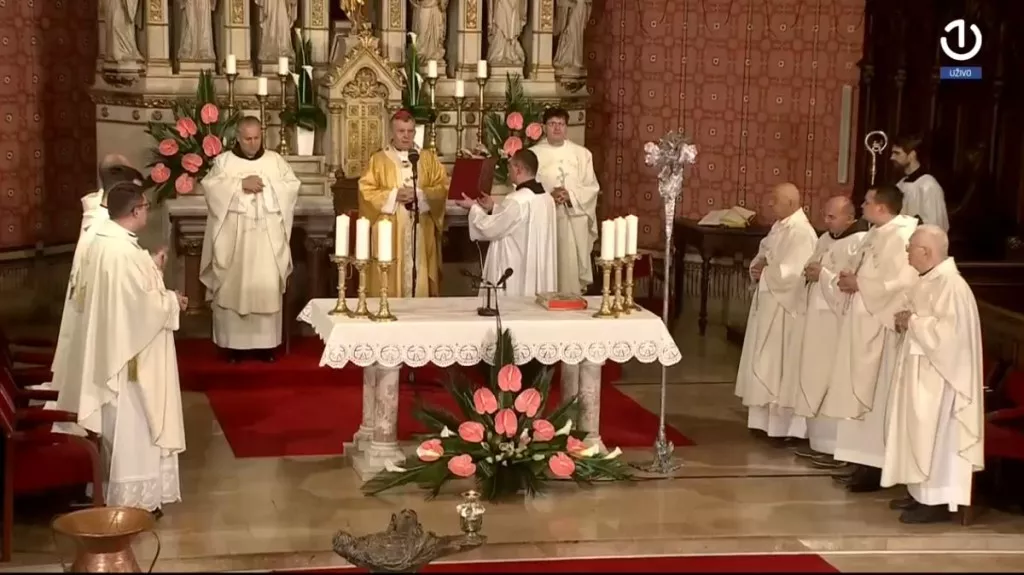
(Patria) - The central solemn Eucharistic celebration on the feast of Easter, Sunday, April 5, 2026, in the Cathedral of the Sacred Heart in Sarajevo was led by the Archbishop of Vrhbosna, Metropolitan Mons. Tomo Vukšić in communion with the Provincial of the Franciscan Province of Bosna Srebrena, Fr. Zdravko Dadić, and the Rector of the Cathedral and Canon, Mr. Marko Zubak, along with ten priests.
A numerous community of believers participated in the celebration, including nuns of various orders, as well as believers who came from different regions to celebrate the greatest Christian holiday – Easter – in the Sarajevo cathedral.
At the beginning of the Mass, after the entrance Easter hymn, Archbishop Vukšić extended Easter greetings to those gathered, encouraging them to gratefully remember the mystery of Christ's resurrection and to personal spiritual renewal.
In his homily, the Archbishop emphasized that the feast of Easter is a holiday by which the Christian community gratefully remembers the morning when Mary Magdalene, on the first day of the week, early in the morning, while it was still dark, came to Jesus' tomb and noticed that the stone had been removed from the tomb. He explained that understanding the Jewish observance of the Sabbath further illuminates the Gospel account, as Jesus' disciples, due to regulations and fear, could not come to the tomb earlier.
Speaking about the meaning of the empty tomb, he stressed that the stone on the tomb in the tradition of that time signified the final victory of death, while its removal signifies the opposite reality – the proclamation of the victory of life over death.
“The stone, placed at the entrance to the tomb, in the tradition of that time signified the final victory of death and the inability of the deceased to leave. However, the moved stone early in the morning on the first day of the week had a completely different meaning: it showed the empty tomb of Jesus, which became open so that others could see that it was empty, thereby indicating and proclaiming to all people the victory of life over death,” said the Archbishop.
He continued by recalling the biblical account of the creation of man in the image of God, emphasizing the dignity of the human person who carries God's reflection within them. At the same time, he warned that through disobedience, man has distanced himself from God, but that through Christ's resurrection, the path of reconciliation has been opened. Referring to the teachings of the Apostle Paul, he emphasized that Christ is the "new man," the "life-giving spirit," who enables the transition from death to life and the renewed closeness to God.
“The Risen Christ is the new man. He is the new man because he is the living and active image of God. Completely and fully. Jesus is the new man because he is the first man in a new way, and through this newness, Jesus is at the beginning of a new spiritual offspring. The image of God, which was realized in Jesus Christ, completely surpasses the one described in the Book of Genesis,” the Archbishop emphasized, adding that the fundamental purpose of Christ's work of salvation is that “people may have life, and have it in abundance.”
He also pointed out that eternal life begins on earth and that man is called to make his life a "vestibule of paradise" by living in service of life – both temporal and eternal.
Speaking about the Easter gift of peace, the Archbishop recalled Jesus' words to his disciples: “Peace be with you,” emphasizing that this peace is not merely the absence of conflict, but a deep gift that comes from God's heart and heals wounds, overcomes fear, and opens man to others.
"When Jesus appeared to his disciples after the resurrection, he greeted them with the words: 'Peace be with you!' (John 20:19). He wished them peace that is always primarily in the service of life, and then also in the service of every human progress, security, satisfaction, and joy. Peace is even the basic prerequisite for all of this. Immediately before his passion and resurrection, in his last discourse to his disciples, Jesus told them that he gives them his peace and leaves it with them (cf. John 14:27), and now, at his first appearance, he blesses and greets them with that peace. He gave it to them and left it as a blessing for themselves and as a task in relation to other people and the world. The aforementioned greeting of Jesus: 'Peace be with you!' is not just a word of comfort in a moment of fear and uncertainty, but a gift that comes directly from God's heart. Christ's peace is not merely the absence of conflict or a temporary balance of power among people. It is a deep peace of a heart reconciled with God, a peace that heals wounds, overcomes fear, and opens man to his brother. Such peace, based on the victory of love over sin, becomes the power of new life and the only firm foundation of all true hope,” the Archbishop stated.
In the context of current global circumstances, he warned about numerous war sufferings, reminding that between 50 and 60 conflicts are currently taking place in the world, including so-called “forgotten” wars. In addition to wars, he highlighted other threats to human life and dignity, such as the killing of unborn children, the suffering of migrants and refugees, human trafficking, and injustices affecting the most vulnerable groups in society.
“These are all different ways of attacking human life or its dignity. They are all contrary to Jesus' rule of love and are in no way in accordance with the Church's teaching on the right of every human being to life and dignity,” the Archbishop warned.
He emphasized that Christ's resurrection clearly conveys that God is on the side of life and rewards those who protect it, while condemning those who endanger it. “Many have the power to start conflicts, but Jesus tells us today that the most powerful are those who are willing to end them. It is also true that many have the power to incite violence, but, in contrast, Jesus' teaching is that those who preserve and build peace and protect life are much more powerful than them,” he said.
He concluded the homily with an encouragement for personal responsibility before God, reminding that each person will have to answer for how they used their life, power, and entrusted tasks.
At the end of the Holy Mass, Archbishop Vukšić imparted a blessing with a plenary indulgence to all present who were truly repentant, confessed, and strengthened by Holy Communion.
The liturgical singing was led by the Cathedral Mixed Choir “Josip Stadler,” and the seminarians of the Vrhbosna Seminary assisted under the direction of the Rector of VBS, Mr. Ivan Rako, announced the Catholic News Agency.
Komentari (0)
Prijavite se za komentiranje
PrijavaJos nema komentara. Budite prvi!
Minuta
Sve →Iz drugih kategorija

High Representative Not Elected: Germans, French and British Sabotaged Americans, New Attempt at End of June

ČOVIĆ WITHOUT MERCY: How Those Who Brought Ademović to Office Created a Political Hell for Him



Sunny Saturday, quite warm



Tragedy in Albanian resort: Two minors drown












