
In Bosnia and Herzegovina, and the wider region, the tendency to associate the fundamental symbols of Islam, condensed in the Arabic orthography of the words Allah, Muhammad, Rasul, or the testimony of faith, Kelime-i-Shahada, (La ilahe illallah), with terror, terrorism, terrorist organizations, and violent individuals is unfortunately increasingly strong.
What is worse, such a tendency is encouraged and given necessary arguments by irresponsible groups, organizations, or self-proclaimed states with an Islamic prefix.
Generally, Muslims and their institutions, especially in these regions, which is our primary concern here, face a big and difficult challenge of confronting two great evils, so whatever decision they make, it seems, cannot be fully adequate and satisfactory. Therefore, instead of choosing between two goods, this frequent choice between a greater and a lesser evil becomes frustrating.
Many Islamic authors point out that in the primary sources of Islam, including the Sunnah of Muhammad (peace be upon him) and the biographies of his companions, there are no undisputed proofs and authentic narrations that state the declaration of Kelime-i-Shahada, in whole or in part, was written on mosques, houses, or fabric, but rather that this practice emerged among Muslims in later periods. The Prophet's (peace be upon him) war banner did not have the words of Shahada written on it; instead, the banner was white or black, without inscriptions, and the hadith stating that the words "La ilahe illallah" were written on the Prophet's (peace be upon him) banner is categorized as an inauthentic hadith.
It is authentically confirmed that the second part of the Shahada, Muhammadun Rasulullah, was inscribed on the Prophet's (peace be upon him) ring, which served as his seal and which he placed at the end of letters he sent to rulers and governors at the time.
Imam Bukhari in Sahih (hadith no. 3106) records a narration that the Prophet's seal contained three words, each in a separate line. The first line read Muhammad, the second Rasul (Prophet), and the third Allah, forming the phrase Muhammad Rasulullah – Muhammad, the Messenger of Allah.
Therefore, it can be stated with full certainty that writing the words "La ilahe illallah" in prominent places or on objects, especially on a war banner, is not the Sunnah of the Messenger of Allah, because he did not practice such a thing, nor did he advise his companions to do so.
Consequently, placing the Shahada on a banner cannot be justified by religious reasons and considered a religious act, but rather a subsequent practice of some Muslim groups.
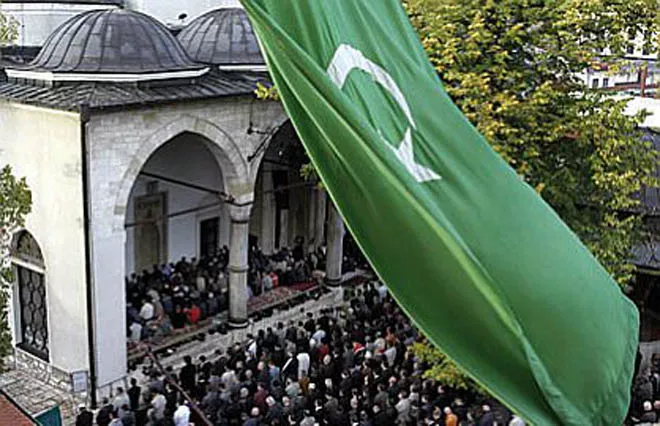
Regarding these regions, this author is not aware of a tradition of a black flag, with or without inscriptions, but rather that the green flag (bajrak) with a white crescent moon and star was, and remains to this day, the tradition of Muslim identity.
I see no need to change this tradition, to replace the existing bajrak with another, which actually represents someone else's tradition that has no religious basis. Why would the Muslims of these regions abandon their tradition and replace it with someone else's?
Bearing the above in mind, Muslims and the Islamic Community in these regions face a dual challenge and task. The first is how to confront the evil of misusing Islamic symbols by irresponsible and unreasonable Muslims and their organizations, to expose their interpretive superficiality, incredibility, and destruction.
The second challenge, which requires great zeal and responsibility, is the necessary opposition to the possible incrimination of Islamic symbols, Islamic terminology, or Islamic teachings and principles in media reports or the actions of law enforcement and judicial bodies. The responsibility of the ulema on both these tracks is immense.
Muslim intellectuals and wise people must contribute, assist the administration and management structure of the Islamic Community and all Muslims in clarifying matters, explaining them scientifically and with arguments. The ulema who study the biography of Muhammad (peace be upon him), historians, and other experts in specific Islamic fields have an obligation to scientifically illuminate all aspects of the historical use of Islamic symbols on flags, coats of arms, and on other occasions, investigate abuses, and offer solutions for the current situation.
At the same time, attention must be drawn to the possible incrimination of Islamic symbols and Islamic insignia, principles of faith and Sharia in media, police, and judicial proceedings, and strategies must be developed to prevent and thwart such extremely dangerous and existentially fateful actions.
The incrimination of Islamic symbols, whether on a flag or in theory, hides immeasurable dangers and harmful consequences.
I am convinced that community imams, chief imams, muftis, the administration of the Islamic Community, the Reisu-l-ulema, Muslims, Bosniaks, and all people have the need and expectations for the highest-ranking ulema and Muslim intellectuals to decisively and bravely offer a theoretical and theological elaboration and argumentation of the current state of Muslim societies and the perspective of Bosniak Muslims, to help clarify matters and call them by their true names, to prevent the incrimination of Islamic symbols as well as their misuse by certain Muslims.
Ekrem Tucaković, Head of the Public Relations Service of the Riyaset of the Islamic Community of BiH
Komentari (0)
Prijavite se za komentiranje
PrijavaJos nema komentara. Budite prvi!
Minuta
Sve →Iz drugih kategorija

High Representative Not Elected: Germans, French and British Sabotaged Americans, New Attempt at End of June

ČOVIĆ WITHOUT MERCY: How Those Who Brought Ademović to Office Created a Political Hell for Him



Sunny Saturday, quite warm



Tragedy in Albanian resort: Two minors drown












