
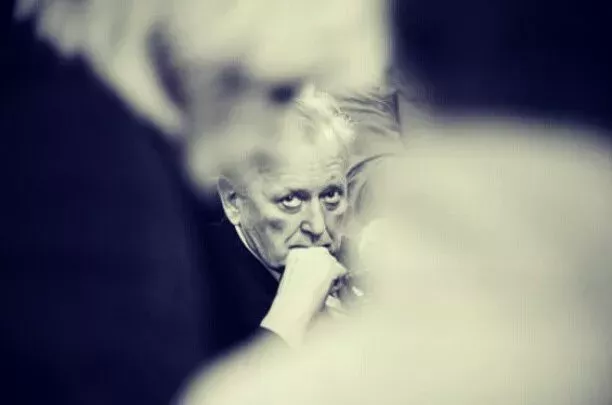
Exactly two years ago, on May 1, 2022, the Bosnian-Herzegovinian public was deeply shaken by news from Graz, Austria…
On that May 1st, just five days before his 81st birthday, Ivica Osim left us forever, writes scsport.ba.
The icon of Bosnian-Herzegovinian football and its synonym passed away in Graz, Austria, where he had been undergoing treatment for a long time, but where he also left an indelible mark by leading Sturm. Osim elevated this, until 1994, average football club in Austria, to the throne, winning two championship titles, one Cup, and two Austrian Supercups, making it an unmissable factor in Austrian football, and the crowning achievement was Sturm's first-ever participation in the UEFA Champions League. Graz certainly repaid Osim, although they themselves admit it was too little compared to what he did. Ivica Osim was magnificently farewelled from Sturm's stadium, and the initiative to name the main street leading to the 'Merkur Arena' stadium after him was also implemented.
Ivica Osim also led Partizan, with whom he won the last edition of the Yugoslav Cup, and Greek Panathinaikos, with whom he won two Cups and one Greek Supercup, and Japanese JEF United, with whom he lifted the Cup trophy, incidentally the first trophy in the club's history, and the Japanese national team, whom he led to the semi-finals of the 2007 Asian Cup.
Ivica Osim also distinguished himself as the coach of the Yugoslav national team. He was the last to hold that position before Yugoslavia itself disintegrated in bloody wars and aggressions. He joined Ivan Toplak's coaching staff for the Yugoslav national team in 1984 and became its coach two years later. He was the first coach of the Yugoslav national team from Bosnia and Herzegovina, but also its last ever. At the 1990 FIFA World Cup in Italy, he led Yugoslavia to the quarter-finals, where they were stopped by Argentina after a penalty shootout. His very engagement in that position, in a country that was beginning to disintegrate in blood, was unique and under greater scrutiny than any other. And it ended with an iconic and primal example of courage, humanity, and (local) patriotism on May 23, 1992, at a press conference in Belgrade.
“Resignation is, like this, the most direct thing when a person says: I'm leaving, and that's it. I tell you again, and I've already repeated it, that I don't believe I can go, nor will I go, to Florence or Sweden. Everything I can do, humanly speaking, and if anyone asks me, there are no problems, it's my personal gesture, and you can interpret it however you want… It's my personal decision, and I won't talk about why or explain, because you know very well. But if nothing else, and the only thing I can do for that city, so that you too remember that I was born in Sarajevo, and you know what's happening…”, Ivica Osim stated then to the assembled journalists, visibly upset, shaken, and disappointed.
However, he gained his football name, his popularity, and, as he emphasized, everything he is, in the blue and white jersey of Sarajevo's Željezničar and at its 'Grbavica'. Connected to the club through his ancestors who were among the founders of Željezničar and born in Hrasno, in the immediate vicinity of the 'Grbavica' stadium, Željezničar was a completely natural and logical step and choice in Osim's life. Osim was, among other things, the first member of Željezničar when the membership system was established, and also its Honorary President.
He began his career in 1954 in Željezničar's youth categories, and he debuted for the first team in 1959 in a match against Proleter from Osijek. He most often played in tandem with Mišo Smajlović, and due to his exceptional technique, precise dribbling, and very good shot, he was nicknamed the 'Strauss of Grbavica'. The words of radio commentator Mirko Kamenjašević will also be remembered, who said in one live broadcast: “Osim dribbles one player, then another, then a third… Dear listeners, until Osim loses the ball, listen to the music from our studio!”.
He played for Željezničar until 1968, when he moved to Dutch Zwolle, but due to injury, he returned to 'Grbavica' after only three months, where he stayed until 1970. Osim then went to France, specifically Strasbourg, from where after two years he moved to Sedan, where he stayed for three years, then went to Valenciennes for one year, from where he returned to Strasbourg and where he ended his playing career.
Although he played for Željezničar for a total of over ten years, and is one of the most responsible for the club's first European matches in their history in the Mitropa Cup, Željezničar fans regretted that Osim, as a player, did not lift a single trophy in his beloved jersey. Let's recall, Osim left 'Grbavica' in 1970, and Željezničar, under the leadership of the great Milan Ribar, won its first and only Yugoslav championship title two years later.
Unfortunately for the 'Blues' fans, Osim did not manage to bring a trophy to 'Grbavica' as a coach either, but he was most responsible for another success, namely the greatest international success of any football club from Bosnia and Herzegovina. He took over the bench of Željezničar in 1978, and he had a very difficult task – to revive the faltering club, which after winning the championship title in 1972 had collapsed, even being relegated to the Second League.
Osim began to create a new generation, a successful generation, and this one, like the previous ones that brought success to 'Grbavica', was composed mainly of 'Željo's children', i.e., players who came through the youth categories of the 'Blues'. Twice, Željezničar, led by Osim, was the Yugoslav runner-up, in 1981 it played in the Yugoslav Cup final against Velež at Belgrade's 'Marakana', which Velež won 3-2, but the greatest success was achieved in the 1984/1985 season when Željezničar reached the semi-finals of the UEFA Cup. The 'Blues' were stopped in the now-iconic two-legged tie against Hungarian Videoton and missed the chance to face the great Real Madrid in the final. The image of Ivica Osim with his hands on his head, a look of shock on his face after Csuhay's goal in the 87th minute at 'Grbavica' went around the world and was etched in everyone's memory…
We should not forget Ivica Osim's playing career in the Yugoslav national team either. He played for it from 1962 to 1969, making 19 appearances and scoring eight goals. He was one of the most important links in the generation that played in the 1968 European Championship final, which they unfortunately lost to Italy. It will also be remembered that French reporters, after a match between Yugoslavia and France in Belgrade, nicknamed Osim 'Mister Millimeter' due to his ability to 'outsmart an opponent in the space of a handkerchief'.
Ivica Osim could not do without football even when he was neither a player nor a coach. With his health visibly impaired due to a stroke he suffered in 2007 in Japan, in 2011 he took over the leadership of the Normalization Committee of the Football Association of Bosnia and Herzegovina. He gathered a respectable team of Bosnian-Herzegovinian football legends around him and fought for major changes in the N/FS BiH, which FIFA and UEFA had suspended due to the non-adoption of the Statute. The months-long struggle of Osim and his Committee was successful, changes were made, and the suspension was lifted, and Ivica Osim himself was declared Honorary President of our national football association.
Throughout his rich career, Ivica Osim faced numerous challenges. One of the biggest was the so-called 'Planinić affair' in 1965. Željezničar was then, due to alleged match-fixing, provisionally banned from relegation to the Second League, but the penalty was commuted to remaining in the league with a six-point deduction. Osim, along with Mišo Smajlović, was suspended for one year. He returned to the field in a match against Radnički from Niš at 'Grbavica'. After coming on as a substitute, the entire 'Grbavica' chanted his name. Just a year later, he was named the best footballer in Yugoslavia.
It is also interesting what Ivica Osim himself wrote in his memoirs about this moment:
“Misfortune never comes alone, as our people say. This was fulfilled once again in my case. That year, which is the blackest in my life, my father died, and I became seriously ill with kidney problems…
At that time, it was said that Ivica Osim was completely lost to football, that the illness was severe and that there was no return for him to his old circle. Osim did not want to talk about it. However, according to some rumors, it seems that on one occasion, while traveling to Zagreb, he drank beer on the train. He sweated and caught a cold in his kidneys.
Many sleepless nights followed, visits to doctors. Examinations, long and painful, full of uncertainty. Until then, I had never gone to doctors, and now it had become a regular practice. I lay in the hospital for weeks, but there were no results or words of encouragement. It simply wasn't known what was wrong with me. I lived under the psychosis that I would never play football again, to which I had dedicated my entire life. I lay in the hospital for three long months. At my request, they discharged me, nodding their heads doubtfully and looking at me with pity. For many, I was completely lost to football. I had unbearable pain, but I decided to fight. I knew I couldn't falter, because it could cost me my life. Perhaps all of this would have been much more bearable if I had had support. In those moments, many abandoned me. The audience, who had applauded me until recently, people who had greeted me on the street… Everyone turned their backs on me. I withdrew into myself. It is difficult to describe all those moments I went through during that year of forced abstinence and illness.
I was scared. Of doctors, of white coats. I was slowly losing my nerves too… I avoided going out on the street, meeting people. I experienced all sorts of things, people looked at me askance. The fans could not forgive me for allowing all of this to happen. For them, I was a traitor. I didn't feel that way then. I am sensitive, and it hurt me. And then that illness! When one combined with the other, it was truly difficult to endure. I would have been happiest if I could have left Sarajevo, gotten away from that environment that was slowly rejecting me. I regretted not having gone into the army… Time passed slowly. That unfortunate year just wouldn't end! I wanted to prove on the field again that I loved 'Željezničar', to show everyone that all of that wasn't my fault. However, I was afraid of returning. What if I don't succeed? What if I fail? Will I justify the trust, will the fans accept me? And, perhaps most importantly, will I even be able to play? Numerous questions, and the answers… Will I overcome the illness? How advanced is it? Will the doctors succeed? Are they right in their assessments? I knew that everything depended on me. I had to overcome the illness with my will. I started reading professional medical books… With my wife Asima and son Amar, I went through difficult times. The time for the suspension to expire was approaching. I started training. It was difficult, I had no strength, and I felt unbearable pain. I gritted my teeth and endured everything. I knew that a lot depended on it. If I succeed, I will have overcome the illness. If I don't succeed, it could have fatal consequences.
And then that day came. My suspension expired, and I felt much better. True, I didn't have enough fitness and strength for the whole match yet, but I wanted to play. For the fans, for all those who had condemned me for a year. If I play, how will they receive me? The match was played at Grbavica in front of 20,000 spectators. The opponent was Radnički from Niš. The team came out on the field, and I headed to the bench with a few players… There was little chance the coach would include me in the game. If the team was doing well… Minutes passed in the first half, and the end of the first half was approaching. The score remained unchanged. Our forwards couldn't outsmart the excellent Knežević. What happened next on the stadium almost brought tears to my eyes. I couldn't believe my ears: the crowd started chanting: “We want Švabo… we want Švabo…” Suddenly, everything changed, the crowd wanted to see me on the field again. They forgave me… It was as if a long and difficult year had suddenly been forgotten… I felt happy. I just had to overcome the illness… In the autumn of 1966, I started playing, first for one half, and then for the whole match. I continued to have medical check-ups. For a while, I played against the doctor's prohibition, at my own risk. It paid off. The past year meant a final return and great joy. I played excellently, I was satisfied with myself.
“Željezničar” also did well, we were winning one victory after another. The season was more than successful. After that, came the call-up to the Yugoslav national team, then the awards given to me by the editorial offices of “Sportskih novosti” and “Eho”. In those moments of joy, my wife Asima and I often recalled everything we had gone through just a year before. Is it possible that all of this could happen in such a short period? The time of disappointment and sorrow was over, and it should be forgotten as soon as possible. The unpleasant moments are behind us. The fans changed their attitude towards me. They too forgot that just a year before they had accused me of something for which, in my deepest conviction, I was not guilty at all. When the team is doing well, they forgive everything…”, Osim wrote in his memoirs for “Plavi vijesnik” in 1969.
Undoubtedly, Ivica Osim is one of the greatest, if not the greatest, names in Bosnian-Herzegovinian football. His playing career, then coaching career, as well as his football and life philosophy and wisdom have forever inscribed him in the history of our football, sport, and our country and people in general. Books and numerous articles, columns, and features have been written about him. Films and many reports have been made about him. The former Zvornička street, where Osim's 'Grbavica' is located, now proudly bears the name Ivica Osim Boulevard. Also, the Bosnia and Herzegovina Supercup, whose revitalization has been announced from next season in Bosnian-Herzegovinian football, should also bear the name Ivica Osim.
But we did not listen to and appreciate Ivica Osim enough while he was among us, we did not. If we had, we would have been more successful and happier. Whatever we do now in his memory will be little, it will be little.
It is not said without reason that some people never die, even when they physically disappear from this world. Those people have done so much during their lives that their deeds will simply continue to live on through the stories and memories of those who remain. And through the deeds of those who remain, which are inspired by the deeds of the one who has left. Therefore, the one who has 'left' has not left. He lives! The one who has done absolutely nothing worthy of mention during his life has not even lived. He died before he physically disappeared from this world.
That is why Ivica Osim did not die, is not dead, never was, and never will be!
Komentari (0)
Prijavite se za komentiranje
PrijavaJos nema komentara. Budite prvi!
Minuta
Sve →Iz drugih kategorija

High Representative Not Elected: Germans, French and British Sabotaged Americans, New Attempt at End of June

ČOVIĆ WITHOUT MERCY: How Those Who Brought Ademović to Office Created a Political Hell for Him



Sunny Saturday, quite warm



Tragedy in Albanian resort: Two minors drown












