
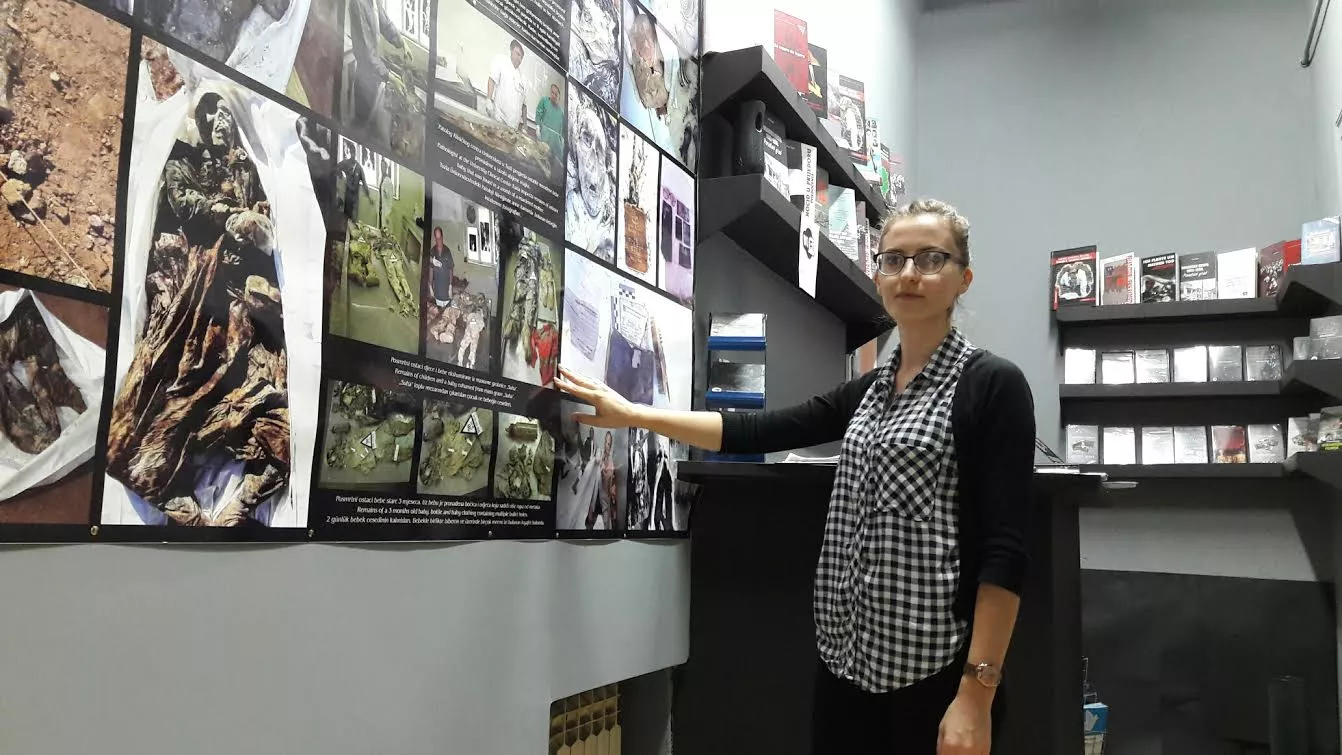
In less than a month since the "Museum of Crimes Against Humanity and Genocide 1992 – 1995" opened in Sarajevo, hundreds of people have visited. Mostly foreigners, who wanted to learn firsthand the true story of the recent conflicts and aggression against Bosnia and Herzegovina.
During the armed aggression against BiH, launched in 1992 by a part of Bosnian Serbs, supported by the authorities of Slobodan Milošević from neighboring Serbia, more than 100,000 people were killed on the territory of BiH. Around 200,000 people passed through camps. Several international organizations agree that one of the greatest crimes on European soil after World War II, genocide, was committed against Bosniaks.
The Hague Tribunal has so far convicted 69 former high-ranking political, military, and police officials, mostly Serbs. Another 25 proceedings are ongoing, 13 cases have been forwarded to national courts...
The museum curator, Nermina Ljutić, explains to the Patria news agency that the Museum, located on Sarajevo's busiest street, Ferhadija, is not open to be aimed against anyone, and certainly not against any nation. The Museum's role, she says, is to point to the suffering and pain from the past war, so that future generations are sent a message to never pick up a rifle again.
The "Museum of Crimes Against Humanity and Genocide 1992 – 1995" was opened by a group of enthusiasts, with the support of the Association of Camp Detainees of BiH. The museum covers 180 square meters. It is divided into several sections. Each section is designed to separately highlight the groups against whom crimes and genocide were committed during the aggression against BiH. And, according to curator Ljutić, crimes were committed against children, civilians, religious buildings, entire settlements and cities...
The museum exhibits original photographs from the exhumation of mass graves. They reveal that crimes against Bosniaks and Croats in the parts controlled by the Serb army were carried out systematically and deliberately. And the torture devices used in the camps, which are also exhibited in the museum, unequivocally indicate that people were killed out of hatred, writes Patria.

Above the door in the museum is a document that was used in the proceedings before the Hague Tribunal against Momčilo Krajišnik, president of the National Assembly of the then unconstitutional RS. The document lists six strategic goals of the Serb people in BiH; demarcation of the Serb people from the other two, a corridor between Semberija and Krajina, elimination of the Drina as a border between Serb peoples, establishment of borders on the Una and Neretva rivers, division of Sarajevo into Serb and Muslim parts, and access of the RS to the sea. Therefore, the aggression and crimes were carried out systematically. Krajišnik was convicted of crimes against humanity.

A part of the museum talks about how the RS army was assisted by Russian and Greek mercenaries, members of the UN Ukrainian Battalion, and some other foreign formations during the aggression against BiH. The picture in the middle shows members of the UN Ukrainian Battalion posing on July 28, 1995, while a few hundred meters away, the RS Army is burning Žepa, one of the UN protected zones. In the picture below, the commander of the Greek Volunteer Guard poses with the war criminal Ratko Mladić in the village of Boja on July 11, before the fall of Srebrenica, also a UN protected zone.


The perpetrators competed to invent more cruel torture devices for camp inmates. The picture shows pliers for crushing the genitals of prisoners in the Čelopek camp in Zvornik, as well as some other devices from other camps.
.jpg)
Obituary of Ševal Tabaković from Višegrad. Tabaković was taken out for slaughter by Draža Mihailović's Chetniks in 1942, on the Mehmed Paša Sokolović Bridge in Višegrad. The Chetnik who slaughtered Tabaković threw him into the Drina without cutting his throat properly, so Tabaković managed to swim to free territory. Fifty years later, the Chetniks brought Tabaković to the same bridge again, but this time he did not survive. Before they slaughtered him, they tied his hands.

During the aggression against BiH, about 3,500 children were killed. In Vlasenica alone, 265 children were killed. The youngest baby killed was only 48 hours old. She was burned with her mother in Višegrad, along with other prisoners.

The museum exhibits documentation from the Hague Tribunal, which details which parts were controlled by the RS Army and which parts by the legal Army of the Republic of BiH. Hague maps also detail the number of indictments, accused, and acquitted for crimes committed on the territory of BiH. Museum visitors can also view original films from the Hague Tribunal about crimes in BiH.

The Museum of Crimes Against Humanity and Genocide 1992 – 1995 is located in the Stakleni grad (Glass City) shopping center, on Ferhadija street in Sarajevo.
Komentari (0)
Prijavite se za komentiranje
PrijavaJos nema komentara. Budite prvi!
Minuta
Sve →Iz drugih kategorija

High Representative Not Elected: Germans, French and British Sabotaged Americans, New Attempt at End of June

ČOVIĆ WITHOUT MERCY: How Those Who Brought Ademović to Office Created a Political Hell for Him



Sunny Saturday, quite warm



Tragedy in Albanian resort: Two minors drown












