
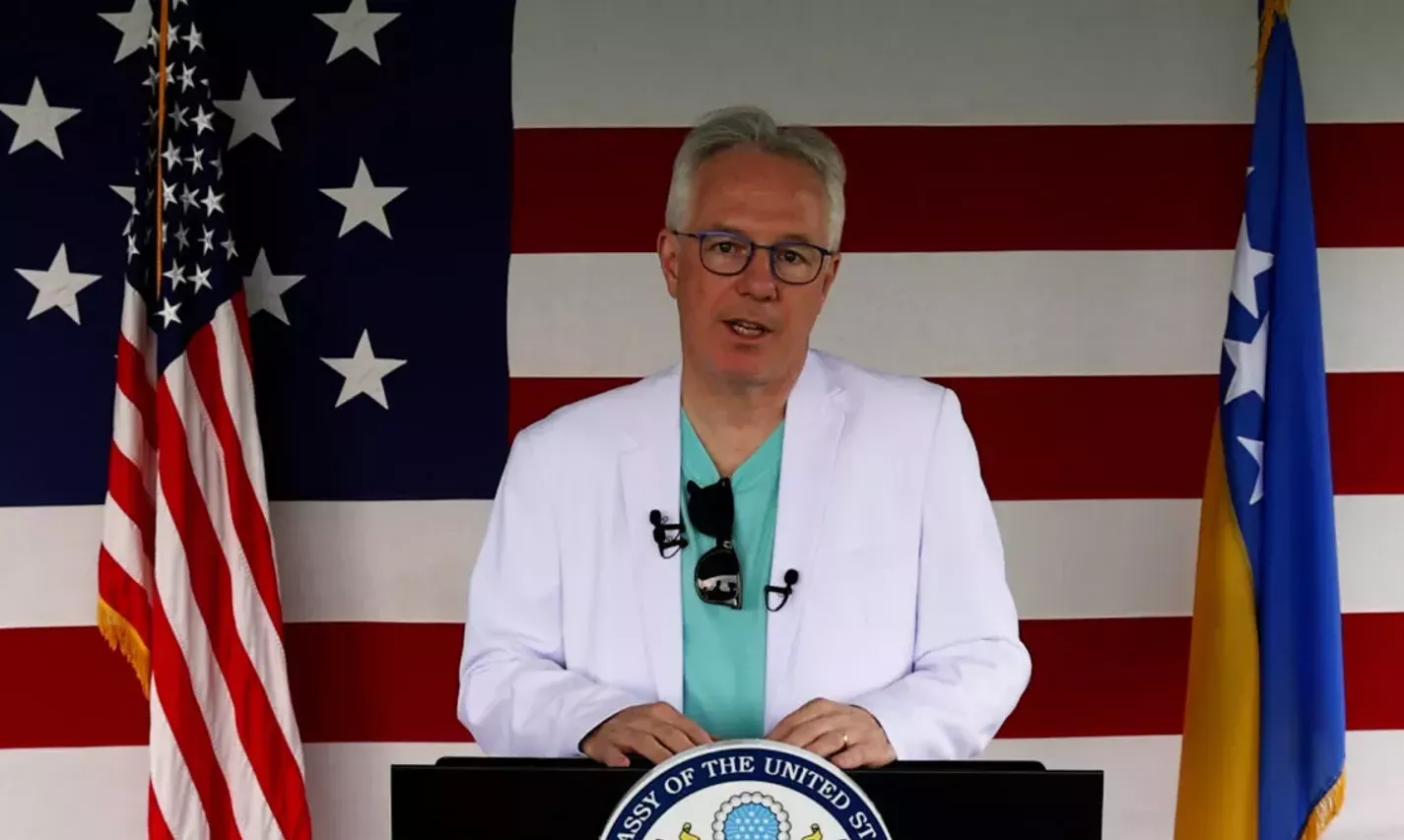
(Patria) - Although the US Embassy was forced to cancel tonight's reception due to bad weather, Ambassador Michael Murphy still delivered a speech on the occasion of US Independence Day.
"Tonight we celebrate the 247th anniversary of the independence of the United States of America. We planned a celebration with an eighties theme, and accordingly many of us, just like me, are dressed in eighties fashion style. Unfortunately, the severe storm that hit Sarajevo forced us to cancel the reception, but that does not mean we won't celebrate tonight. I want to share with you what I intended to say to our guests tonight.
The events related to America's struggle for freedom are close to me, not only because I am a proud American, but also because I am a history enthusiast. That is why I read and learn as much as I can about your history – the history of Bosnia and Herzegovina. But my first love was the history of my own country: our struggle for independence, our civil war and the end of slavery, and the United States assuming the position of a world leader over the last century.
If there is any decade in American history that I can understand without any research, without libraries and Wikipedia, it would be the eighties. In many aspects, that decade is my cultural reference point. Feel free to ask anyone who works here at the Embassy. Rarely does an internal meeting pass without me quoting some movie from the eighties to illustrate what I mean. I have a copy of the best American high school movie ever made, 'The Breakfast Club,' in my office…on VHS tape. All this means that I am the one you should thank (or criticize) for the theme of this year's celebration.
I came of age in the eighties, and the cultural, social, and political events of that decade had a huge impact on me, just as on the rest of the world. The eighties laid the foundations for consumerism as we now know and live it. It was the decade of MTV, when a single TV station, a pioneer in the field, spawned American mega-stars like Madonna, Prince, Whitney Houston, and Michael Jackson. CNN, the first TV station to broadcast news 24 hours a day, was born in the eighties.
In the eighties, personal computers experienced an explosion of popularity in America, video games took over our homes, and the internet was born, ushering in an unprecedented revolution in information and communication. Any of you who are parents know how much the revolution brought by microchips in the eighties changed the way young people spend their free time. All of this was accompanied in the United States by a period of unprecedented economic growth and progress.
By the end of the decade, there were reasons for great optimism in America and the world. Communism collapsed, the Iron Curtain fell, the Berlin Wall was torn down, and we saw democracy and free market economies spread, not only in Eastern Europe but also in Latin America and elsewhere. Some called this moment the End of History. More than three decades later, we know we underestimated the challenges that followed the end of the Cold War.
And while the United States and much of Europe bid farewell to the eighties with optimism, the citizens of Bosnia and Herzegovina faced a much different and darker reality – one that many in America and the West did not want to see. We did not react decisively when ethno-nationalist rhetoric reached dangerous proportions in the Balkans. And when war came, when this city found itself under siege, when we watched your horrors on TV screens in our living rooms, via that same CNN that was born in the eighties, we did not immediately respond to your calls. We hesitated…too long. In time, we did act. The tragedy is that it was too late to save thousands of lives, including the victims of the genocide in Srebrenica. But when we reacted, we reacted decisively.
The Dayton Peace Agreement, brokered by the United States, ended the war that lasted from 1992 to 1995. It was not and is not a perfect agreement. Today, Dayton is being questioned, deliberately misinterpreted, and blamed for the persistent ethnic divisions in the country. This last point represents a reversal of the argument, i.e., cause and effect, but it is true that the political leaders of this country have squandered the promised peace. They have chosen to constantly exploit and emphasize divisions in this country. Regardless, the Dayton Peace Agreement stopped the bloodshed and saved lives. That, ladies and gentlemen, is a fact, and the alternative, meaning more death and destruction, is terrible even to contemplate.
Defending peace and democracy, ensuring prosperity, and healing wounds will never cease. To paraphrase President Ronald Reagan, these are generational challenges. Challenges we hoped the world would overcome after the Cold War at the end of the eighties are painfully visible today – from the brutal Russian aggression against Ukraine to the rise of illiberal, anti-democratic political movements across the Western world.
Likewise, today's challenges to the sovereignty, territorial integrity, and multi-ethnic character of Bosnia and Herzegovina cannot be denied. From electoral irregularities and corruption, incitement to war, denial of genocide, to the activities of the NSRS since June 27 – the tensions are clear, and for many citizens of Bosnia and Herzegovina, the similarity to the country's pre-war history is disturbing. But one thing is different. The United States is here.
After the war that lasted from 1992 to 1995, the United States quickly found its place here in BiH. We became your number one bilateral development partner, and over time, your main military partner. Today, no other country is as committed as we are to BiH, its institutions, organizations, its youth, and its future within the Euro-Atlantic community of nations.
This team of Americans and their BiH colleagues who are hosting you today works tirelessly every day to help the citizens of this country achieve their aspirations for a peaceful, democratic, prosperous, and secure Bosnia and Herzegovina where voters' voices are fairly counted, where hard work is valued, where politicians are accountable to citizens and the law, and where the economy can thrive.
Our commitment to such a future, our willingness to speak out loudly in its favor when others challenge it, and our understanding that progress is achieved step by step, not by one great, utopian leap into an abyss devoid of reality, does not always sit well with some political actors in the country, especially when our commitment to a peaceful, democratic, and secure future clashes with their narrow political interests. But the United States' commitment to Bosnia and Herzegovina is not a commitment to any political leader or party – we are committed to the citizens of this country. That has not changed and will not change.
With that in mind, I invite you all to raise our glasses in honor of the enduring friendship between our peoples and in honor of our joint, serious, complex, but crucial daily efforts to secure for Bosnia and Herzegovina the place it deserves in the Euro-Atlantic community of nations. The United States stands with you, with Bosnia and Herzegovina, now and forever. Thank you and cheers," Ambassador Murphy said in his speech.
Komentari (0)
Prijavite se za komentiranje
PrijavaJos nema komentara. Budite prvi!
Minuta
Sve →Iz drugih kategorija

High Representative Not Elected: Germans, French and British Against Americans, New Attempt at End of June

ČOVIĆ WITHOUT MERCY: How Those Who Brought Ademović to Office Created a Political Hell for Him



Sunny Saturday, quite warm



Tragedy in Albanian resort: Two minors drown












