
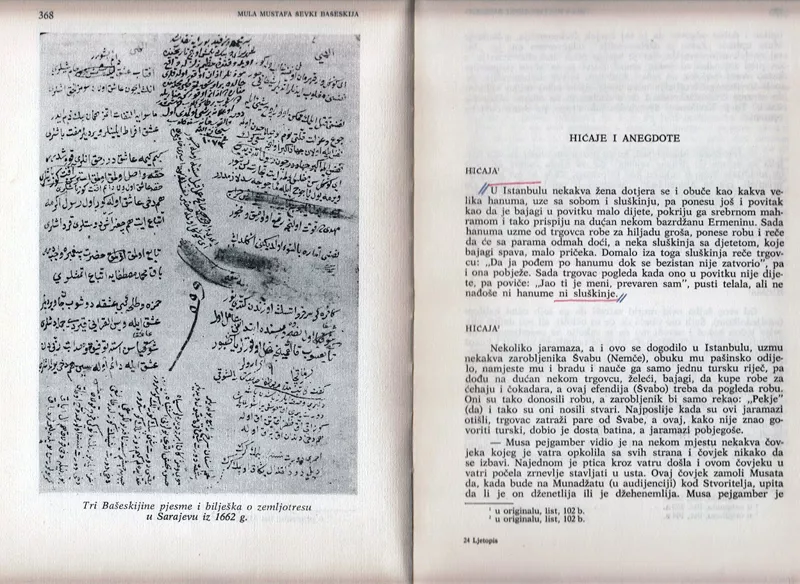
Sarajevo lost Mula Mustafa Bašeskija 205 years ago today – an alim, scholar, and Bosniak chronicler whose records are the most reliable source on Sarajevo in the 18th century, and which are still used today as authoritative documents from that period, writes the Bosnian news agency Patria (NAP).
According to the latest research, Bašeskija died on 18 August 1809. He gave much to Sarajevo, and to Bosnia and Herzegovina. He is far more than a chronicler of a single era, and his „Chronicle“ is the first work of its kind among Bosniaks.
Bašeskija recorded events, made comparisons, and analysed the life of Sarajevo's residents during the 18th century. But not only that. Bašeskija constantly taught the uneducated in Sarajevo to write and read, instructed them in religion, Sharia law and other matters, and helped the educated to upgrade their knowledge.
Thus, besides his work as a folk scribe, which he performed in a small shop near the Clock Tower, Bašeskija was a mualim in several Sarajevo mosques, and for a time in the mosque in Zgošća near Kakanj, and in 1800 he became an official of the Gazi Husrev-beg's waqf, writes NAP.
Bašeskija was born in Sarajevo in 1731 or 1732 in the Mimar Sinan neighbourhood. We know about him only what he recorded about himself in his „Chronicle“, so this is the only source for learning about his life and work.
His full name is Mula Mustafa Bašeskija with the poetic pseudonym Ševki. He is the son of Ahmed and grandson of Kadri-hodža.
He received his initial education in a mekteb under hodža Sulejman-efendija Arnaut, where he stood out among his peers. He also learned the coppersmith trade from master Šahinbašić, a kazaz and imam of a Sarajevo mosque, but he did not pursue this trade for long. He continued his education in a madrasa, and in 1757 he was appointed as a sibjan-mualim in the mekteb near the Ferhadija mosque. Two years later, he also took on the duties of imam and hatib of the Buzadži hadži-Hasan mosque.
Bašeskija was not satisfied even with the mualim service, which he left, and in 1763 he became a folk scribe (katibi-am). This would become his main occupation, and for his scribal work he rented a shop in Mudželiti near the Clock Tower.
Bašeskija composed and wrote private letters, petitions, complaints, contracts, certificates, and inventoried the estates of deceased citizens for the illiterate, among other things. The fact that his scribal work progressed well and brought good income is also evidenced by his renting a larger shop and hiring other scribes as assistants.
Interestingly, Bašeskija never gave up improving his education throughout his work, and he continued to attend lectures on Sharia law and astronomy under muderris Mehmed-Razi Velihodžić of the Gazi Husrev-beg's madrasa. With sheikh hadži-Muhamed of the Hadži-Sinan tekke, he studied mysticism (tasawwuf) and joined the Qadiri dervish order.
In his shop, besides scribal work, he taught madrasa students and others in Arabic calligraphy and Sharia inheritance law. Moreover, in 1779 he notes that he met with several friends once a week at the home of a certain Vilajetović on Atmejdan, where, besides socialising and conversation, they devoted half an hour to reading books. Such gatherings with halva were also held in other places in Sarajevo and were called "Sohbet-halva".
Little is known about Bašeskija's family, except what he wrote, namely that his father died when Mula Mustafa Bašeskija was still a child. His mother remarried, and later she also died. Bašeskija married Safija when he was very young, and she bore him ten children, writes Patria.
Komentari (0)
Prijavite se za komentiranje
PrijavaJos nema komentara. Budite prvi!
Minuta
Sve →Iz drugih kategorija

High Representative Not Elected: Germans, French and British Sabotaged Americans, New Attempt at End of June

ČOVIĆ WITHOUT MERCY: How Those Who Brought Ademović to Office Created a Political Hell for Him



Sunny Saturday, quite warm



Tragedy in Albanian resort: Two minors drown












