
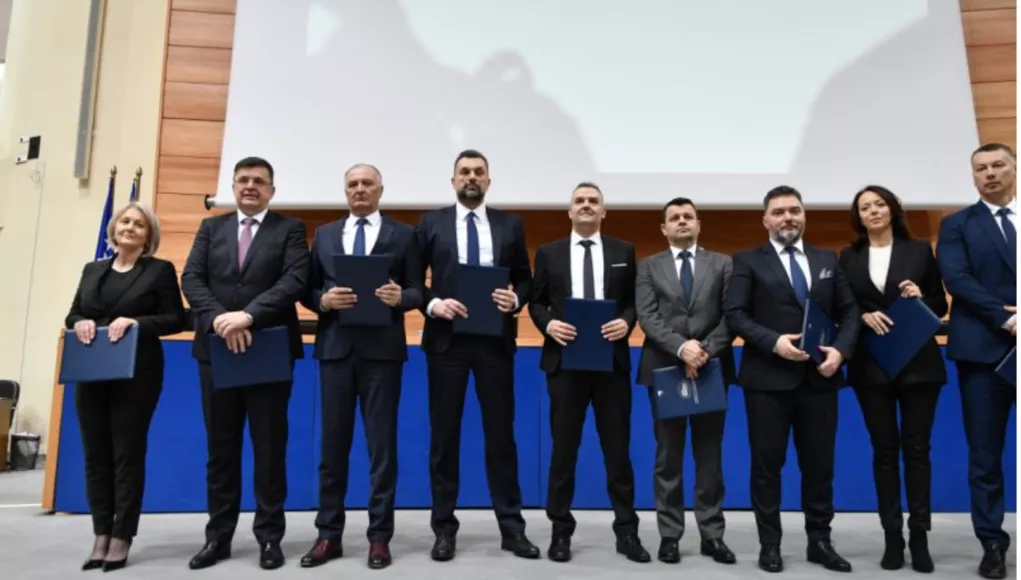
(Patria) - Deputy Chairperson of the Council of Ministers of BiH Zukan Helez will not inform the European Court of Human Rights in Strasbourg that Borjana Krišto's stance on the status of BiH agents is her personal stance, and not the stance of the Council of Ministers of BiH.
This was confirmed by Minister Helez himself in a statement to Istraga.ba, saying that he “agreed with the Minister for Human Rights Sevlid Hurtić on everything”.
“Hurtić sent it, it is his jurisdiction. That's how it was agreed so we don't look unprofessional,” Helez said, writes Istraga.ba.
Sevlid Hurtić, however, says that there is no agreement on sending a letter to Strasbourg and that he expects Helez to do it as the deputy chairperson to Krišto, who unilaterally sent an notification to the European Court of Human Rights stating that Monika Mijić and Harisa Bavčić have the legitimacy to represent BiH in the Kovačević case.
Let us remind you, the European Court of Human Rights requested an explanation from the Council of Ministers of BiH in mid-October regarding whether Monika Mijić and Harisa Bavčić had active legitimacy when, without the prior stance of the Council of Ministers, they submitted a Request for review of the ECHR ruling in the case Slaven Kovačević v. Bosnia and Herzegovina on September 19. Although it was proposed that the Council of Ministers of BiH respond to this ECHR inquiry, Chairperson Borjana Krišto decided that she would unilaterally send a response. In that response, Krišto, of course, supported the positions of Monika Mijić and Harisa Bavčić and, in fact, legalized the appeal. Bosniak ministers in the Council of Ministers of BiH now, however, do not want to inform the Court that this is the personal stance of Chairperson Krišto, and not the stance of the Council of Ministers of BiH.
This is the first time that Bosnia and Herzegovina is seeking a review of any decision of the European Court of Human Rights related to electoral legislation – i.e., constitutional order.
Let us remind you, the European Court of Human Rights ruled that Slaven Kovačević, as a voter and citizen of Sarajevo, was denied the right to vote for a candidate for the Presidency of BiH from the Republika Srpska. The Court stated that the Presidency of BiH is a state institution and that all citizens must have the right to elect all members of the Presidency of BiH. Thus, the Court, in fact, determined that, in addition to ethnic discrimination, territorial discrimination is also in force in BiH. To eliminate this discrimination, it is necessary to have a single electoral unit when electing members of the Presidency of BiH and delegates to the House of Peoples of the Parliamentary Assembly of BiH.
Dissatisfied with these decisions, BiH agents Monija Mijić (HDZ) and Jelena Cvijetić (SNSD) submitted a request for review. Agent Harisa Bavčić did not sign this appeal, although, as we learn, she supported her colleagues in drafting the request for review.
According to the Rules of the European Court of Human Rights, the Grand Chamber, consisting of seventeen judges, decides on the request for review. The initial decision, we remind you, was made by seven judges. They voted 6:1. The only one who opposed the initial decision was the Austrian judge Gabriele Kucsko-Stadlmayer. It was on her dissenting opinion that agents Mijić and Cvijetić based their appeal.
For the request for review to even reach the Grand Chamber of seventeen judges, it is necessary for its admissibility to be initially determined by a Chamber of five judges.
This Chamber, by virtue of their office, includes the President of the European Court of Human Rights and two Vice-Presidents. In addition to them, there are two rotating judges who are chosen from among the judges of the remaining sections. When considering a request for review of a judgment, no judge who participated in the rendering of the initial decision will be on the Chamber.
It is precisely from this request for review that the leaders of SNSD and HDZ intend, with the tacit consent of Naša stranka, NiP, and SDP, to annul the decision of the European Court of Human Rights in Strasbourg, which determined that in BiH, in addition to ethnic, there is also territorial discrimination. By implementing this ruling, BiH would move closer to the EU.
According to Istraga's information, officials from the Republic of Croatia and the OHR have engaged in efforts for the European Court to challenge the initial decision through the Grand Chamber.
Komentari (0)
Prijavite se za komentiranje
PrijavaJos nema komentara. Budite prvi!
Minuta
Sve →Iz drugih kategorija

High Representative Not Elected: Germans, French and British Sabotaged Americans, New Attempt at End of June

ČOVIĆ WITHOUT MERCY: How Those Who Brought Ademović to Office Created a Political Hell for Him



Sunny Saturday, quite warm



Tragedy in Albanian resort: Two minors drown












