
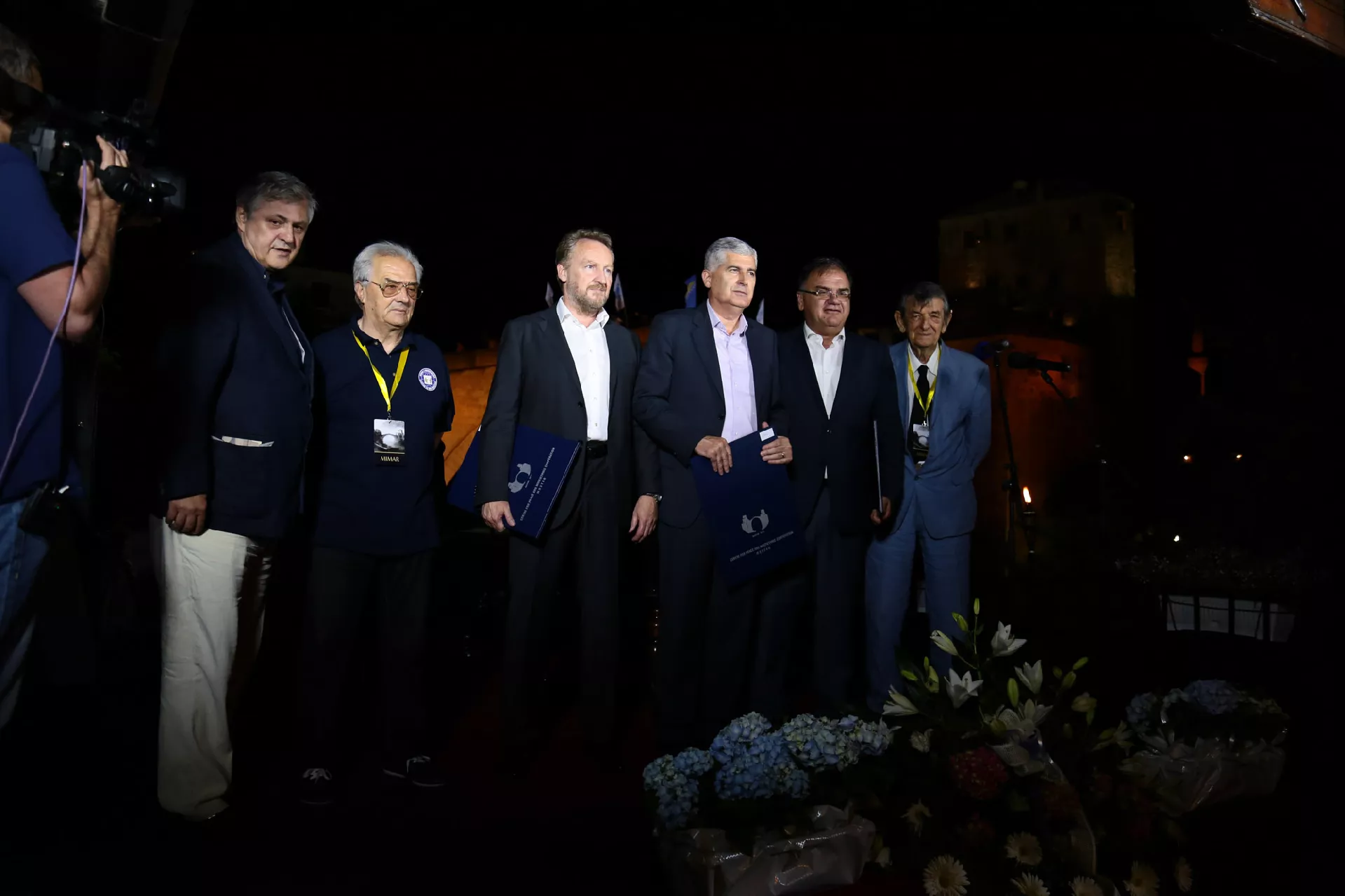
On the eve of the 449th jumps from the Old Bridge, on the terrace of the Labirint restaurant, above the Neretva, from which the Bridge and its upstream surroundings are perfectly visible, that evening crowded with people and lit by torches, while beams of multi-colored light struck into it, in front of a crowd of guests, the highest, high, and ordinary guests, the traditional ceremony of awarding the prestigious Mimar mira (Architect of Peace) award was held, which has been awarded for years, on the day of the Old Bridge's reconstruction, by the Center for Peace and Multietnic Cooperation of Mostar.
That Thursday was so special that I too decided to set aside my urban wanderings a little, because this is a special event for the city and the Bridge and all its people who value true values, an event like any similar one, akin to a resurrection, and the large crowd that filled the Bridge and its surroundings, and the aforementioned terrace where the grand ceremony in celebration of the bridge's anniversary took place, is not surprising at all.
The Bridge
And my little anniversary continuation of Hodopis (Travelogue) should be dedicated to that, although I did not belong to that evening in any special status, I am just a journalist and a logical guest, but intimately, I am a witness to all the happy and unhappy things that have happened to that bridge in the last half-century, since I probably first saw it, when my late father was selling peppers and table grapes from our vineyard on the Tepa, with a cloud of bees over each bunch. I would stare at that bridge and wonder how something made of stone could hang over the river, so high and relying on nothing. I thought about those first memories while the official host, colleague Alija Behram, announced the guests and program details, among which the most significant was that three members of the Presidency of this country, which is being rebuilt much slower than that bridge, were arriving, a reason for great Mimar's fear, then for centuries a place for people and goods to cross, surrounded by towers and narrow alleys, with a slight arch from which brave young men jumped into the blue water, then, innocent - guilty, it became a military and artillery target and, as it lay shattered like stone at the bottom of the Neretva, it became an unofficial deity and an absolute symbol of defiance, a metaphor for suitability or unsuitability, it became an almost living being, sacrificed so that other beings would not kill each other completely, so even dead, that bridge separated and guarded them, until, lo and behold, by human and divine grace, it once again spanned the river, remaining silent about everything, as it had been silent until now.
So many people have walked its ribbed arch that a decent planet could be populated by them, but times take away some, and bring other important people, so the aforementioned three were the most important that evening, officially. That's okay. The most important to me was the little East Asian boy who was licking ice cream with one hand and preparing his mobile phone with the other to photograph the jumper who plunged into the river through the flash of fire, and the boy didn't manage to click. Mom, dad, or someone else from the crowd of identical faces comforted him, saying they had filmed it. That encounter of the boy from the other side of the planet, that excitement about the Bridge and the human being who dares to jump from it, is a sight that can be seen here every day, it doesn't have to be summer, but it is still rarely seen, because everyone is watching the jumper.
What I mean is: the human gaze here stretches exactly between the towers even when the jumper disappears under the arch, the voyeuristic gaze is a phenomenon that no one deals with, which I truly regret. This jumper flew into the depths in honor of the three, perhaps also because they have been seen together often lately, it is a beautiful and not necessarily pathetic message, important at a time when madness is emerging in a previously unknown way, and if not madness, then certainly depression, because people would endure if they could, but even the last reserves of nerves have disappeared before the thick walls of impossibility and hopelessness.
Their host was Safet Oručević, president of the Center, they walked casually through the crowd around the Bridge, had a drink, talked to people, gave calming statements, so... it's okay. Then they also squeezed onto that terrace, where we listened to Šantić's Emina, arranged by Đelo Jusić, for the trumpet, which Ivan Bevanda from the Mostar Symphony Orchestra played twice that evening. Then we watched a film, a documentary, the one filmed during the war. I was glad that the little East Asian boy and his group had already moved away somewhere, marveling at some new wonder, because I would never want him to watch that film and see a different reality, recent and difficult to forget. A numerous and clearly multi-ethnic gathering watched that film with emotions that were not necessarily the same. But the facts are indivisible here. Those who knew nothing about the arduous and difficult path from destruction to reconstruction could learn about it through that film.
Oručević reminded of the course of the Center's enormous activities, but above all, he was in some other "center", the focal point of all events related to everything here, but the Bridge was a metaphor for everything, whether someone liked it or not, Safa managed to animate the world around it, he already had people on his side, and he built his side of the path towards the other side. From there, it went a little slower, but it went, and Dragan Čović spoke honestly about it here, although for me (and I think for most others) it was quite enough that Safet and Dragan spoke one after the other in the same place and at the same time and for the same reasons.
It even seemed to me that Oručević was speaking what the Bridge would say if it could, while the namesake spoke of some personal experiences, he did not hide his emotions, and he certainly emphasized that he would not admit to anyone that they could love the city and the Bridge more than him, but the context brought many troubles that are now slowly passing, so the meaning of the Bridge is experienced anew in the same way, and Mostar is still officially considered the most multi-ethnic city in the country, which, according to Čović, is a great something compared to nothing, with which I agree.
He then presented the international recognition to the three - the Mostar Peace Connection award, and posthumously to the former President of the Republic of Turkey, Süleyman Demirel (the award was received and a thank-you speech was given by Bermek Tolnaj, the Turkish Consul General here) and the former Prime Minister of the Republic of Croatia, Ivica Račan (the award was received and a speech of thanks was given by his widow, Dijana Pleština).
The essence of the Presidency members' reactions is in the statements reported by the Mostar portal Nova Sloboda: The Presidency of BiH is trying to make a different step forward, and this can be seen in the last nine to ten months because we have not had any public confrontation despite some disagreements. Nevertheless, things are moving. I see this as an award for the new spirit, which is, after all, noticeable in BiH" (Ivanić); "I am trying to get out of the atmosphere of mutual distrust, to move past some things and to move forward. I see no alternative to that," said Izetbegović, and Čović emphasized his personal effort to subordinate everything to peace, peace without alternative, the kind that should finally bring the long-awaited prosperity for our people. This award has also been received in the short history of its awarding by Nelson Mandela, Václav Havel, Alois Mock, Mohamed el-Baradei, and Irina Bokova.
Exit
The central part of the ceremony is dedicated to the recipients of the Mimar mira title, and for this year, it was awarded posthumously to Prof. Dr. Radovan Ivančević from Zagreb, Prof. Dr. Milan Gojković from Belgrade, Engineer Josip Šilić from Zagreb, Ratko Pejanović, and director Sulejman Kupusović. Mimare mira were also awarded to Željana Zovko, Siniša Šešum, Đelo Jusić, fra Iko Skoko, Erna Cipra, Florijan Mićković, Gojko Berić, Omer Karabeg, Ivan Lovrenović, Martina Mlinarević - Sopta, Josip Muselimović, Milan Jovičić, Gradimir Gojer, Zdravko Grebo, and Roko Markovina.
And on behalf of all, Roko Markovina thanked, a man who almost forced me to listen to his speech, because for years no one has been able to force me to even think of something similar. It's a shame it was a bit long, but it was worth delivering that personal essay about Mostar and the city, people and non-people, especially about "two fingers of cheek", the greatest wealth he has achieved in life, and it would be an even greater shame if that speech were not published somewhere. Perhaps it will help someone find those two fingers for their own cheek. It was nice here in Labirint. You exit (enter) from it through two exits (entrances). But, will the exits from our real labyrinth ever open, the Bridge cannot know. Although, it offers two, even three possibilities: you can go east or west across it. Or simply jump...
Published in Hodopisima – Dragana Marijanovića
Komentari (0)
Prijavite se za komentiranje
PrijavaJos nema komentara. Budite prvi!
Minuta
Sve →Iz drugih kategorija

High Representative Not Elected: Germans, French and British Sabotaged Americans, New Attempt at End of June

ČOVIĆ WITHOUT MERCY: How Those Who Brought Ademović to Office Created a Political Hell for Him



Sunny Saturday, quite warm



Tragedy in Albanian resort: Two minors drown












