
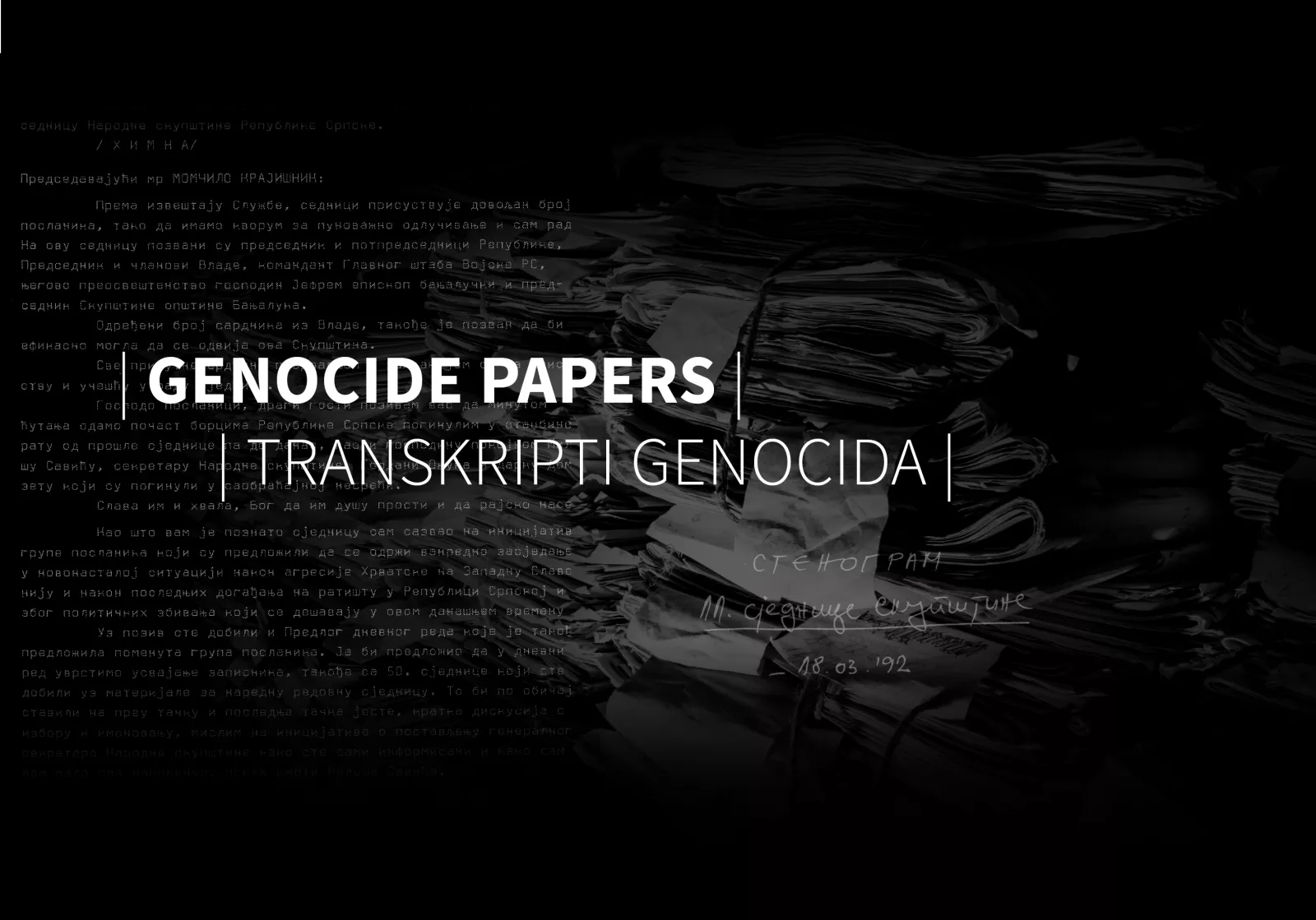
The Srebrenica-Potočari Memorial Center - Memorial and Cemetery for the Victims of the 1995 Genocide has brought together young researchers, proofreaders, designers, and programmers to create a new generation tool for the new generation, concerning one of the key segments of research into the history of the Bosnian genocide. "Genocide papers" or "Genocide Transcripts" represent a collection of searchable stenograms/transcripts of sessions of the Assembly of the Serb People in BiH / National Assembly of Republika Srpska.
"These documents were public before, but they were inaccessible and their formats did not make it easy to search their content. The Memorial Center recognized their content as important in the process of raising public awareness about the existence of a broader political consensus on the operation of genocide against the Bosniak population throughout Bosnia and Herzegovina. The 'Genocide Transcripts' project is financed directly from the budget of the Srebrenica Memorial Center, without the support of external donors, and we are proud that a larger part of the project's implementation relies on the internal capacities of our institution," stated the Srebrenica Memorial Center.
According to them, the project will deliver this application to universities and civil society organizations in the region, as well as to the media.
"We are open to cooperation with researchers, journalists, and all individuals, groups, and organizations interested in using these materials to raise public awareness about the content and activities of the so-called National Assembly of Republika Srpska in the period from 1991 to 1996," they state.
Excerpts from the transcripts
Radovan Karadžić spoke at the session on February 13, 1995.
"The first point in all of Kutiler's principles, if you remember, was that Bosnia is a state consisting of this and that, but it always stated that Bosnia is a state and we never accepted that and sought the maximum we could accept, Bosnia is a confederation of states, if we must remain in some confederation, but our minimum is that our state is a state and that it cannot be merged into anyone's statehood or sovereignty except by our will into the statehood and sovereignty of the Republic of Serbia, not even Yugoslavia, because if it is Yugoslavia, then we want to retain our federal unit, our state as a federal unit of that federation, although our priority was to become part of Serbia. No one offered us anything else but to disappear, to nullify our state, to accept a common state with Izetbegović, or with the Muslims and Croats, and they clearly told us at cocktails and lunches that it is, gentlemen, because we do not want to accept the existence of an Islamic state in Europe, which means that we are sacrificed so that this state does not exist but rather a mixed one, which means that we spend our lives and the lives of our generations neutralizing Islam, and that Europe be a community of happy Christian nations while we guard its walls like a moat of dirty water that exists for no other reason than to neutralize Islam. We did not accept that. Someone said we are alone," Karadžić stated.
Two years earlier, on January 8, 1993, Momčilo Krajišnik spoke.
"Well, gentlemen, we can now decide and take a stand that Muslims as a people are a communist creation. We do not accept this artificial nation. We consider Muslims to be a sect, a group, or a gathering of Turkish origin. Does anyone else have anything to add? No. I put all these conclusions to a vote. Who is for? Is anyone against? Abstaining? Gentlemen, thank you, we have adopted the conclusions unanimously," stated Krajišnik, who was definitively sentenced to 20 years in prison by the International Criminal Tribunal for the former Yugoslavia (ICTY) in The Hague in 2009 for crimes against the non-Serb population in Bosnia and Herzegovina.
Milorad Dodik spoke at the session on October 15 and 16, 1995.
"And the biggest mistake of the war is Srebrenica and Žepa, and someone should be held responsible for that. We should not have so easily given up areas where we could have gained diplomatic points, and we caused a diplomatic disaster. Who is responsible for that? We legalized before the international community that protected zones could be taken, and then five days later we shouted that the protected zone of RSK could not be attacked, and we did what we did five days earlier. We lost the position we could have defended," he stated.
Karadžić responded.
"As the supreme commander, I stood behind the plan for Žepa and Srebrenica, mainly for Srebrenica, Žepa was implied. Gentlemen, we would have lost the war if Žepa with 90,000 armed Muslims existed, we would have lost the war. I personally supervised the plan without the knowledge of the General Staff, not hiding it, but by chance encountering General Krstić and advised him to go straight into the city and declare the fall of Srebrenica, and afterwards we would chase the Turks through the forests, I approved both the closer task and the radical task, and I do not regret it. It is not true that we had the Krajina because of this, as Croatia had not intended to attack Krajina until then and attacked it because of Srebrenica, or because the world did not take pity on the Serbs," he said.
"A Turk is a Turk"
A few months later, on December 17, 1995, Dodik spoke again.
"Mr. President, I am speaking here to refute the accusations that Grujo Lalović made against the Club of Deputies, the Independent Club. They are indeed harsh and require a definitive stance from the Assembly on this issue. I don't need to mention what Mr. Lalović presented, but I must say that we indeed differed in our thinking on how to reach a final solution, but we were never in a position to jeopardize the national interests of the Serb people in these areas. We advocated in a different way, we tried, but we really only tried to present our opinion to this assembly, and you must accept the fact that our proposals rarely, almost never, passed. I will not now give an overview of everything that was proposed and how, although I can tell you all of it, and it could be clearly defined on which side certain culprits should be sought for all this, but I must say that our approach from the beginning was that we believed that we could not carry out our just struggle in Republika Srpska to the end without Serbia, regardless of who sat there as president, whether it was Milošević or someone else tomorrow, we considered a certain level of cooperation necessary. As long as our state leadership cooperated with Serbia, we believed there was no need for us to try anything there, and even after that, what we did was truly just an attempt. Therefore, no decisive contribution to the overall situation and the overall solution like this," Dodik stated.
During the 55th session of the National Assembly of RS, on October 22 and 23, 1995, General Manojlo Milovanović addressed the deputies.
"When you win, you are not to blame, when you lose, you are guilty. That is my contribution. President Milošević, as far as I can see from almost all the speeches, attacked you for Abdić and for our stance that a Turk is a Turk. Gentlemen, you certainly did not know until now, I was pushed twice, thanks not to politics in RS, but outside of RS, almost into Fikret Abdić's embrace, on November 16 last year, a meeting was imposed on me in Plitvice, which I knew nothing about, I immediately reported it in writing to both the supreme commander and the chief of the General Staff. The second time this happened to me was on February 14, on Petrova Gora, when I was invited to coordinate actions, then with the Serbian Army of Krajina, then I was simply told, after we finished that meeting, Mr. General, a man wants to see you, I thought it was someone from my former colleagues, friends, officers. I entered the room where Fikret Abdić was sitting, since I was taken by surprise, I did not have authorization from the Supreme Command or the General Staff to talk to him, we each drank a glass of milk, it was the beginning, when they had those initial successes around Ključ. I asked him, to get out of it somehow, Mr. President, an autonomous province cannot remain an independent entity, you must align yourself with someone, either with RSK, RS, or Croatia, and he told me literally this. General, do you know that I am a merchant by nature, meaning Mr. President, you go where you are offered more, he replied, maybe so. And then, as now, I advocate the thesis, a Turk is a Turk, even if he is Fikret Abdić," stated Manojlović.
The platform will also be launched online in the future, and its goal is to be further expanded in the future by including new stenograms, decisions, and documents from various institutions relevant and related to the planning and organization of the genocidal operation and other war crimes during the war in Bosnia and Herzegovina from 1992 to 1995.
(N1)
Komentari (0)
Prijavite se za komentiranje
PrijavaJos nema komentara. Budite prvi!
Minuta
Sve →Iz drugih kategorija

High Representative Not Elected: Germans, French and British Sabotaged Americans, New Attempt at End of June

ČOVIĆ WITHOUT MERCY: How Those Who Brought Ademović to Office Created a Political Hell for Him



Sunny Saturday, quite warm



Tragedy in Albanian resort: Two minors drown












