Written by: Rasim Belko @rasimbelko
The finality of the guilty verdict against human rights and democracy in the form of the Election Law according to the HDZ model depends only on Dragan Čović's willingness to confront the European Union as well, after the US.
In other words, only the European Union, by convincing the HDZ and Dragan Čović that the Election Law officially proposed by the Croatian National Assembly is not a priority in the process of seeking BiH's negotiations with the EU, could change this. In that situation, Čović would be up against a wall and, due to his already clear conflict with the United States, would not dare risk breaking good relations with Brussels and its outpost in Sarajevo.
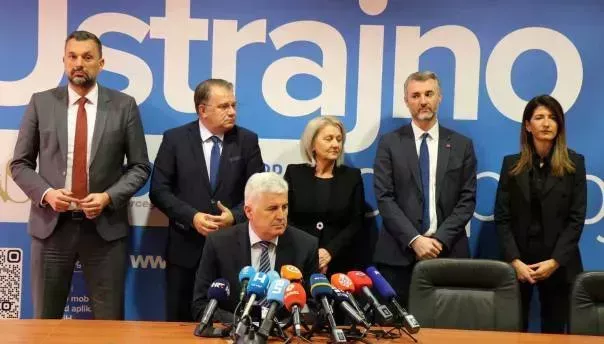
If, however, the fate of the HNS's proposal for the Election Law depends on the leaders of the Trojka - Elmedin Konaković, Nermin Nikšić, and Edin Forto, there is no doubt that we could very soon get an Election Law that absolutely denies all norms of democracy and all conventions on human rights and the prevention of discrimination.
And the first discrimination, if the HNS's proposal for the election of members of the BiH Presidency is adopted, would be directed at Croats living in multi-ethnic environments such as Sarajevo, Tuzla, Bihać, Zenica. These Croats, although they would have the right to elect the member of the Presidency from the Croatian people, would not have any form of electoral role that the inhabitants of, say, the West Herzegovina Canton would de facto have.
However, before I continue listing what is all behind the game regarding the amendments to the Election Law according to Dragan Čović's model, I must note that what the HNS released to the public on February 12 is identical to the law proposed by the HDZ and adopted by the House of Peoples of the BiH Parliament on June 15, 2022.
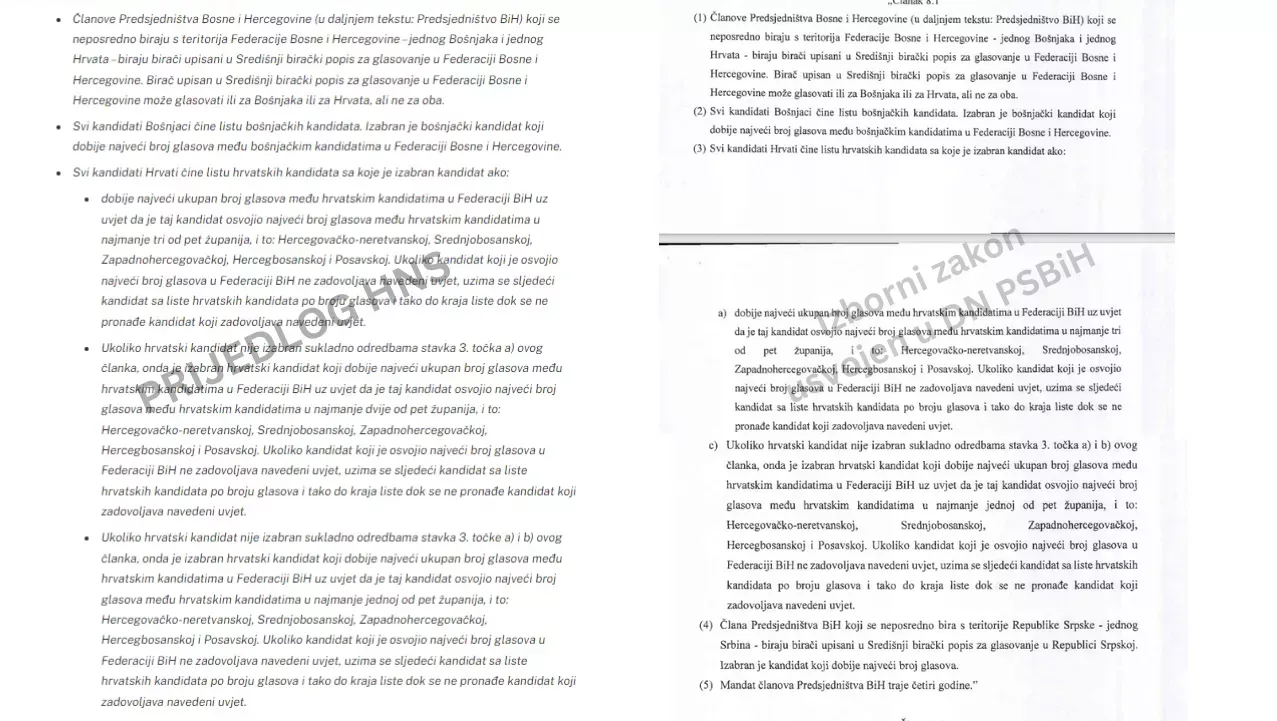 On the left is the HNS proposal, on the right is part of the adopted amendments to the Election Law
And that is the first fraud that Čović has prepared for the BiH public. Given that it is the same text of the law amendments, for which the Constitutional Court of BiH said it does not violate the vital interest of Bosniaks, these amendments to the Election Law will, according to Patria's information, be sent to the House of Representatives of the BiH Parliament. There is no doubt that Čović expects that the representatives of the Trojka parties will raise their hands for this law, because the leaders of the Trojka, as he himself said, agreed to the proposal. In that case, the law would enter into force and in the general elections of 2026, members of the Presidency from the Bosniak people and from the RS entity would be elected as before, while the member of the Presidency from the Croatian people would be elected in two stages - with the total number of votes at the level of the FBiH and with the highest number of votes in three out of five cantons (HNK, ZHK, Livno Canton, Posavina, and SBK).
In translation, for the victory of Dragan Čović or some other HDZ candidate, the one who has the highest number of votes in, say, ZHK, HNK, and Livno Canton would be elected, even if they did not win the most votes at the level of the entire FBiH entity. In that case, the results are easy to predict, because it is difficult to expect anyone serious to try to oppose the HDZ, given the strength that the new Election Law would give it.
It is therefore expected to have one candidate for the member of the Presidency from the Croatian people (read: HDZ), and in that possibility lies another, for many unexpected, plan. In this scenario, ethnic Croats who are no longer needed by Čović and the HDZ would be "redistributed" to vote for the candidate from the Bosniak people.
The math in this case is simple and shows that Croatian voters in SBK, ZDK, Posavina, Sarajevo Canton, Tuzla Canton, BPK, and USK could vote for, say, Denis Bećirović as the candidate of the parties gathered around the Trojka.
In practice, for example, Denis Bećirović or some other Bosniak candidate tailored to the HDZ could already count on more than 50,000 votes before the polling stations even open, which is the sum of votes that the parties gathered around the HNS won in the election for cantonal assemblies in ZDK, SBK, TK, and KS, and these votes are quite sufficient to calculate the electorate of the HNS parties in these four cantons.
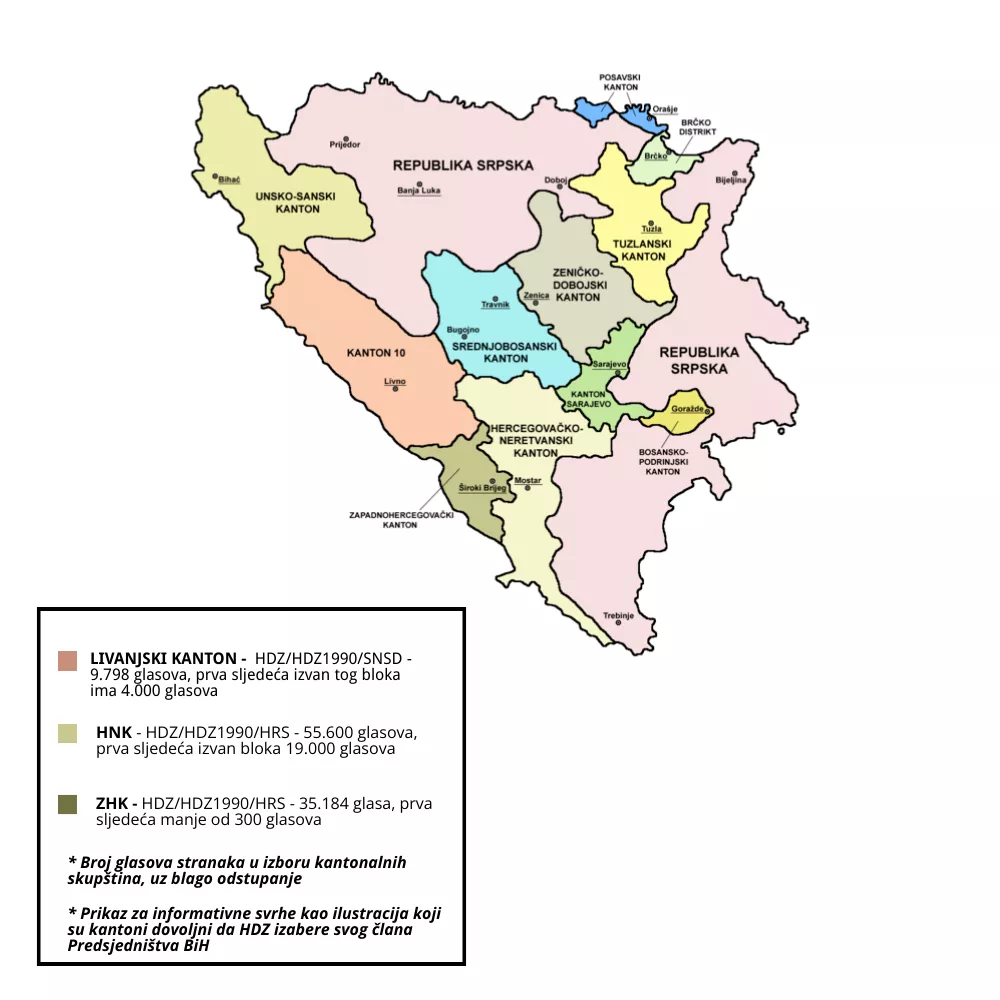
In this game of numbers and hidden plans lies the discrimination that Dragan Čović wished for while accusing someone of "usurping the position of the member of the BiH Presidency from the Croatian people." Because, when and if he ensures that his candidate is secure in the election from the Croatian people, Čović will start implementing the plan for which he accused others.
In this game, the Trojka parties will inevitably play a role, as the victory of their candidate in the race for the BiH Presidency would absolutely suit them. And in this fact, one should seek the reasons why the Trojka leaders told Čović they accept the amendments to the Election Law and why, if the law comes to the agenda, it would receive the support of the Trojka representatives.
Because the history of elections in BiH shows that Bosniaks have so far mostly had three or more candidates. One would be from the Trojka, another from the SDA, a third from some new bloc and political entity. Given that in that situation, the votes of Bosniaks would be split into three parts, those fifty thousand or so that are "surplus" for Čović would decide the elections for the member of the Presidency from the Bosniak people.
And that already moves from discrimination to majorization of the worst apartheid model.
Thus, politics with Dragan Čović at the helm would move from an imagined majorization to a phase of absolute majorization of Bosniaks, who make up 51 percent of the citizens of Bosnia and Herzegovina, as well as that part of the Croatian population that is not loyal to the HDZ BiH.
And all this ultimately leads to the creation of a third administrative unit in Bosnia and Herzegovina, as an introduction to the final division of the state of Bosnia and Herzegovina.
Komentari (0)
Prijavite se za komentiranje
PrijavaJos nema komentara. Budite prvi!
Minuta
Sve →Iz drugih kategorija

High Representative Not Elected: Germans, French and British Against Americans, New Attempt at End of June

ČOVIĆ WITHOUT MERCY: How Those Who Brought Ademović to Office Created a Political Hell for Him



Sunny Saturday, quite warm



Tragedy in Albanian resort: Two minors drown












