
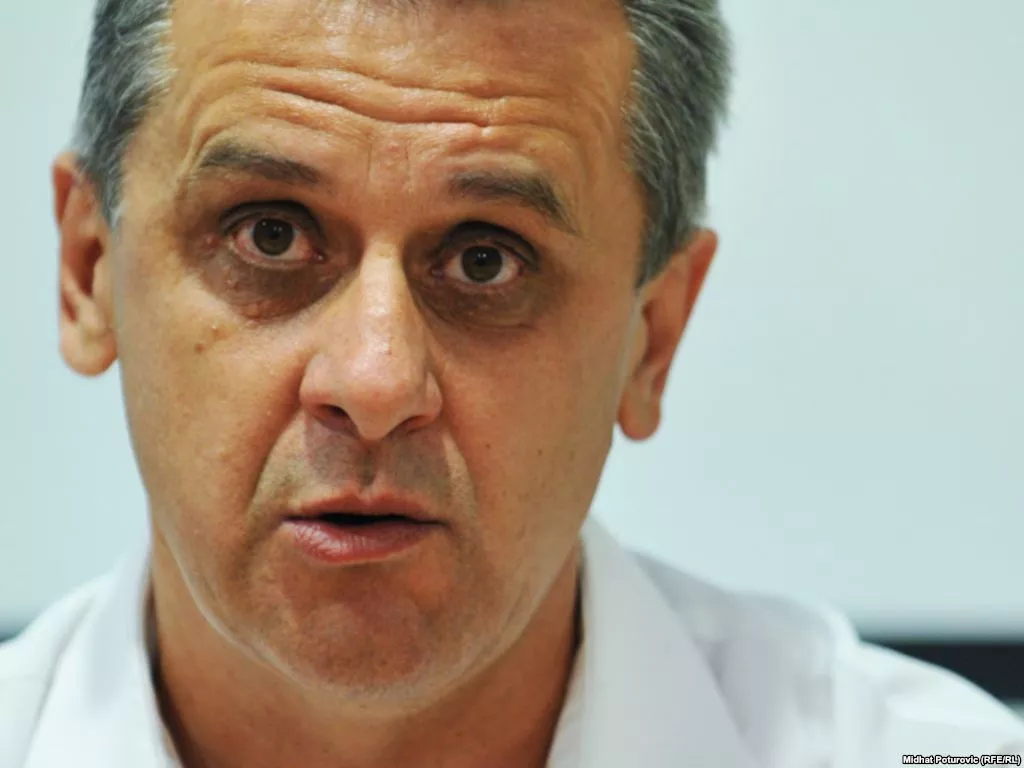
By: Dubravko Lovrenović
(On the occasion of the presentation of books by author Mehmed Kardaš held at the Faculty of Philosophy in Sarajevo on December 22, 2015.)
Concordance dictionary of Cyrillic inscriptions of medieval Bosnia. Compiled by: Mehmed Kardaš, Institute of Language, Sarajevo, 2014.
Mehmed Kardaš, Language and script of medieval Bosnian epigraphy, University of Sarajevo – Institute of Language, Works, Volume 19, Sarajevo, 2015.
I come to this promotion at a time when I am struggling with the feeling of the greatest possible loss – the loss of a child to whom, admittedly, I was not the biological father, but who called me father and was my son. I also come with a terrible realization that I have not yet processed, and I don't know if I ever will, that my Mahir, according to everything that, unfortunately, only came to light after his death, was a victim of peer violence. Limited by the investigation of police and judicial authorities, I will not present all the details of the horror to which this unique child was exposed. Everything is unfolding and coming together faster than one would expect into a picture that even a "resident" of Dante's Inferno would envy – Mahir's peers-abusers, male and female. I pity those children and sincerely wish them to recover from the violence with which they are deeply infected, I am sure I do not wish for them, or their children tomorrow, to suffer Mahir's fate. However, responsible institutions, police, prosecutor's office, relevant ministries, parliaments, assemblies, schools, pedagogical institutes... must urgently take appropriate, palliative measures at the very least, so that something like this does not happen to someone else's child exposed to sociopathic forms of behavior. An experienced expert in juvenile delinquency and violence tells me that the form of abuse to which Mahir was subjected is devastatingly destructive to a child's personality and leads to dissociation. Irreversibly! The ultimate goal of all the aforementioned institutions should be a Law that appropriately sanctions peer violence in schools, from which teachers should not be excluded. Because terrorizing has moved from the media to families and schools.
What further investigation will reveal remains to be seen. I hope that, among other things, it will answer the question of whether Mahir was, admittedly "only" verbally, abused even by some of his teachers? And what Mahir thought of such schools and such teachers, he showed by burning his backpack with books before jumping from the eighth floor of the building where he lived. Could there have been a more eloquent will?
Behind all this, besides the sociopathy that has affected minors, lies the question of identity. How, when, and where, in what ways did this abuse take place, so that my wife and I can finally tell the public, is the task of the investigative and judicial bodies. I want to believe that they will do their job professionally. Nothing more, but nothing less! I want to believe that this case will not gather dust in judicial labyrinths and the shifting of responsibility from one to another! Not only for Mahir, but also for other children exposed to the same or similar peer abuse. To make matters worse, it seems: even by some teachers. Their responsibility, if it exists, must be determined by name.
Precisely because of my personal loss, I will speak quite differently at this promotion today. Honestly, openly, of course: with arguments – without false collegiality. Mahir's case has devastated me, Mehmed's gives me hope – we must start from the middle.
ABOUT THE BOOKS
The books we are presenting, in addition to a series of highly specialized issues, concern Bosnian studies, humanities, and identity: our eternal Sisyphean themes. In short: this is about an above-average author and above-average books, dedicated to medieval Bosnian epigraphic literacy – stećci, which with their content, accuracy, and sovereign concept restore almost extinguished hope in Bosnian studies and humanities. I did not have the good fortune and honor for colleague Kardaš to be my student, but he was a student of both today's promoters (Mr. Josip Raos and Prof. Dr. Dževad Jahić), who recognized his qualities and chose him as an assistant at this faculty, which, unfortunately, is turning into a gray home of former humanities before our eyes. Because humanities, by definition, ask questions, open debates, question dogmas. Here, however, dogmas are produced, along with a dogmatic, murderous consciousness.
We have not been receiving students like Mehmed Kardaš since the 90s, or only exceptionally, so – the young colleague is a pure rarity. On this occasion, I will start with the first book: the Concordance Dictionary.
From my point of view, even if he had not published "Language and script of medieval Bosnian epigraphy", even if he had not digitized the texts of the most important medieval Bosnian Gospels (and meanwhile another one is ready, which is very important to emphasize), which have been waiting for decades, Kardaš, at his 30 years of age, would still have deserved a prominent place in Bosnian and Slavic philology, and therefore I believe that such promotions must also be formed as places where we will talk about what is a cancer on our post-war ethnically-driven and tycoons-driven para-sciences, which, besides us, are also suffering from PTSD and various forms of corrupt practices. So, it is time for anti-promotions to restore the original meaning to promotions, because words are losing their meaning unstoppably and we are losing ourselves every day. We will start looking for ourselves in offices: Found – Lost!
Let's return to the Dictionary! One of the fundamental questions is: How did the Concordance Dictionary come about? One would expect a strong institution, state financial support, serious language policy, a serious team of experts, and a long-term publishing strategy to stand behind this Dictionary. That, of course, is not the case. The book was conceived and created by the author himself, in his home, in his study, seriously dedicated to such a task. So, behind everything stands a single name – Mehmed Kardaš. The publisher and editor only signed the finished book.
Why they did so and why they did not deem it necessary to explain this in at least two or three sentences is a question whose answer is hinted at. It is – in short – devastating and far from the spirit of humanism, which does not deviate from its truth to any reserve position of directorial sinecures and quick careers, which turn village "greats" (however, all honor to the village), overnight into "experts" and national "greats". It is clear that this is a practice that has long taken root in our country.
The book, with its 4450 entries from about 320 inscriptions – unique in Bosnian and Slavic studies – was published and equipped in a way that would be more fitting for some remote local community than for a company located in the very center of Sarajevo, with the sonorous title Institute of Language, which was once a counterpart to Belgrade and Zagreb. This in itself speaks volumes about where humanism is today, and not only in Sarajevo, especially the Institute of Language, which with its recent staff reinforcement has sent a clear message to both society and Bosnian studies itself. Of course, their blessed fortune is that they are convinced that the main task of science is updating the website, so they will be calm for some time to come. Besides, as long as there are various cantonal doctorates – they will survive. Except for doctorates from Pale.
And the management will build top science on traumatic past events. Of course, for those who need it. In the case of the promoted Dictionary, the good thing is that there are second and third editions, which, if we were not ashamed of our own illiteracy and provincialism, should be worked on, which will fully correspond to the content of this extremely valuable book, appropriate to the spirit of the times it focuses on; namely the Middle Ages and the scriptoria of that time where monks, line by line, copied the Gospels. Books like this are created in silence and dedication, by practicing patience and self-control, far from the global cacophony and the scientific underworld that roams the ethno-space of the so-called academic community today. Far from gossip – a discipline in which we can claim the title of world champions. Otherwise, as is known, we are at the very bottom of all relevant statistics.
ON BOSNIAN STUDIES AND HUMANITIES
These are just some of the indicators of how low humanities have been reduced in this country and what the so-called academic community has turned into, which mostly remains silent or questions who has, and who does not have, a problem with the so-called national identity.
That Bosnian studies, despite such brilliant books, is not doing well could be read just yesterday in a daily newspaper that brings to light the latest "discovery" of one of the doctoral students of Tuzla professor Amira Turbić Hadžagić, similar to the discoveries of the legendary "Surrealists" about mobile phones in Herzegovina as proof of life. Imagine, they are proving to us that verbal forms in Bosnian texts differ from those in Croatian and Serbian. It is all devastating and confirms that neither the candidate nor the professor attended Old Church Slavonic. For the professor, it is understandable. There was a war. Every diploma was a national interest. And we overlooked the fact that a professor who has not gone through the school himself cannot offer it. The professor tries in vain to prove to her students that she is "respected" in Zagreb, by some disguised Croatian nationalists, but the truth is quite different, since I know Zagreb much better than she does, so it is quite clear to me what message the western neighbors are sending us with these poorly descriptive doctoral theses, in which Bosnian texts are transliterated according to Damjanović's uncritically accepted model, so the professor accidentally writes Božijko Banovij instead of Božićko Banović. Besides the logical ones, there is a whole series of professional shortcomings here, but that's for another time. Due to the same deficiency, the professor's term bosančica covers all developmental forms of Cyrillic. Because of such notorious mistakes, students fail their exams. Who will bring back our professor, when she herself examines? She just hasn't learned the material she's examining.
Therefore, in order to raise awareness of the place and role of such publications in Bosnian studies, it is necessary to mention these self-proclaimed experts. As far as I understand, her colleagues only laugh at her work over coffee because she has, they say, an "unpleasant" disposition. The lady seems to be a figure of fear. Therefore, it is really difficult to say here who we should pity. From the same kitchen is a certain Indira Šabić – it is even easier to convince yourself of this.
Or to emphasize once again, precisely because of both: this case, one of many, requires us to introduce anti-promotions in practice, in addition to promotions, which will show at least part of the "magnificent" ignorance of newly minted "experts", "authorities", and owners of depleted chairs as incubators of sociopathic national identities, from which, admittedly, one can live well and irresponsibly.
Let us therefore restore dignity to Bosnian studies, because it had it just yesterday, in those "dark" times of "dictatorship", when books were published in editions of tens of thousands of copies, and when serious projects in philology and linguistics, sponsored by the AVNOJ Bosnian-Herzegovinian republic and state, were carried out. Our essential need, and not only in this branch of humanities, is to turn to ourselves and not to servilely copy Zagreb models and salon linguists whom serious Slavic studies have already written off, ridiculed, and scientifically buried.
I will recall just one of them, a respected Viennese and Zagreb professor, who, like most of his colleagues from Croatia, who are welcomed with open arms and servility in Sarajevo, and not only at the Faculty of Philosophy, which has long exceeded the last measure of taste, denies the Bosnian language, and over a good drink claims that Bosniaks are stupid. These are the ones who write (or, more often, whisper in the corridors), and their hosts here who hug and kiss them know very well that Bosnia and Herzegovina is a construct – a non-existent category. It is sad, dear Bosniaks and Bosniak women, how you prostrate yourselves and bow to them. Why do you do this? Is it just inferiority complexes, or does it also concern some bibliographical items? You will, I am sure, know best yourselves, my opinion is that it is an inferiority complex and following "authorities" at all costs. In the name of so-called careers that are more important to you than the humanities and Bosnian studies you swear by. You have failed the exam, but you still have a chance for the so-called social term. Remember that when students beg you for an extension. Some of you, ex cathedra, refuse them, invoking the law.
Therefore, the time has come for some colleagues from this Faculty, primarily from the Department of BHS, to stop warmly welcoming people from Zagreb – who openly, under the roof of this same house, before your eyes and ears, are turning the Bosnian language into Bosniak, while they eloquently remain silent. And they are silent because it comes from Zagreb, and only the noble comes from there. Therefore, nothing from Zagreb is questioned here because it is still not known in Sarajevo how Croatian language policy is defined. Inquire, dear colleagues, because you have already gotten deeply stuck, and completely unnecessarily. Before the Bosniakization of the Institute of Language, we could have been an example. Kardaš's work also speaks of this. Likewise, the time has come to stop citing them because in this way you reduce the relevance of your careers to the area from Marin Dvor to Vijećnica, or at best to Kozja ćuprija. Outside of that area, a scientific terra incognita opens up for you. So, well, let's even reach linguistic Zagreb but: What kind of reference is that for you, with exceptions, in the world of serious science? For example, in the world of sociolinguistics?
Dear colleagues, first of all, colleague Jahić, in order to restore dignity to Bosnian studies, which also means to ourselves, we must first clear up various fast-career phenomena and elementary scientific disasters, whose names I would not list here. I have listed some, and you can convince yourself of others by reading the text in the latest issue (43) of the magazine Bosna franciscana. Books like these, which we are promoting today, in which your merit is also reflected, clearly indicate the path to follow, a path that, as it seemed in the sixties, seventies, and eighties, when Belgrade and Zagreb were not even close to us in that field, was clearly laid out. Because science – or as you would say: nauka – can only be that if it is not ethno-national, as it mostly is today and which, besides promoting mediocrity, only serves to deepen the chasms dug in the nineties for future genocides which – we know this – begin with words. Abuse in the name of identity is at play, and our humanities, passively or actively, participate in it.
ON IDENTITY, MINE, BUT ALSO YOURS (in the hope that paranoia has not overcome you)
Therefore, having clearly realized that the (all-)Croatian identity in BiH is a radical-clerical construct of the 19th century that has made generations unhappy and backward, and which will continue to mourn, in order to exclude myself nominally from the ethno-national pan-Croatian Danse Macabrea, I decided on my "Croatian Question" during the last census in BiH, without waiting for the Danaean gifts of the EU, Paćko and Čović, in the only appropriate way: as far as possible from Zagreb, Kaptol and Opatička 10, from various Pranjkovićs, Katičićs, Damjanovićs, Talangs, Šimićs, Mihaljevićs, Šimunovićs, Ježićs, Ančićs, Brkovićs, Valentićs, Raspudićs, Lučićs, Srakićs, Jezerinac and Bozanić, who still dream of a thousand-year dream of Croatia to the Drina (if not to Tokyo), using BiH Croats as cannon fodder for their own sick ambitions and unprocessed superiority complexes. And the only thing that must be acknowledged to them (apart from open Bosniaphobes) is that they mostly engage in this obscure and well-compensated denial of Bosnia and Bosnian studies in the spirit of thousand-year civilization, i.e., with white gloves, unlike our Serbian colleagues from SANU and outside SANU who do it brutally and with a passion that seeks to destroy everything Bosnian, Bosniak, and Muslim. And not from yesterday.
At the same time, our Zagreb linguists, some openly, some covertly, enjoy the support of (and not only) the top of the Catholic Church. Cardinal Puljić, for example, who receives a bishop's staff from the president of a rural political party, and on the altar, all in the name of the "Croatian people". Has this shepherd with an artificial smile, who calls for peace and love every now and then, heard of simony: the trading of church things, positions, and offices – a sin against which the Catholic Church has fought for centuries? Moreover, both from the church and secular side, heads have fallen. If not, he can find out quickly from Klaić's Dictionary of Foreign Words: just five lines, page 1227. I wouldn't burden him with extensive professional literature, he needs to show off his power in the guise of a church prince by building (a church needed by no one!) in a scandalously imposed parish in Haljinići. A parish within a (friar's) parish! Then, some friars went underground because of this scandal, some were excommunicated. Love and mercy, Cardinal Vinko constantly repeats. Catholic press says: holy construction is progressing. Rejoice, nations, let the faith of Jesus spread. I would say, congratulations, mashallah (!), but what if this is interpreted as a violation of vital national interest? This means that being a Croat in BiH limits a person in their most elementary need: to speak and express themselves in the spirit of the environment to which they belong by birth. By birth, not by ideology. How many examples of this self-censorship imposed in the name of identity are there?! People have an identity, but at the cost of their lives being nullified. They are alive, but killed in spirit, like lost souls they wander through Bosnia, which pan-Croatianism has turned into a necropolis instead of an acropolis.
Therefore, so as not to have to greet with Boooog (more on that later in the text), after all the delusions and losses in time and energy, so as not to lose myself as well, I have officially (re)jected the ethno-national Stadler and Puljić identity, which, like others, without my knowledge and without anyone asking me, has been attached to me like a "blood type" that I must carry and drag until the end of my life, so that, like my unfortunate father, run over, I would end up at Bleiburg, while the criminals with blood up to their elbows, who made him and tens of thousands (in Croatian: tisuća) like him a living shield, loaded with looted gold and artworks, "leaked" through so-called rat channels towards Argentina and Madrid. One of them, admittedly later, called their bloody work and shame in the name of pan-Croatianism "sin, crime, and madness". And after all these decades, and after all the devastating experiences, Croatian identity in BiH is still all of that today. Plus crime. The Cardinal as an altar boy for the president (pardon: Chairman) of a political party. I imagine him pouring water on Čović's hands during mass to symbolically wash them like Pilate. Does this mean the Chairman will start baptizing? Distributing communion? Confirming? Preaching from the altar? Hearing confessions?
Granting absolution? Marrying? I would sign up for confession. How much does it cost to apply at the Chairman's office? An application, as it is called now. What is the procedure, I would apply. What is the tariff for sins: light and heavy, especially for premeditated crime and sociopathy. We are in the market, I would like to follow trends, contribute to Euro-Atlantic integration, which are just about to become a reality. Especially since in our Poor Country, only U is left of the EU. And that, it seems, for eternity. E here, U there.
I do not want, to put it briefly, to do that or to be a victim of "sin, crime, and madness". Bosnia – even if ravaged – is the only historically attested and scientifically provable home, patria, or "holy Krstjanluk" as it is written in Franciscan chronicles and documents, only it reconciles reason and science. And therefore – is there anything more logical and natural than to be what you are: a Bosnian. Or a Herzegovinian. Therefore, Catholic pan-Croatianism is nothing more than an autogenocidal (and genocidal) rejection and flight from the inevitable, directed against the very essence of history: from Bosnia and everything Bosnian. That is the tragicomic sight, among hundreds of similar ones, when a Catholic from the vicinity of an ancient Bosnian city, in a store, greets with a drawn-out Booooog, instead of the Zagreb way: Bok! His Bosnian Booooog and Zagreb Bok are irreconcilable, except as a joint criminal enterprise. And not just once! From these enterprises, inspired by madness and rage, he usually got the short end of the stick, and his teeth went numb not only for him but also for his descendants. Up to the ninth generation, as they say. True, something remained for him: God and Croats! I translate this as B-H: Branko and Hamdija. Everything indicates that it was precisely they, and precisely for BiH Croats, who were their last real political chance.
I am writing a book about all this in the hope that I will finish it as I intended. That in the spirit of science, as the only remaining moral authority, I will finish this "Farewell Letter" to the Nation, the thousand-year mythical Croatia of Sorrow and Buga, Muhle and Klukas, Sanader and Karamarko, Srakić and (Zadar) Puljić, our Poor Country as it was called by those few who still do not believe in brazen lies and Tuđmanism as the only "principles" because they live in a plundered and devastated country, not only materially but also spiritually, where bishops and university (pardon: sveučilišni) professors initiate an initiative to introduce the Ustasha salute, "Za dom spremni", as the official salute of the Croatian army. There is, admittedly, a small problem: our Poor Country was not plundered by Chetniks or Islamists, least of all communists (except disguised ones), it was done by Croatian gentlemen, practical Catholics, polished family men who go to mass on Sundays in new suits, confess and take communion devoutly, and afterwards, as soon as they cross the church threshold, they become and remain what they are: scoundrels, petty thieves, and bigots who live godlessly and parasitically from astronomical parliamentary salaries and numerous sinecures, from assets created over decades in Tito's SFRJ.
If I ever finish this book, I will dedicate it to my son Mahir because both of us, along with millions of others, known and unknown, each in our own way, are victims of monstrous, sacralized, and tycoonized identities – the identity of Thanatos: the ancient Greek deity of death. It is time, says Pope Francis, for "cultural narcissism". Narcissism or Nazism?
ON SUICIDE AND ABUSE
Let us therefore stop driving our children crazy with the pagan deities of so-called ethno-national identity, with cases and syntax, prefixes and suffixes, grammars and transliterations, with bans, kings, and maps, all with mouths full of God, let us first teach them to be human, to distinguish people only by whether they are good or evil, whether they are knowledgeable or ignorant, not by the name, faith, and social status of their parents. If not, the number of children who will take their own lives in this destroyed country, where only lies, force, and money are still valued, will grow, our questioning of this terrible act will increase, and we ourselves will become further from ourselves and from each other every day – we who are different yet so similar in our common tragedy without meaning and end. Will a new scientific discipline, anti-anthropology, as a negation of everything human and divine in man, be born in BiH, besides anti-promotions? The global picture of terror favors such predictions. Are we already keeping pace with the trend?!
ON THE CULTURE OF DISAGREEMENT
Let us open, colleagues, before evolution completes its full circle and returns to the beginning, to the primordial time when God had not yet "spoken" and thus made Man a cosmic mistake (as one of my colleagues said), a dialogue about the culture of disagreement. Let us discuss and talk, while the downfall we are rushing into together can hardly be prevented.
Global indicators, extremely pessimistic, are in our "favor". Namely, the world political order has collapsed, climate change is inexorably leading the Earth towards apocalypse. Man, like a mad dog on a chain, has broken free from ethics. This means that we, here in BiH, are the orchestra on the Titanic, which, while the ship is irrevocably sinking, only needs to play its last notes. Let us therefore tune our instruments, so as not to play out of tune, if nothing else, then for our students, to whom, besides knowledge, we also owe the truth about the world they live in, or rather the answer to the question: Why is that world like that and why is Evil so profitable? How much have we participated in this ourselves and still participate? Are there such questions in our curricula? Finally: why do our students remain silent and ask no questions?
I address you, Professor Jahić, at the end with a proposal that we address this and numerous other marginalized issues at one of our, I hope, future forums under the title: "Culture of Disagreement". I am convinced that, if we cannot immediately bridge it, the gap between us will at least become smaller afterwards. Because, my dear friend and colleague Dževad, Bosnia is our common preoccupation, our fate and our destiny, our tragedies are also common, it is impossible, and I will never agree to it, I believe neither will you, that we will not manage to find a constructive Bosnian minimum of eros against the culture of narcissism and thanatos. Because, esteemed colleague, the Titanic is sinking, and the ships that could possibly help in the rescue mission are too far away. Whether there will be room for all "passengers" to be saved on the lifeboats – we cannot know, and it is better that way. As things stand, we are even lucky, because by then we will have permanently solved our "housing" problem, in our, yours and mine, "noble land".
May God have mercy on those who will not be as fortunate as we are. I said God – and I cannot take back my word, although something is relentlessly pushing me to do so.
Here is another absurdity: the more you run away from God, the less successful you are. Something like Bosnia. Or is all this that we still call life just a play of shadows? Or is Thomas Aquinas right when he says: "God is a question, not an answer"? So – I keep asking.
Finally, if nothing else, to be on trend, let's follow, in the spirit of neoliberal capitalism which returns evolution to the very beginning in the name of profit, the motto of a local bank: "Life's reality is ups and downs. Let's go through them together."
True, with one significant difference: there it is about money, here about spirit, science, and intellect. There about the culture of narcissism and the deity of profit, here about deciphering purpose and goal
About questions!
P.S.
And suddenly: a "miracle" arrives by email. Vesna, a guest worker, my school friend, with whom I once played in a decent band, sends me a recording – a "miracle" that took place in a church in Genoa. At the end of the mass, led by an old friar holding a red scarf, the faithful sing an anti-fascist resistance song: "Bella Ciao". People have repented, and to expect something like that from Puljić's Church is beyond the realm of possibility. Clerical anti-communism is in vogue there. "Yet", as Galileo would say, "it moves".
“Your destruction is within you, Jerusalem.”
The time of "red" but rather church visionaries like fra Jozo Markušić is over for us, forever. The thousand-year dream has come true. The time of Srakić has come.
(tacno.net)
Komentari (0)
Prijavite se za komentiranje
PrijavaJos nema komentara. Budite prvi!
Minuta
Sve →Iz drugih kategorija

High Representative Not Elected: Germans, French and British Sabotaged Americans, New Attempt at End of June

ČOVIĆ WITHOUT MERCY: How Those Who Brought Ademović to Office Created a Political Hell for Him



Sunny Saturday, quite warm



Tragedy in Albanian resort: Two minors drown












