
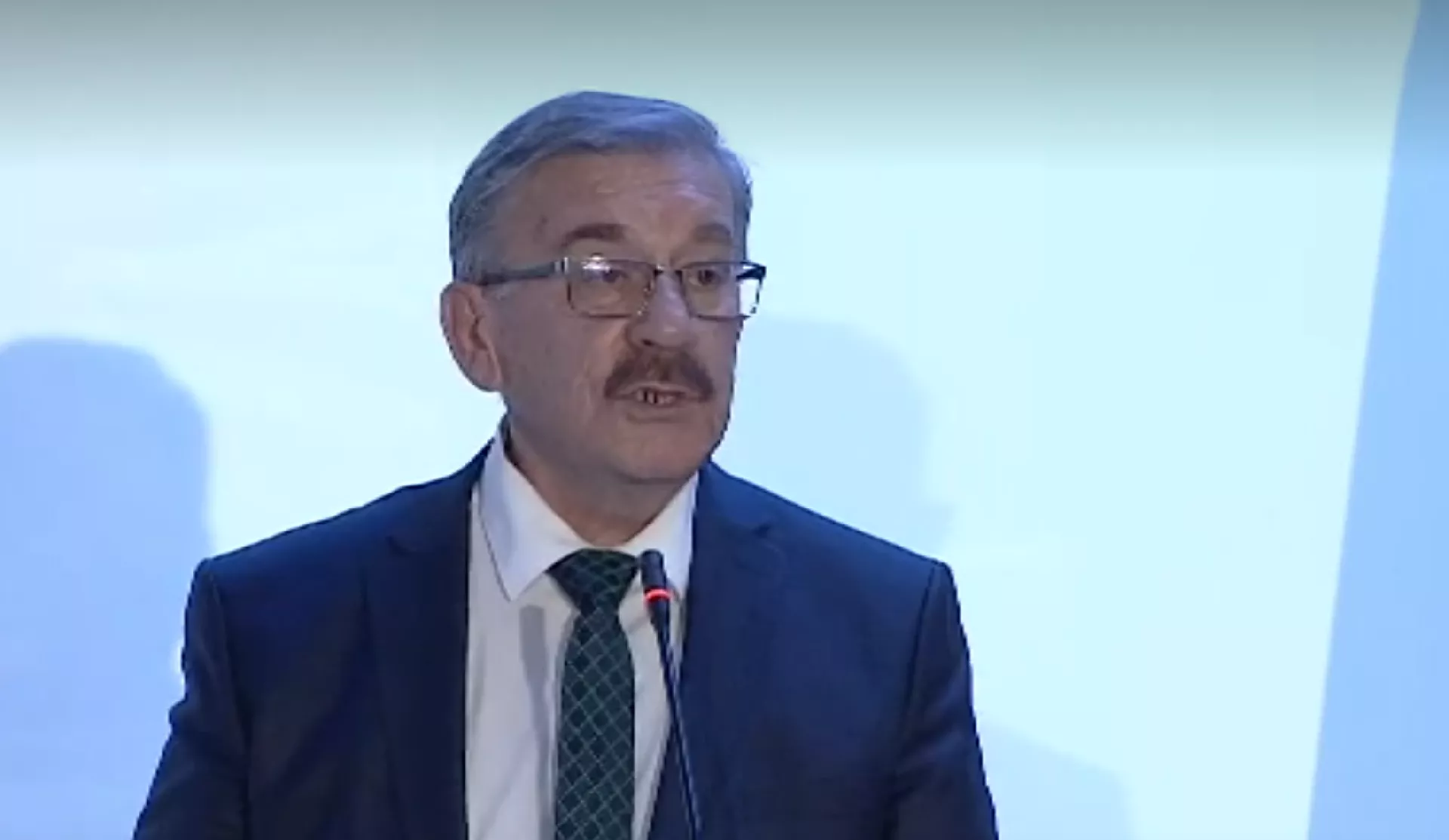
(Patria) - Speaker of the RBiH Assembly, member of the wartime BiH Presidency, and DF member Miro Lazović addressed a convention in Sarajevo tonight, organized under the slogan "Bosnia is Ours - Bosnian" by Krug 99 and NGO Guardians of Bosnia.
Lazović stated at the beginning of his address that he, like many in the convention hall of the "Holiday" hotel, is a witness to the turbulent times of the breakup of the former common state of Yugoslavia and the dramatic events that followed.
- BiH paid the highest price. We are still paying that price today. I often say that Yugoslavia has not yet broken up, because the shadows of that breakup still hover over Bosnia and Herzegovina, Montenegro, and Kosovo.
We are holding tonight's gathering at a time when our country is going through difficult and uncertain political processes. We are still facing external and internal attacks on the sovereignty and territorial integrity of our country.
Why is that so? What is the reason? Why is BiH perceived as an unstable country whose future is constantly questioned and whose existence is doubted?
Many of us will rightly point the finger at the current policy of official Serbia. The wartime Greater Serbian and current political goals of the "Serbian world" have not changed much.
Destroying BiH as a state, strengthening its entity division, respecting Republika Srpska and its representatives, belittling and bypassing state institutions, preventing the creation of a state-building Bosnian-Herzegovinian nation, etc.
These goals are not being abandoned. On the contrary. This pressure is intensifying through the conclusions of the recent so-called all-Serbian assembly and Dodik's announcements about peaceful separation - points out Lazović.
He states that the president of Republika Srpska, Milorad Dodik, continuously denies BiH, saying that the Dayton Peace Agreement has failed.
- And I can agree that Dayton is outdated. It has become an obstacle to building a functional and stable state. However, if the Dayton Agreement has failed, it does not mean that the state of BiH has failed.
Its entity division has failed. Both Republika Srpska and FBIH have failed, and BiH remains within its borders with a new constitutional order or a return to the Constitution of the Republic of BiH, as provided for by the Constitutional Law adopted on December 12, 1995 - emphasizes Lazović.
He also says that the current BiH is a state of international design, and as much as the responsibility for its future lies with domestic actors, so does it lie with international ones.
- The European Union and America must, in order to defend international law, and certainly their own interests, help BiH on its path to the EU and NATO.
Dayton's BiH is a young and fragile state whose construction constantly trembles on the bad Dayton constitutional foundations. They were firm enough to stop the war, but not to support the building of a stable and strong state.
Firm and stable constitutional foundations require civic reinforcement. We need help. From friendly countries in the international community, but from the USA above all.
Palliative and forced moves by the international community to de-escalate political tensions must be replaced by setting the stage for a new constitutional order of BiH.
With such a constitutional order, today's BiH appears as a state stretched between Dayton and Brussels. Brussels demands that we move faster towards the EU, while our feet are shackled by Dayton's chains.
The Dayton Constitution affirms the ethnic concept and ethnic divisions, while Brussels advocates for a civic society and a state of full human rights and freedoms - says Lazović.
According to him, our country is at a crossroads - either we will remain trapped in ethnic cages where individual rights and freedoms suffer, or we will break the ethnic shackles and move towards building a civic state, with full human rights and freedoms throughout the territory.
- As early as 1996, my friend, the recently deceased Prof. Esad Zgodić, published the book "Civic State", in which he wrote:
"The fate of BiH as a state, as well as the existential survival of Bosniaks as a people, will depend on the outcome of the political struggles between totalitarian ethnic policies and the civic concept of government."
And indeed, it is so. The Bosniak people cannot survive without the state of BiH, and the state of BiH can hardly survive if it is not civic.
Solutions for a civic state exist. They are found in the rulings of the European Court of Human Rights in Strasbourg. From the first ruling in Sejdić and Finci, through Azra Zornić and Ilijaz Pilav, to the latest in the Kovačević case.
A civic state does not mean a unitary state and the domination of the majority nation, as we often hear from its opponents. A civic state is not anational, supranational, nor does it annul and dissolve ethnic-national pluralism through political violence.
A civic state does not stifle the needs and rights of citizens for national subjectivity. On the contrary. It has numerous principles for incorporating the ethnic into the civic, such as the principle of equality, national parity, and proportional representation, as well as other mechanisms that guarantee the expression, freedom, and rights of national attributes as an essential part of the autonomy of civil society - emphasizes Lazović.
It is clear to us, Bosnians and Herzegovinians, as well as to international officials, that with such a Constitution, BiH cannot become a member of the EU or the NATO alliance.
- The Dayton formula - two entities and three peoples - has proven to be an unsuccessful experiment. This formula must be changed. And it can only be changed if there are organized, strong, united political forces that will demonstrate, both within BiH and externally, a strong commitment to an undivided society and a stable, strong state.
A state that will be able to affirm and protect civic rights on every inch of its territory. To protect the individual and the citizen through the affirmation of two principles - the principle of freedom and the principle of equality.
Finally, I believe that the messages from this Sarajevo gathering will be accepted by the majority of our citizens. And therefore, I call for such gatherings to be organized in other cities and municipalities of our country - concluded Miro Lazović in his presentation.
Komentari (0)
Prijavite se za komentiranje
PrijavaJos nema komentara. Budite prvi!
Minuta
Sve →Iz drugih kategorija

High Representative Not Elected: Germans, French and British Sabotaged Americans, New Attempt at End of June

ČOVIĆ WITHOUT MERCY: How Those Who Brought Ademović to Office Created a Political Hell for Him



Sunny Saturday, quite warm



Tragedy in Albanian resort: Two minors drown












