
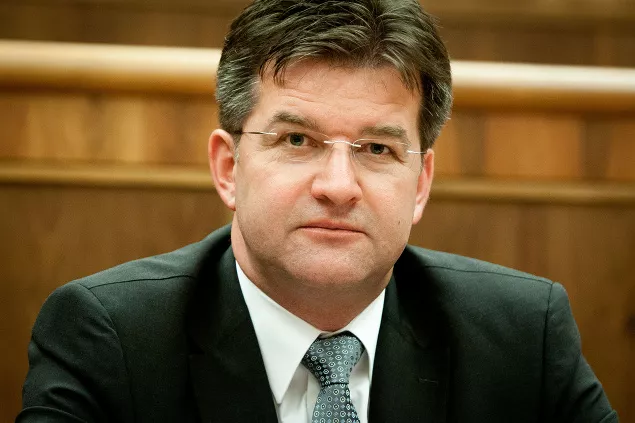
Former High Representative in BiH, and currently Deputy Prime Minister and Minister of Foreign and European Affairs of the Slovak Republic Miroslav Lajčák gave an exclusive interview to the Patria News Agency.
Among other things, Lajčák, as an excellent connoisseur of the local situation, gave his assessment of the current political situation, fulfilling the conditions for EU accession...
PATRIA: When you compare the time when you were High Representative and today, how do you assess the BiH political scene?
LAJČÁK: I still follow events in Bosnia and Herzegovina, including the political scene, very closely. I am very happy that political representatives and institutions have reached a key agreement and signed and adopted a joint declaration on commitment to reforms and integration, thereby paving the way for the Stabilization and Association Agreement to finally enter into force.
It is a pity that the political leaders of Bosnia and Herzegovina have wasted a lot of time in the past on activities that did not lead to integration and progress in improving the situation of citizens. Time cannot be turned back, and therefore leaders should look forward more and more, not backward, and agree on the implementation of domestic reforms. It remains to be believed that the achieved political progress is not in vain and that Bosnia and Herzegovina will move forward.
PATRIA: If you were the High Representative in BiH now, what would you do within the powers of the High Representative to unblock the political and economic situation BiH is in?
LAJČÁK: You surely remember that as the High Representative of the international community and the EU Special Representative, I tried on the one hand to establish direct communication with citizens, and on the other hand to encourage the domestic political process - a process led by domestic politicians.
If Bosnia and Herzegovina wants to join the European Union, it must be able not only to solve its own challenges and problems, but it must learn how to contribute to solving the problems of the entire Union.
In other words, the country must be interested in being part of the solution, not part of the problem, on its own. Therefore, even today, I would not draw your attention, and by that I mean the attention of journalists, to the powers of the High Representative, or the influence of foreign officials, but I would draw attention to the elected representatives of the country, to their responsibility to unblock the great human and economic potential that Bosnia and Herzegovina has. It has it, there is no doubt about that.
PATRIA: Can the politicians who have gained the trust of the citizens in the elections fulfill all the obligations that BiH faces regarding Euro-Atlantic integration?
LAJČÁK: The answer is very simple. In a democracy, citizens elect their representatives based on their work and vision for the future. In the next elections, voters will give recognition to politicians with their votes. It is up to the citizens of Bosnia and Herzegovina to assess the work of the politicians they themselves have elected. Given that you are at the beginning of a new electoral mandate, a lot can be done by the next elections.
PATRIA: When you were the High Representative, you could not answer some questions, but now you can. Do you think that the Democratic Front and its leader Željko Komšić, by advocating for a civic state and concept, can contribute to improving the situation in the country?
LAJČÁK: The Democratic Front, as a new political party, achieved a very good result in the last elections. In other words, the party has gained the trust of a significant number of the electorate. It is up to each party how it will use the electoral result for the benefit of citizens' progress in the country, whether their voters or others. If you ask me about the relationship between the national and civic elements in the political life of Bosnia and Herzegovina, much depends on mutual trust, which does not come by itself, but must be built and strengthened.
PATRIA: Can the coalition of SDA, HDZ, DF and the Alliance for Change, i.e. Izetbegović, Čović, Komšić, Bosić, Ivanić and Čavić solve what has been accumulating for 20 years?
LAJČÁK: I will not express a specific stance on concrete coalitions that have been formed or are being formed, as this could lead to different interpretations and speculations. This issue is solely within the jurisdiction of domestic actors. However, I want to say that your politicians have enough ability, knowledge, and many years of experience to successfully solve their country's problems.
For example, they know which ways of political work do not lead to the country's progress. The question is whether they have enough state courage to move together towards changes and reforms that will bring results in the coming electoral mandates.
PATRIA: What is your message to BiH politicians, given that you know them very well?
LAJČÁK: The best progress is that which comes from the country itself, not that which comes from outside. My message is the need for the country's credibility and a solid track record in fulfilling domestic tasks. We can help you, but you must also want to move forward. Time does not wait, certain changes will surely come, but why shouldn't you be the bearers of progress, right now. In that sense, I consider the examples from your immediate neighborhood in the region to be very inspiring.
Komentari (0)
Prijavite se za komentiranje
PrijavaJos nema komentara. Budite prvi!
Minuta
Sve →Iz drugih kategorija

High Representative Not Elected: Germans, French and British Against Americans, New Attempt at End of June

ČOVIĆ WITHOUT MERCY: How Those Who Brought Ademović to Office Created a Political Hell for Him



Sunny Saturday, quite warm



Tragedy in Albanian resort: Two minors drown












