
Popularly called the reform agenda, which aims to strengthen sustainable, efficient and stable economic growth and create a fair social environment, has been elaborated in detail, and an action plan for its implementation has been made, writes the Patria news agency.
The Economic Reform Agenda represents an important instrument for the economic and social development of BiH and creates preconditions for accelerating the process of BiH's integration into the European Union.
Among other things, the action plan elaborated in detail by sector what the Council of Ministers should do, specifically in the reform of public finances, taxation and fiscal sustainability, business climate and competitiveness, and the rule of law and good governance.
It is precisely in the area of the rule of law that the largest volume of work lies, and little from the action plan has been adopted, only the Amendments to the Criminal Code of BiH to fulfill the recommendations of Moneyval, and a working group was formed to monitor obligations from the FATF Action Plan, participation in meetings and submission of Progress Reports from this Action Plan. The Strategy and Action Plan for the Reform of the Justice Sector were also adopted, but nothing further was done, and there is a series of tasks and obligations, including the obligation to establish an electronic register of asset declarations.
It is necessary to establish effective prevention of corruption and conflict of interest in the judiciary, and here the Council of Ministers did not set a deadline, but stated that they are continuously working on it.
Also, according to the action plan, the Council of Ministers was supposed to improve the legal framework regulating the confiscation of illegally acquired assets, money laundering and recovery, including improving the procedure for selling seized property, by February.
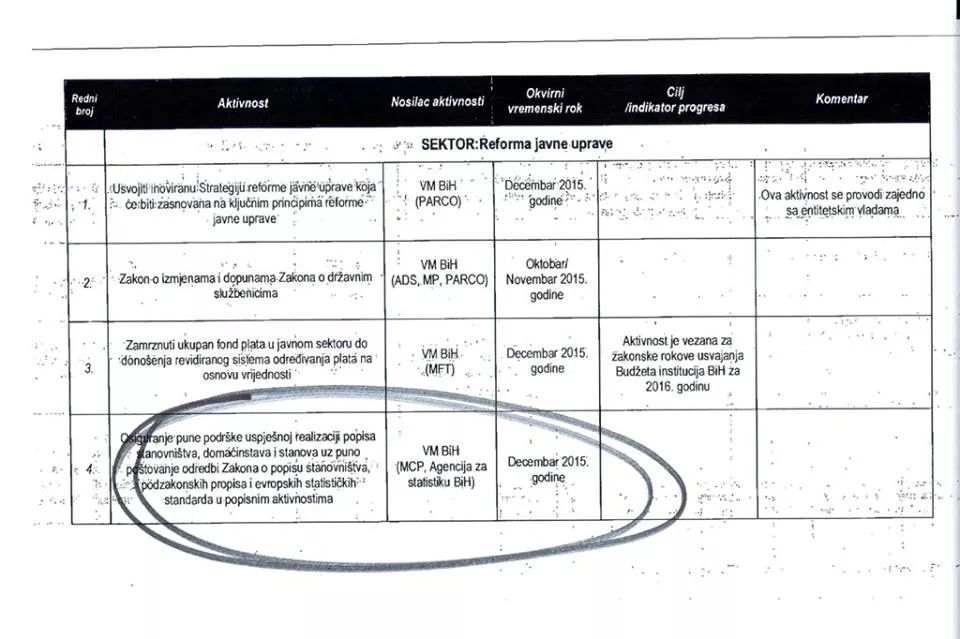
Although the state Prime Minister Denis Zvizdić often emphasizes that the reform agenda is being successfully implemented, it is still unclear how it can be called successful when even in the action plan drafted by the Council of Ministers it states that full support should have been ensured for the successful implementation of the census of population and housing, with full respect for the provisions of the Law on the Census of Population, by-laws and European statistical standards in census activities.
The deadline set by the Council of Ministers itself for publication and implementation was December 2015, meaning a full three months have passed since that deadline, and there is increasingly frequent talk in public that the Census results could be rejected if they are published after July 1, 2016.
In this regard, it is important to note that there is still no consensus or agreement on the non-resident population.
Komentari (0)
Prijavite se za komentiranje
PrijavaJos nema komentara. Budite prvi!
Minuta
Sve →Iz drugih kategorija

High Representative Not Elected: Germans, French and British Sabotaged Americans, New Attempt at End of June

ČOVIĆ WITHOUT MERCY: How Those Who Brought Ademović to Office Created a Political Hell for Him



Sunny Saturday, quite warm



Tragedy in Albanian resort: Two minors drown












