
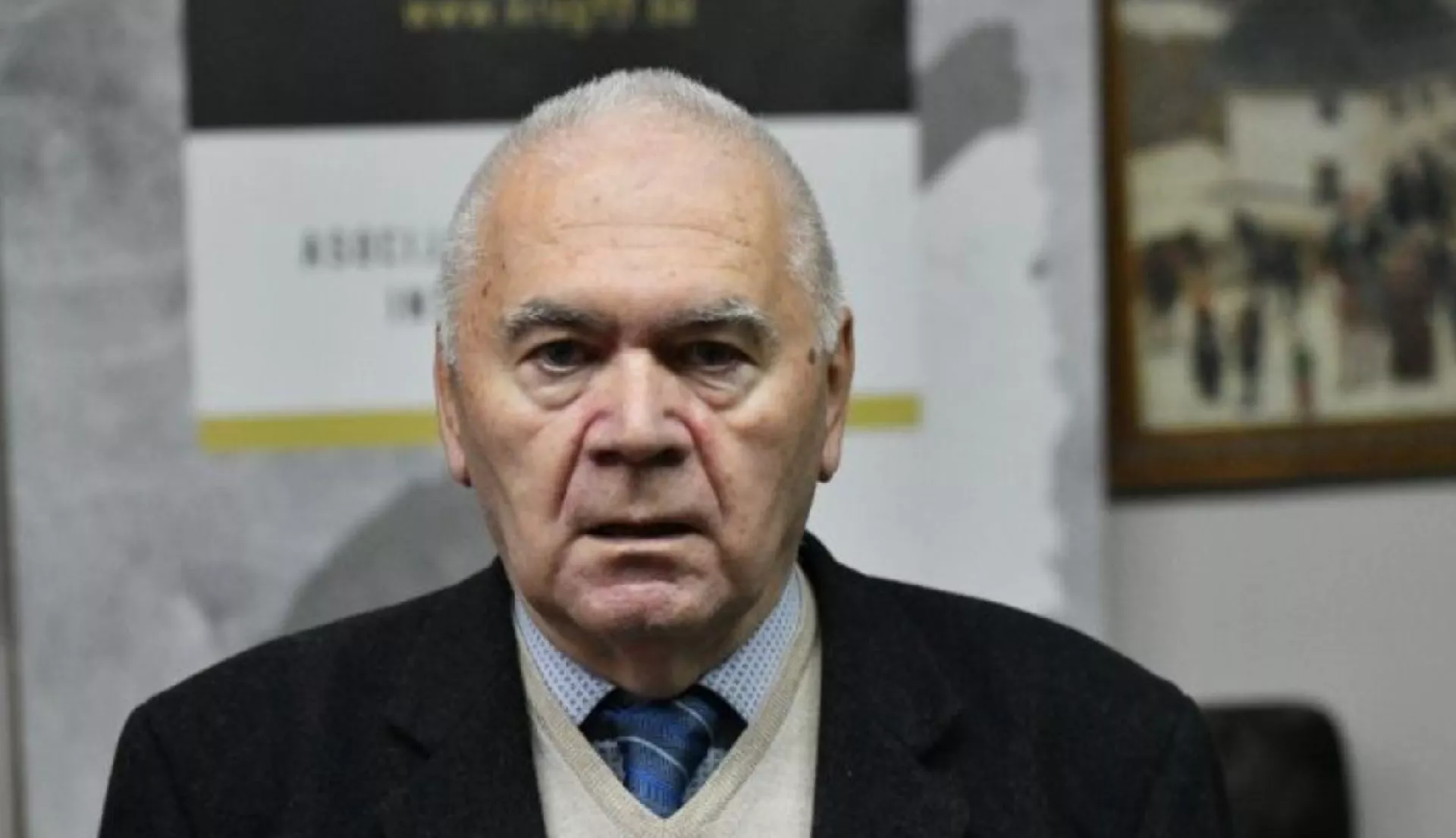
(Patria) - A regular Sunday session of the Association of Independent Intellectuals Krug 99 was held today in Sarajevo, titled "Croatian Flowers Still Fighting for Others' Interests".
The President of Krug 99, Adil Kulenović, says that this topic transcends the boundaries of daily political polemics and returns us to the very core of a long historical process that, unfortunately, has lasted through almost the entire twentieth century and continues in various forms today.
- This is a process in which a segment of conservative political circles in Bosnia and Herzegovina persistently hides behind the term "reality", presenting it as a supposedly neutral political fact, while in reality it is an ideological cover for accepting hegemonic powers and Bosnian national subordination.
The forgetting of the conflicts from 1993, the War Crime Perpetrators (UZP), the camps, and the attempts at territorial division of Bosnia and Herzegovina are not presented by them as a grave historical sin, but as a given that has produced new political subordination.
In other words, when history is relativized for the sake of current political pragmatism, space is opened for the repetition of the same patterns of domination in the future. And even for the increasingly intense actions of aggressive factions in the south of BiH today - emphasizes Kulenović.
He notes that this "reality" has never been just a description of the existing situation, but that throughout the entire twentieth century it served as a pattern of political subordination, as a rhetorical instrument used to justify the abandonment of one's own Bosnian political subjectivity.
- In the name of "reality", foreign state projects, hegemonic constructions, and imposed political frameworks have been accepted. In the name of "reality", Bosnia and Herzegovina has been pushed into a position where others decide about it, and its people bear the consequences.
Every era had its own "reality". In the Austro-Hungarian period, it was the imperial framework; in the Yugoslav era, the centralist, banovina, or federal narrative; in the war and post-war years, the ethno-territorial logic; and today, the same pattern appears through the claim that the existing ethnopolitical architecture is the only possible political reality of Bosnia and Herzegovina.
What is presented as "realism" is often just a sophisticated form of political capitulation. Bosniak conservative circles, instead of problematizing hegemonic relations, hide behind the alleged necessity of the existing order.
These forces are clearly recognizable in the language of politics they use - either due to the laziness of their own political minds or due to the separate and naked utilitarian political interests of the nomenclatures.
Thus, the hegemony of neighboring countries is normalized, and the produced divisions are presented as a natural and unchangeable state of society and the state - underlines Kulenović.
According to him, "reality" is often just another name for a hegemonic vocabulary that produces political passivity and maintains the status quo of a captured state.
- The Krug 99 glossary - reforms of political language shows that terms such as political reality, nation, legitimate representation, constitutionality, vital national interest, consociation, coexistence, and sovereignty, and many others, are not neutral terms, but instruments through which policies of what is considered possible, legitimate, and permissible are shaped.
When "Bosniak nationalists" advocate for this, it becomes an even stronger weapon in the hands of those who, in international relations, present the Bosnian state as a "special case" outside and beyond the world of sovereign democratic states.
In this sense, the critique of the so-called pro-Croatian current among Bosniaks is not just a critique of a wrong political orientation, but a symptom of a broader discursive pattern in which political subjects act within predetermined conceptual boundaries.
This is precisely where the space for a key insight opens up: the problem is not only in the policies, but also in the language through which these policies are conceived and legitimized. Its most dangerous consequence is that abandoning principles begins to be presented as wisdom, and political servility as pragmatism - these are Kulenović's words.
In this sense, he adds, invoking "reality" is not an expression of political maturity, but a form of political and intellectual consent to hegemony.
- Therefore, the essence of the problem is not only in individual political actors or ideological currents, whether on the right or left of the political spectrum, but also in the language through which political reality itself is produced.
When a nation is reduced to an ethnic community, legitimacy to identity belonging, and sovereignty to the territorial possession of a collective, then political language ceases to be a means of democratic rationality and becomes an instrument of Croatian and Serbian hegemony.
In this sense, the critique of the "pro-Croatian" current within the Bosniak political body must be extended to a critique of the entire ethnopolitical discourse, because the same conceptual apparatus, in different variations, produces the same effect: blocking the state, suppressing the citizen, reproducing parallel centers of power, and reducing state sovereignty.
Only the reform of political language - from ethnic to civic, from hegemonic to European normative meaning - opens space for the creation of a modern political nation of Bosnia and Herzegovina as a community of equal citizens - Kulenović concluded his address.
Komentari (0)
Prijavite se za komentiranje
PrijavaJos nema komentara. Budite prvi!
Minuta
Sve →Iz drugih kategorija

High Representative Not Elected: Germans, French and British Sabotaged Americans, New Attempt at End of June

ČOVIĆ WITHOUT MERCY: How Those Who Brought Ademović to Office Created a Political Hell for Him



Sunny Saturday, quite warm



Tragedy in Albanian resort: Two minors drown












