
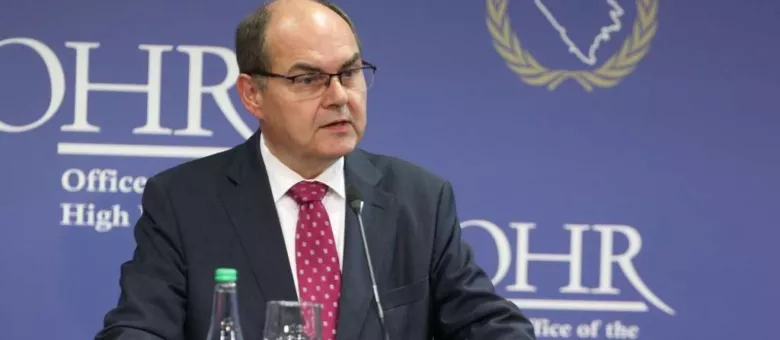
(Patria) - Following the news that High Representative Christian Schmidt will appear before the Grand Chamber of the European Court of Human Rights, Krug 99, through this open letter addressed to the members of the Steering Board of the PIC and the democratic public of Bosnia and Herzegovina, expresses its protest.
We publish the letter in full:
Article 2 of Annex 10 of the General Framework Agreement for Peace concluded in Dayton clearly defines the competencies of the High Representative. Our address is based on Annex 10, Article 1, which clearly states that the job and competence of the High Representative is the implementation of the civilian aspect of the Dayton Peace Agreement in Bosnia and Herzegovina, and not outside it, and especially not on the international political scene. Krug 99, while providing true and complete facts, also expresses serious warnings about errors in the High Representative's conduct, i.e., an attempt to violate the Convention for the Protection of Human Rights and Fundamental Freedoms and the rule of law in Bosnia and Herzegovina.
To this end, we point out the following facts:
― HR C. Schmidt, pursuant to Annex 10, Article II, has no authority to interfere in disputes conducted by individuals, citizens, before the European Court of Human Rights against Bosnia and Herzegovina for violations of individual human rights prescribed by the European Convention for the Protection of Human Rights and Fundamental Freedoms, nor does he have jurisdiction to appear as a party in any dispute before international courts.
― HR C. Schmidt has not been authorized or invited by any party to the proceedings! In accordance with Rule 44 (Third-party intervention), and in connection with Article 34: The Court may receive applications from any person, non-governmental organization or group of individuals claiming to be the victim of a violation by one of the High Contracting Parties of the rights set forth in the Convention or the protocols thereto. The High Contracting Parties undertake not to hinder in any way the effective exercise of this right.
― In the proceedings before the Grand Chamber of the Court in the case of Dr. Slaven Kovačević vs. BiH, C. Schmidt requested the Court, without the knowledge of the members of the Peace Implementation Council, to hear him as a third party in the proceedings, through a British law firm, which is scandalous and paradoxical. Based on the above, the question arises in what capacity C. Schmidt is addressing the European Court of Human Rights in the Kovačević case? By whose approval is he doing this? Who is paying for it?
― The HR must know that the civilian aspect of the General Framework Agreement for Peace in BiH is not protected by consolidating and strengthening ethnic divisions and by attempting to relativize or annul final judgments, thereby degrading the European Court of Human Rights itself.
In the judgments of the "Sejdić-Finci case law," more precisely in the judgment Zornić vs. BiH, the Court concludes: The finding of a violation in this case was a direct consequence of the authorities' failure to introduce measures to ensure compliance with the Grand Chamber judgment in the case of Sejdić and Finci. The failure of the respondent State to submit constitutional and legislative proposals to end the current incompatibility of the Constitution and the Election Law with the Convention.
In Article 43 of the said judgment, the Court concludes: "...at the time when the contested constitutional provisions were adopted, there was a very fragile ceasefire on the ground, and that the aim of those provisions was to stop a brutal conflict marked by genocide and 'ethnic cleansing.' The nature of that conflict was such that it was necessary to agree on 'constituent peoples' in order to ensure peace.
However, now, more than eighteen years after the end of the tragic conflict, there can be no reason for maintaining the contested constitutional provisions in force...".
Simply put, overturning the Kovačević judgment would call into question all other judgments from the Sejdić-Finci case law, as well as their implementation.
Likewise, in Annex III of the Dayton Peace Agreement, Article 4 - Right to Vote - clearly states: Every citizen of Bosnia and Herzegovina aged 18 or over whose name appears on the 1991 census of Bosnia and Herzegovina shall have the right to vote, in accordance with electoral rules and regulations. From the above, it follows that no priority is given to ethnic groups as a collective, but this right is given equally to all citizens of Bosnia and Herzegovina.
C. Schmidt has self-invited himself to Strasbourg! He is seeking to be a "Third party – intervention" in the proceedings, but not to appear as an "amicus curiae" in the case of Dr. Kovačević. The official OHR statement that they were invited as "friends of the court" is an absolute untruth. By doing so, he directly influences Bosnia and Herzegovina to remain trapped in the gap of ethno-politics and regress in its democratic development. C. Schmidt thereby supports the unhistorical idea of "legitimate representation of peoples" and the concept of the election law subordinated to it.
This is completely contrary to his mandate!
What can HR Schmidt say regarding the Judgment in the case of Dr. Kovačević? Surely he will not testify that Bosnians enjoy discrimination and apartheid? The statements of Croatian Prime Minister A. Plenković that he influenced C. Schmidt regarding the adoption of undemocratic amendments to the Constitution and the Election Law of the FBiH are already known. Is C. Schmidt in the role entrusted to him once again by A. Plenković? Is he concerned about his position after the decisions that created chaos in the complex electoral system of Bosnia and Herzegovina? The question of the non-implementation of the judgments of the European Court of Human Rights and the non-respect of the European Convention on Human Rights in Bosnia and Herzegovina is justifiably imposed.
Unfortunately, it seems that C. Schmidt himself is not even trying to work on the implementation of these judgments or the recommendations of the Venice Commission. The public of Bosnia and Herzegovina should receive information from C. Schmidt on all these issues. The citizens of BiH deserve to be truthfully informed about his work on developing a democratic order.
It is unacceptable for the High Representative to fulfill the wishes and orders of the politics of the Republic of Croatia in BiH. He should be fully committed to working on the development of Bosnia and Herzegovina as a state governed by the rule of law, and not to play the role of a colonial governor doing shady business on behalf of some hegemonic projects.
The High Representative is responsible to the citizens of BiH for his actions, which he must justify in a reasonable and logical manner. Without that, he becomes a nightmare of our social and political life!
Due to his visible bias towards ethno-politics, which is the perception of the vast majority of citizens of Bosnia and Herzegovina, we believe that the time has come for the Steering Board of the PIC to consider whether Christian Schmidt is the appropriate person for the job of High Representative in Bosnia and Herzegovina.
We believe that with this open letter we contribute to the implementation of the civilian aspect of the peace agreement, rightly expecting that the members of the PIC will consider the allegations of this letter and take appropriate steps.
Komentari (0)
Prijavite se za komentiranje
PrijavaJos nema komentara. Budite prvi!
Minuta
Sve →Iz drugih kategorija

High Representative Not Elected: Germans, French and British Sabotaged Americans, New Attempt at End of June

ČOVIĆ WITHOUT MERCY: How Those Who Brought Ademović to Office Created a Political Hell for Him



Sunny Saturday, quite warm



Tragedy in Albanian resort: Two minors drown












