
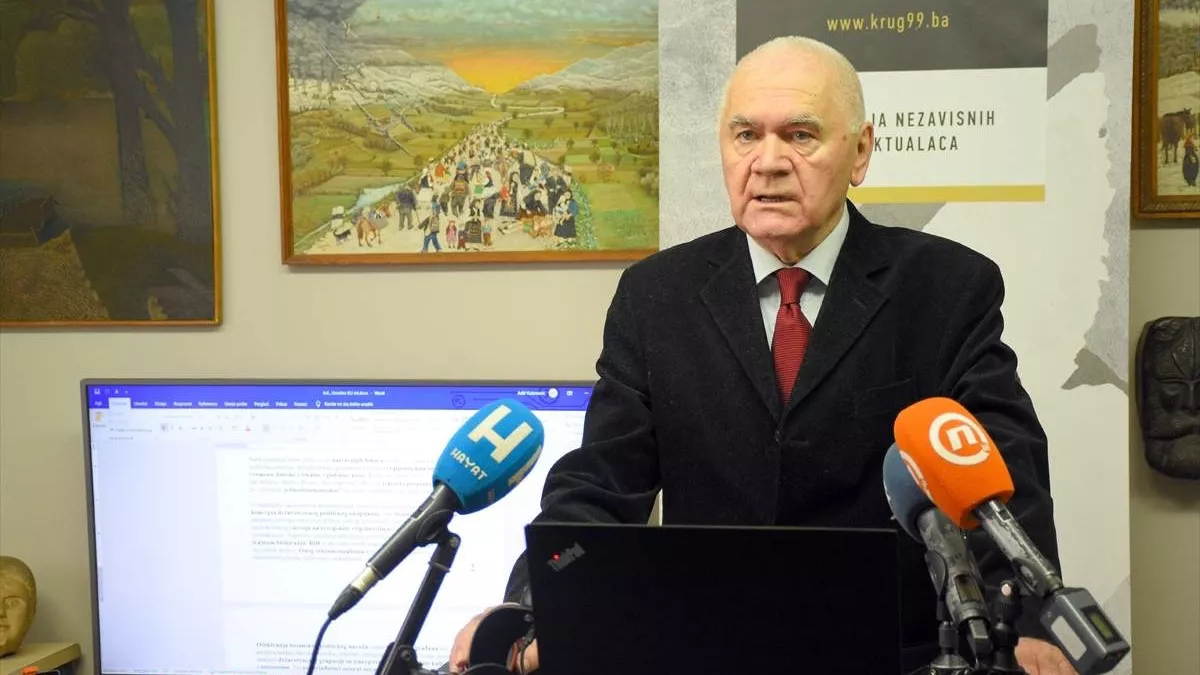
(Patria) - "Islamophobia: Concept, dynamics and response in the context of Bosnia and Herzegovina" is the topic of today's regular session of Krug 99, which is being held in Sarajevo.
The introductory speakers are Ahmet Alibašić, a professor at the Faculty of Islamic Sciences in Sarajevo, and Đermana Kurić, a research associate at the Irish Centre for Human Rights at the University of Galway.
Although the topic is not new, its context has significantly changed today.
The president of Krug 99, Adil Kulenović, says that we are no longer talking about a marginal social phenomenon, but about a phenomenon that is increasingly entering the main political vocabulary, into the way security, belonging, and loyalty are defined.
Therefore, Kulenović points out, it is important to say at the outset - this is not just a discussion about a concept, but about the position of Bosnia and Herzegovina in contemporary Europe, where Islamophobia is increasingly becoming political legitimization.
- Bosnia and Herzegovina is not a neutral space for discussing Islamophobia. It is not a laboratory, nor an experiment. It is an internal European experience, whether we like it or not.
An experience in which Islam did not arrive as a "new challenge", but as a historically indigenous element. An experience in which pluralism is not a theory, but our old social practice.
An experience in which coexistence and civic loyalty to the state existed before they became European slogans about a special case - "corpusu separatumu" - states Kulenović.
He emphasizes that today's session of Krug 99 is taking place at a time when the European political space is visibly changing. In that space, some political actors are increasingly openly building their identity on exclusionary language.
- Islamophobia here is increasingly not an incident, but hegemonic vocabulary: the language of security, the language of suspicion, the language of cultural hierarchy and exclusion. This is not a marginal phenomenon. It is a political framework in which decisions are made. And which inevitably produce consequences for the Bosnian being - these are Kulenović's words.
According to him, Bosnia does not enter this context empty; it enters with the experience of a war that was not just violence, but the destruction of its political form and essence.
- And with the post-war order that brought peace, but also a long-term state in which imposed - bureaucratic stability takes precedence over full democracy.
I am not going into an analysis of that order here, but it is important to say that Bosnia and Herzegovina has long been living in a space of postponed political maturity.
In such a space, every external narrative that reduces Bosnia again to an identity issue, especially religious diversity, has much deeper consequences than in consolidated democracies - notes Kulenović.
He emphasizes that one of the terms constantly used in this context is "multi-ethnic character of the state". It is legitimate, says Kulenović, as a description of social reality.
- The problem arises when multi-ethnicity becomes an unchangeable matrix of constitutional order, becomes a model and a substitute for citizenship and equality of people. Then political responsibility is replaced by balance, democratic rationality by fear, and civic equality by the parity of three ethnic collectives.
In that language, any discussion about the equality of all citizens easily becomes a threat to "balance". And within that framework, the discussion about Islamophobia gains additional weight - points out Kulenović.
Therefore, he continues, it is important to clearly state from which position we are speaking. The Bosnian nation, in a political sense, is not an ethnic substance. It is the form of political community of the state.
- Citizenship is its content: equal rights, equal responsibility and loyalty to institutions, not identities. Within that framework, religion is not a political category, ethnicity is not a source of sovereignty, and a democratic majority is not a threat. This is and is not an answer to Islamophobia. This is a prerequisite for discussing the state rationally at all - says Kulenović.
If Islamophobia in Bosnia and Herzegovina is discussed outside of this context, he warns, it easily becomes either a moral condemnation without effect, or a political label, or a new reason for polarization.
- But if it is conducted as part of a broader discussion about hegemonic language, about blocked democracy, and about the relationship between identity and citizenship, then it becomes a necessary element of serious political analysis.
In this regard, today's introductory speakers have a key role. Not to confirm predetermined views, but to precisely explain how Islamophobia is produced today, how it circulates, and what consequences it leaves in the social and political space of Bosnia and Herzegovina.
This introduction does not aim to precede them with scientific arguments. Its ambition is only one: to clearly define why this discussion is necessary, legitimate, and responsible - said Kulenović.
Bosnia and Herzegovina, he points out, is not seeking special treatment today. It is seeking precise language. Language that does not turn complexity into suspicion, that does not see pluralism as a weakness, and that does not sacrifice citizenship for the sake of apparent stability.
- In that language, the discussion about Islamophobia is not a threat to anyone. Stating the truth, however sensitive it may be, is a test of our political maturity - added Kulenović.
Komentari (0)
Prijavite se za komentiranje
PrijavaJos nema komentara. Budite prvi!
Minuta
Sve →Iz drugih kategorija

High Representative Not Elected: Germans, French and British Sabotaged Americans, New Attempt at End of June

ČOVIĆ WITHOUT MERCY: How Those Who Brought Ademović to Office Created a Political Hell for Him



Sunny Saturday, quite warm



Tragedy in Albanian resort: Two minors drown












