
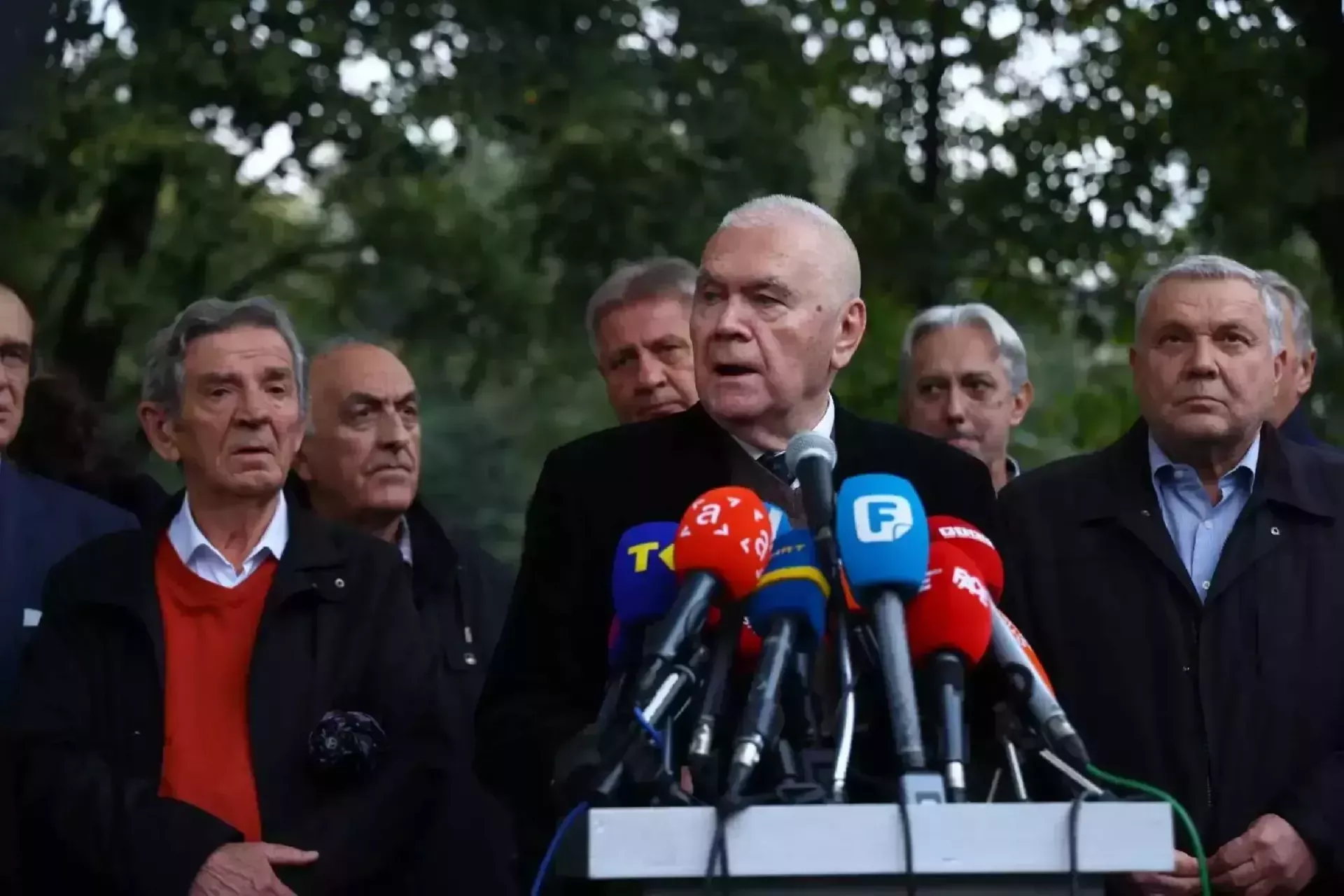
(Patria) - A regular session of Krug 99 was held today in Sarajevo, with the topic titled "Rejecting Hegemonic Political Vocabulary for Democratic Transition" marking 30 years since the signing of the Dayton Peace Agreement.
The introductory speaker was the president of Krug 99, Adil Kulenović, who, in his explanation, stated among other things that Bosnia and Herzegovina has been living under the pressure of a political vocabulary that shapes, limits, and often deforms public space for three decades.
- During three decades of work, and within Krug 99 itself, theoretical and political concepts have crystallized over time that more clearly reflect the goal we strive for – a modern European Bosnia and Herzegovina. The Dayton Agreement undeniably established peace, but it did not profile a democratic future for a sovereign, internationally recognized, and inclusive state.
We ourselves have contributed to this by remaining within the categorical, conceptual, and linguistic apparatus of the hegemonic ideologies of Greater Serbian and Greater Croatian ideologies. Political language is not just a mere communicative message; it is a carrier of the production of reality and the meanings we strive for. Political language is not neutral; it is contextual.
The language that keeps the Bosnian state in uncivilized projections of a special case, a kind of corpuses separatum, a trapped discriminatory political system with no real possibility for progress for the state and society, must be rejected – said Kulenović.
To that end, he adds, Krug 99 has prepared an "Analytical Study of Hegemonic Vocabulary, Ethno-Political System, and European Standards" – in draft form, as well as a Differentiating Dictionary. After discussion and contributions from all members, these will evolve into a document of Krug 99.
- We are also preparing a Glossary of Political Terms of Bosnia and Herzegovina with clear differentiating meanings of those used in BiH and those used in the meanings of European democratic standards – explains Kulenović.
According to him, Bosnia and Herzegovina today finds itself in a political space where the language of the last century still dominates – a language in which the Bosnian nation is understood as an ethnic community, not as a political community of citizens – a sovereign nation. And the Dayton trap that prevents a real and open path to Brussels.
- This study shows how such a perception of the nation, both past and present, is not just a theoretical difference, but a fundamental tool of political control. That is precisely why, throughout the study, we consistently avoid the term "international" and use the term "international," because it more precisely describes relations between states as political entities, not between ethnic groups.
The term "international" emphasizes relations between states – subjects of international law, while the term "international" in the Balkans is often distorted to suggest relations between "peoples."
As if there are courts, institutions, declarations, resolutions, relations, etc., between peoples, and not between communities of sovereign states. This directly supports the ethno-national narrative of Serbia and Croatia about Bosnia and Herzegovina as a "community of peoples," not as a political community of its citizens.
It is precisely this terminological ambivalence that has produced misinterpretations of BiH's constitutional order for decades. And this is one of the reasons why the study decisively opts for international vocabulary and the development of political vocabulary in line with this conceptual definition and political practice – says Kulenović.
At the center of the hegemonic narrative of Serbia and Croatia, he notes, is precisely the ethnically defined concept of the nation. In both political discourses, the nation is understood as "people," a historical-cultural and biological community.
Such an understanding of the nation, Kulenović points out, allows hegemonic and ethno-national elites to position themselves as the sole legitimate interpreters of political rights in the Bosnian state, which leads to a completely non-European suppression of the citizen as a political subject.
The study shows that this is a legacy of the Yugoslav and Soviet concept of "peoples and nationalities" – and the Dayton system, which was created so that the collective would be more important than the individual.
The most problematic terms in that system are constituent people, legitimate representation, and vital national interest. Instead of serving to protect cultural identities or prevent discrimination, these terms are used as instruments for blocking institutions, preventing functional government, manipulating elections, preventing civic equality, maintaining ethnic dominance, and discrimination.
The concept of sovereignty reveals the key difference: in the hegemonic narrative of Serbia and Croatia, sovereignty belongs to ethnic communities, while in European political theory, sovereignty belongs to the state and is realized through citizens.
- That is why both Belgrade and Zagreb almost always recognize the "territorial integrity of Bosnia and Herzegovina," but avoid uttering the term sovereignty of Bosnia and Herzegovina as a unified state. The first term recognizes geography, and the second recognizes political subjectivity – and it is precisely this subjectivity that is being challenged – states Kulenović.
The study also reveals the manipulative use of terms such as "Muslim," "Christian," and the geographical term "Sarajevo basin." In political discourse, they are used as symbolic tools of mobilization and polarization.
- "Muslim" is instrumentalized to present Bosniaks as a non-political, pre-modern collective, "Christian" as a marker of alleged endangerment, while "Sarajevo basin" is used to delegitimize the idea that Bosnia and Herzegovina has its political center and continuity.
Through such terms, Serbia and Croatia have built and maintain parallel power structures in BiH: "soft" structures (churches, education, culture, media) and open political structures (special ties between RS-Serbia, political mentoring, institutional influence on Croatian and Serbian political parties in BiH).
In parallel, both countries actively lobby international institutions – the European Union, the Council of Europe, diplomatic networks – promoting the narrative that BiH is a "community of constituent peoples," not a sovereign state of its citizens.
This dual mechanism – internal parallel power, plus external international lobbying – keeps Bosnia and Herzegovina in its current state: a state with recognized borders, but with challenged political definition as a sovereign state and nation recognized by admission to the United Nations.
That is precisely why the study offers a Differentiating Dictionary as a tool for dismantling the hegemonic vocabulary. In it, hegemonic terms – such as sovereignty, federalism, entity, citizen, public policy, rule of law, political culture, identity, and public interest – are returned to their European and democratic meanings – said Kulenović.
The goal of the study and glossary is not just academic. The goal is politically clear: for Bosnia and Herzegovina to be understood and organized as a political community of its citizens, not as a geopolitical hostage of ethno-national projects. Without redefining the political language, Bosnia and Herzegovina remains trapped in post-Dayton power relations.
- Our choice is Western democratic integration based on the values of a society of equal and sovereign citizens; our political and theoretical vocabulary must be contextualized with this commitment – added Kulenović.
Glossary of BiH Political Language (30 terms)
1. NATION
Hegemonic meaning: In the Bosnian-Herzegovinian political discourse, the nation is understood primarily as an ethnic community tied to origin, cultural homogeneity, and territorial connection. This definition stems from the Soviet-Yugoslav model of "nation as an ethnic collective," which in practice means that the carrier of political rights is the collective, not the individual.
Function in the power structure: Such an understanding of the nation allows ethnic elites a monopoly over political representation and delegitimizes the citizen as a political subject. This narrows the space for democratic decision-making and reinforces the idea that individuals are primarily "members of a people," and only then subjects of law.
European meaning: In the European political tradition, the nation is a legal-political community of citizens who share a constitutional order and public space. It is a community of equal individuals, not an ethnically exclusive construct.
Consequences of misinterpretation: In BiH, this leads to institutional blockades, the replacement of civic sovereignty with ethnic collectivism, permanent political crises, and the inability to find common interest.
Proposed democratic use: Use the term nation exclusively in the sense of a community of citizens of Bosnia and Herzegovina.
2. CONSTITUENT PEOPLE
Hegemonic meaning: A collective that possesses political superiority over the state and citizens.
Function of power: Justifies ethnic veto and state fragmentation.
European meaning: A cultural, not political, category.
Consequences: Diminution of civic subjectivity, discrimination.
Democratic use: Limit the term exclusively to cultural identity.
3. LEGITIMATE REPRESENTATION
Hegemonic framework: Representation of a specific ethnic group through affiliation.
Function: Monopoly over positions and elections.
European meaning: A representative is legitimate if elected by citizens.
Consequences: Blockades and ethnic ghettoization of politics.
Democratic use: Legitimacy = voter choice, not origin.
4. VITAL NATIONAL INTEREST
Hegemonic function: Instrument for halting political decisions.
Consequences: Paralysis of institutions and legal uncertainty.
Democratic meaning: Protection against actual discrimination.
Use: Legally narrow and depoliticize.
5. SOVEREIGNTY
Hegemonic framework: Ethnic ownership of territory.
European meaning: Belongs to the state and is realized through citizens.
Consequences: Undermining state cohesion.
Use: Sovereignty = will of BiH citizens.
6. STATE
Hegemonic framework: Collection of ethnic territories.
European framework: Unified legal order.
Consequences: Fragmentation, inefficient governance.
Use: State = guarantor of public interest.
7. FEDERALISM
Hegemonic interpretation: Ethno-territorial concept.
European model: Functional division of competencies.
Consequences: Misinterpretations, increased fragmentation.
Use: Federalism as administrative rationality.
8. ENTITY
Hegemonic meaning: Substitute for statehood.
European meaning: Administrative unit of the state.
Consequences: Challenging state continuity.
Use: Entity = part of the state, not a political subject.
9. POLITICAL POWER
Hegemonic function: Control of ethnic space.
European meaning: Responsibility and mandate.
Consequences: System of blackmail and blockades.
Use: Power = responsibility towards citizens.
10. POLITICAL REALITY
Hegemonic meaning: Narrative of impossibility of change.
Function: Naturalizing blockades.
European meaning: Reality = constitutional and democratic framework.
Use: Reality is defined by institutions, not fears.
11. CITIZEN
Hegemonic framework: Secondary political figure.
European framework: Holder of sovereignty.
Consequences: Degradation of individual rights.
Use: Citizen = foundation of the political community.
12. POLITICAL SUBJECT
Hegemonic framework: Collective, not individual.
European framework: Individual + institutions.
Consequences: Reduced political responsibility.
Use: Subject = citizen within institutions.
13. INSTITUTIONS
Hegemonic practice: Arena for ethnic negotiations.
European framework: Neutral, depoliticized holders of power.
Consequences: Weak institutions and politicization of administration.
Use: Professionalization and accountability.
14. PUBLIC POLICY
Hegemonic framework: Ethnic protection, not analysis.
European framework: Policy based on data and performance measurement.
Consequences: Absence of strategies and reforms.
Use: Public policy = expert process.
15. CONSTITUTIONAL RESPONSIBILITY
Hegemonic framework: Interchangeable with political demands.
European framework: Responsibility lies with the function, not identity.
Consequences: Evasion of political responsibility.
Use: Individual and institutional responsibility.
16. DEMOCRATIC DELIBERATION
Hegemonic meaning: Formality, rhetorical procedure.
European meaning: Open and rational public reasoning.
Consequences: Absence of substantive debate.
Use: Deliberation as the foundation of democracy.
17. BALANCE OF POWER
Hegemonic framework: Ethnic distribution of control.
European framework: Institutional balance.
Consequences: Reproduction of blockades.
Use: Balance = functional separation of powers.
18. TERRITORIAL IDENTITY
Hegemonic framework: Identity = territory.
European framework: Identity = cultural category.
Consequences: Ethno-territorial claims.
Use: Territory = administrative, not ethnic space.
19. MINORITY RIGHTS
Hegemonic framework: Ethno-political privilege.
European framework: Protection of vulnerable groups.
Consequences: Incorrect categorization.
Use: Rights = individual + cultural.
20. CONSTITUTIONAL PLURALISM
Hegemonic framework: Arbitrary interpretation of the constitution.
European framework: Pluralism within a single constitutional order.
Consequences: Legal instability.
Use: Unified framework + diverse policies.
21. POLITICAL CRISIS
Hegemonic framework: Permanent state, normalized as "reality".
Function: Justification for inaction and blockades.
Democratic framework: Crisis = exception, resolved institutionally.
22. INSTITUTIONAL BLOCKADE
Hegemonic meaning: Legitimate political tool.
Function: Maintaining monopolistic power.
Democratic meaning: Illegal obstruction of public functions.
23. RULE OF LAW
Hegemonic framework: Declarative principle, without application.
European framework: Equality before the law + independent institutions.
24. POLITICAL RESPONSIBILITY
Hegemonic framework: Collective, diffuse, without sanctions.
European framework: Individual and functional responsibility.
25. IDENTITY
Hegemonic framework: Political category.
European framework: Cultural, personal, and social category.
Use: Identity ≠ political power structure.
26. CONSTITUTIONAL EQUALITY
Hegemonic framework: Exception, not the rule.
European framework: Foundation of the constitutional order.
27. POLITICAL NARRATIVE
Hegemonic framework: Means of control and mobilization.
Democratic framework: Rational public discourse.
28. DAYTON ARCHITECTURE
Hegemonic framework: Final power structure.
European framework: Peace framework, not a final model.
Use: Transition from peace to democratic phase.
29. TRANSITIONAL DEMOCRACY
Hegemonic framework: State without progression.
European framework: Time-limited phase of reforms.
30. PUBLIC INTEREST
Hegemonic framework: Ethnic interpretation of interest.
European framework: Interest of all citizens, measurable and verifiable.
Additional suggestions:
CHRISTIAN - a term associated with "persecuted" Croats or Serbs in BiH. It is irreconcilable with Bosniaks and Islam.
SARAJEVO OR SARAJEVO BASIN - a term that denotes a unitary state of BiH, or by which the right to a unitary state is denied.
MUSLIM - a term used as a cudgel or threat to demand concessions or compromises from the demographically majority population.
Komentari (0)
Prijavite se za komentiranje
PrijavaJos nema komentara. Budite prvi!
Minuta
Sve →Iz drugih kategorija

High Representative Not Elected: Germans, French and British Sabotaged Americans, New Attempt at End of June

ČOVIĆ WITHOUT MERCY: How Those Who Brought Ademović to Office Created a Political Hell for Him



Sunny Saturday, quite warm



Tragedy in Albanian resort: Two minors drown












