
By: Rasim Belko
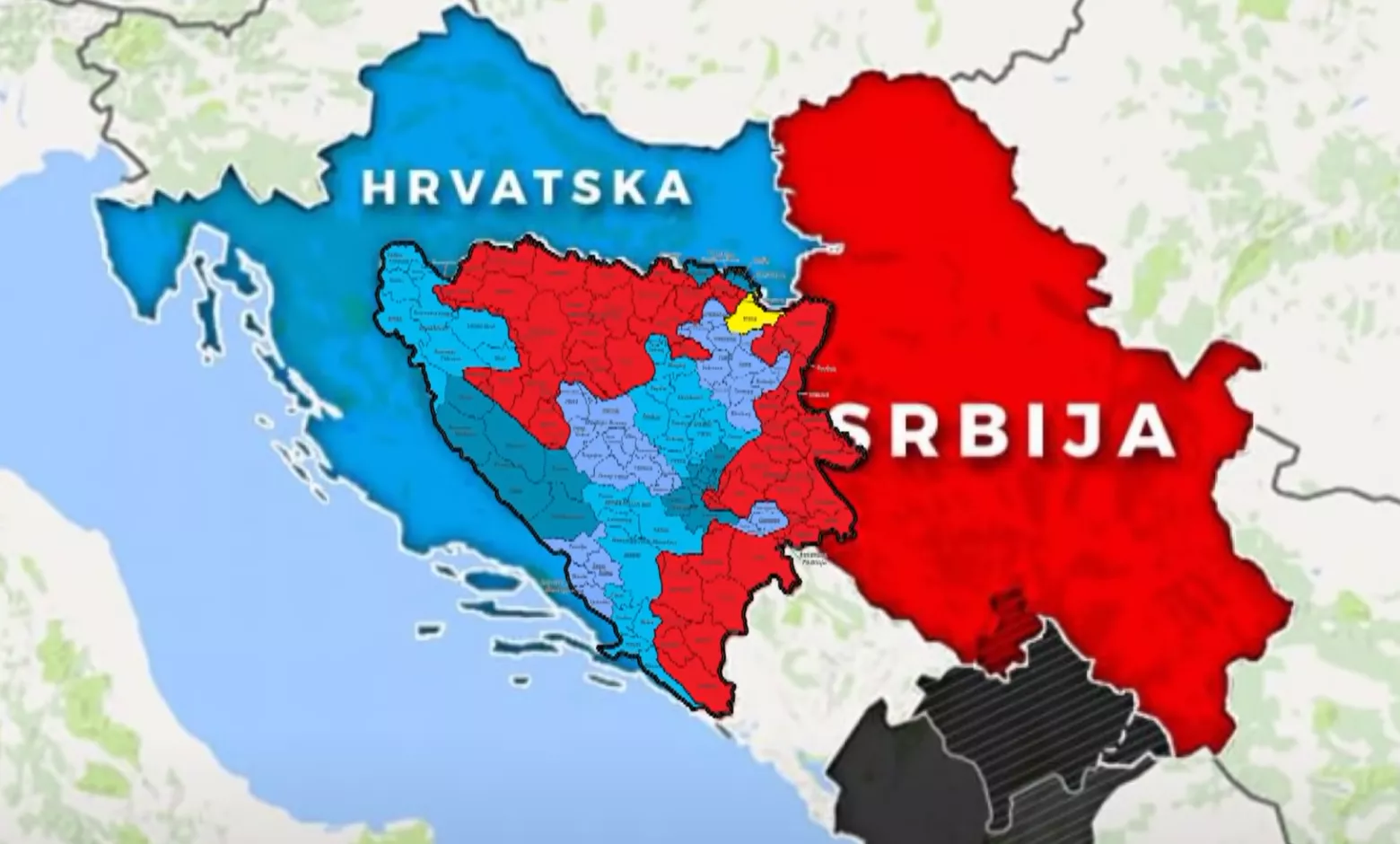
Bosnia and Herzegovina, a country that for centuries was a crossroads of civilizations and cultures, is today at a turning point of political and moral identity. Consociational models of government, which are being imposed here as a solution for "peaceful coexistence," in reality represent the institutionalization of the consequences of aggression, joint criminal enterprise (JCE), and genocide.
Instead of seeking solutions in line with European standards and values, based on the verdicts of international and domestic courts, UN resolutions, the European Parliament, and numerous other documents about Bosnia and Herzegovina, our country is being forced into a yoke that will lead to its ultimate ruin in the next few decades. The facade is reformist, while the essence is the legalization of ethno-political conquests and the ethno-territorial demarcation of three small states in a loose alliance.
The first step towards understanding this phenomenon is to look at the very nature of consociationalism. Consociationalism in theory promotes proportional representation of political groups, which in our reality is presented as equal distribution of political power (power sharing) among ethnic communities/groups, thereby directly undermining democracy and rendering all elections meaningless. Consociationalism is not democracy, but its deviation, and that is why it has been rejected. Through the Dayton Peace Agreement, a status quo was introduced in Bosnia and Herzegovina that greatly favors proponents of consociationalism or secession.
Therefore, the Dayton Agreement is not and will never be fully implemented, because its application is deeply contaminated by compromise with ethnic cleansing and territorial divisions. Instead of being a temporary solution leading to an organized state, the Dayton construct has become a (long-term) framework that legalizes the facts on the ground produced by aggression.
In this context, ethno-territorial demarcation within Bosnia and Herzegovina becomes a key instrument of political manipulation. The borders of entities and cantons, as well as decision-making mechanisms, directly reflect the outcome of armed aggression, genocide, and JCE. Republika Srpska and the Federation of BiH, as administrative entities, are not just administrative units – they are institutionalized traces of ethnic cleansing and genocidal policies.
By legalizing these borders through a consociational system of government, with the additional division of the FBiH planned to begin with a fabricated Election Law, the international community and domestic political actors simultaneously confirm and legitimize the injustice committed during the war.
JCE, or joint criminal enterprise, is not just a legal term from the verdicts of the Hague Tribunal; it is also a kind of empirical framework for understanding the policy of ethnic demarcation. Consociationalism in BiH, through the blockade of central institutions and the prioritization of ethnic interests over civic ones, implicitly confirms the results of JCE – territorial division, segregation, and permanent institutional discrimination. More precisely, three ethno-homogeneous and ethnically clean units. In this way, democratic principles become secondary, and ethnic engineering becomes the primary goal of the political system.
One of the most dramatic aspects of such an arrangement is the disregard for justice for victims of genocide and other war crimes. Srebrenica, Prijedor, Foča, Mostar, Vitez, and many other cities are symbols of suffering, but also places whose ethnic reshaping is becoming the normative framework for political reality. Consociationalism not only fails to enable reparation or reintegration of affected communities but, through institutional ethnic division, perpetuates violence in a symbolic and practical sense.
Justice for victims, if not integrated into the political framework, becomes mere rhetoric, while consociationalism becomes a mechanism by which forcibly acquired territorial advantages are cemented into law.
The political discourse in BiH is often based on "ethnic exclusivity," while citizens' rights are treated as secondary. This rhetoric hides systemic inequality; ethnicity becomes the dominant criterion for political participation, while the territorial consequences of aggression are legitimized through administrative units that reflect ethnic homogenization. Particularly, at least currently, in the entity of RS, a large part of which has been ethnically homogenized after the ethnic cleansing of the non-Serb population.
International actors, from the United Nations to the European Union, often emphasize stability as a priority. However, stability built on compromise with crime and ethnic engineering is not sustainable; rather, it latently suppresses social tensions. This advocacy and emphasis on stability at the expense of democracy and human rights is nothing but a mask for a transitional phase, after which the ethno-territorial demarcation, with the legal framework of consociationalism, is now clearly being prepared.
The epilogue of the Kovačević v. Bosnia and Herzegovina case perhaps best revealed the intentions of European, British, and American diplomats and strategists to dismantle Bosnia and Herzegovina through consociationalism. Because, if Kovačević's appeal is ultimately accepted and the first-instance verdict confirmed, it will fundamentally shatter the application of consociationalism in Bosnia and Herzegovina. Therefore, the reasons why the operational conclusions, rather than the final verdict, produced more questions than answers, and also showed that the ECtHR is not immune to political manipulation of justice, should be sought in that orbit of possibilities.
The European Court of Human Rights is a Court of the Council of Europe, and it is linked to the EU through Articles 6.2 and 6.3 of the Treaty of Lisbon on the European Union, which state that the European Convention on Human Rights (and thus the European Court of Human Rights) is part of the European legal acquis.
For Bosnia and Herzegovina to break out of this vicious circle, it is necessary to redefine the approach to resolving the final model of Bosnia and Herzegovina's organization. At least on the side that declaratively advocates for a unified European BiH, although it has not yet defined how to achieve it. And the definition could go in the direction of re-examining and abolishing ethnic blockades in parliaments, strengthening civic rights, and de-legitimizing the territorial consequences of aggression, genocide, and JCE. Ethno-territorial demarcation must not become the norm; it must be treated as a historical fact that democratic processes can and must overcome. Only such an approach can enable the transition from the legalization of crime to social and political justice and a system based on such norms.
The conclusion is clear, though painfully simple: consociationalism in its essential form is not a model of peace, but a model of institutionalized violence. It is, in the most direct sense, the legalization of the consequences of aggression, joint criminal enterprise, and genocide.
The ethno-territorial demarcation, perpetuated through this model, threatens not only the integrity of the state but also the moral foundation of a society that aspires to be integrated into alliances based on completely different principles. The transformation of the Dayton model of Bosnia and Herzegovina towards a centralized and democratic state remains the key greatest challenge for Bosnia and Herzegovina, primarily for those structures that advocate for its sovereignty and integrity. In opposition to this is the attempt to impose a consociational arrangement.
If this challenge is not recognized and addressed, the state will remain trapped in a structure created by violence, and future generations will be deprived of the chance to build a society that acknowledges and rectifies injustice.
Consociationalism, therefore, must be viewed as a mirror of the effects of crime, which is unacceptable in the definition of the problem and a cause for alarm, because the final epilogue is the disintegration of Bosnia and Herzegovina.
Komentari (0)
Prijavite se za komentiranje
PrijavaJos nema komentara. Budite prvi!
Minuta
Sve →Iz drugih kategorija

High Representative Not Elected: Germans, French and British Sabotaged Americans, New Attempt at End of June

ČOVIĆ WITHOUT MERCY: How Those Who Brought Ademović to Office Created a Political Hell for Him



Sunny Saturday, quite warm



Tragedy in Albanian resort: Two minors drown












