
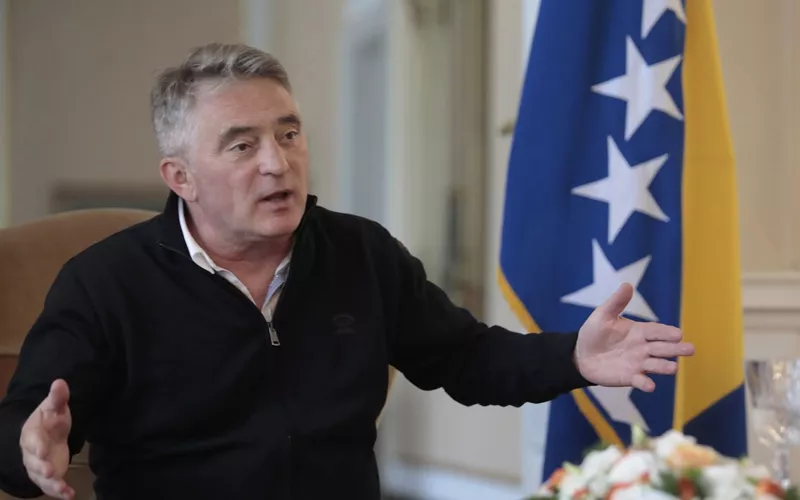
(Patria) - The Chairman of the Presidency of Bosnia and Herzegovina speaks to the Serbian daily Danas about relations with Serbia and Croatia, the role of Milorad Dodik and Andrej Plenković, the idea of a civic state, Dayton, elections in the RS, and pressures on Bosnia and Herzegovina.
“We do not wish for any destabilization of Serbia, let alone an escalation of violence that threatened or may still threaten given the current political relations in Serbia, because that would only mean additional destabilization of the region,” says Željko Komšić, Chairman of the Presidency of Bosnia and Herzegovina, in an interview with Danas.
He adds that Bosnia and Herzegovina wants normal neighborly relations and cooperation with Serbia, especially economic cooperation, where “both countries have their own concrete, but also common interests.”
At the same time, he points out that Milorad Dodik is, as he says, “the most important man of Zagreb in Bosnia and Herzegovina,” and that the cooperation between Andrej Plenković and Dodik is long and intensive and “to the detriment of Bosnia and Herzegovina, and if you will, to the detriment of a part of the Serb people in Bosnia and Herzegovina.”
Speaking about a possible rift in the Dodik–Vučić relationship, Komšić is explicit: “It is known who is senior in that relationship, regardless of how much it is respected, because it is truly a question of strength, and Vučić is stronger there.”
Asked whether official Belgrade and Zagreb care about good relations with Bosnia and Herzegovina, Komšić says that “a cynic would say that Belgrade is now more concerned with itself, so it has no time to deal with Bosnia and Herzegovina.”
“Jokes aside, in the last ten years, relations between Sarajevo and Belgrade have functioned on a hot-cold principle. There have been tensions, but never through the fault of the Bosnian side, because we are not to blame for Serbia harboring a number of convicted war criminals who fled Bosnia and Herzegovina to avoid serving their sentences,” emphasizes Komšić.
He adds that there have been certain gestures that inspired hope for improved relations, but that they ultimately remained just – gestures.
When it comes to relations between Sarajevo and Zagreb, Komšić states that they are significantly more complex and have seriously cooled in the last ten years, starting with, as he says, unfounded accusations by the former President of Croatia and their security agencies.
“There is also the dimension of the imposed government in the Federation of BiH, which was imposed by the High Representative at the mercy of Andrej Plenković. That government has no legitimacy from the citizens because it did not win power in elections but by suspending the FBiH Constitution. The citizens will pass judgment on that in the 2026 elections,” Komšić says, adding that the current line of the Troika towards Zagreb is “beneath all dignity.”
Speaking about the constant threats by Milorad Dodik to secede the RS and the ideas of Dragan Čović about a “third entity,” Komšić says that “everyone is fed up with these threats, which impress no one.”
“Bosnian Serbs and Croats would not have such a good political status in any other country except in this and such a Bosnia and Herzegovina, where they are still masters of their own. What is problematic is the constant intention of nationalist policies to, despite this, tear this country apart and put it under the control of neighboring countries,” warns Komšić.
Commenting on the cooperation between Plenković and Dodik, Komšić says that both are “almost equally unacceptable” to him because he would never subordinate the interests of Bosnia and Herzegovina to those of Zagreb.
“That cooperation is to the detriment of Bosnia and Herzegovina, but also of a part of the Serb people in BiH, especially those who want cooperation with Sarajevo. Dodik is extremely bothered by the good cooperation between the citizens of East Sarajevo and Sarajevo, because he constantly wants to produce conflict, but he has not succeeded in that recently,” emphasizes Komšić.
He adds that Dodik and the HDZ, as he says, see danger in the normalization of relations between Serbs and Bosniaks.
“Milorad Dodik is the most important man of Zagreb in Bosnia and Herzegovina, incomparably more important even than Dragan Čović,” concludes Komšić.
He used his recent address at Oxford to emphasize that “a state is as strong as its security and defense capacities.”
“Bosnia and Herzegovina today is not as strong as I would like, but it is strong enough. We have the capacities to defend ourselves. I remind you that the Republic of BiH defended itself in 1992 without an army, and today we have incomparably more resources,” says Komšić.
Asked about a possible “Dayton 2,” Komšić answers briefly and clearly: “There will be no Dayton 2. The United States of America stands behind the Dayton Peace Agreement and does not want its dismantling due to the partial dissatisfaction of one policy.”
Commenting on the repetition of elections at some polling stations in the RS, Komšić emphasizes that irregularities were obviously present, but that a proper judgment can only be made after the repeated voting.
“It can already be concluded that there is a serious polarization of the political will of the citizens, which was not the case before,” he says.
Speaking about the candidacy of Slaven Kovačević and the attacks coming from both the HDZ and the Troika, Komšić says that they are not afraid of him or Kovačević, but rather – of the concept of a civic state.
“They are afraid that the concept of a civic state will stand in the way of Greater Croatian pretensions, according to which Zagreb governs not only the Federation of BiH but the entire Bosnia and Herzegovina, through Dodik and the HDZ,” concludes Komšić.
Finally, speaking about the position of Serbia and Aleksandar Vučić, Komšić emphasizes that Bosnia and Herzegovina does not want the destabilization of its neighbor.
“That is an internal matter of the Republic of Serbia. It is up to us to respect the citizens of Serbia and their democratically elected representatives, just as we expect Bosnia and Herzegovina to be respected. What we want are normal neighborly relations and cooperation, regardless of who is in power in Serbia today or tomorrow,” says Željko Komšić.
Komentari (0)
Prijavite se za komentiranje
PrijavaJos nema komentara. Budite prvi!
Minuta
Sve →Iz drugih kategorija

High Representative Not Elected: Germans, French and British Sabotaged Americans, New Attempt at End of June

ČOVIĆ WITHOUT MERCY: How Those Who Brought Ademović to Office Created a Political Hell for Him



Sunny Saturday, quite warm



Tragedy in Albanian resort: Two minors drown












