

(Patria) - Member of the Presidency of BiH Željko Komšić, in his capacity as the applicant for the Venice Commission's Opinion on European practice regarding the election of judges to constitutional courts, addressed the 139th Plenary Session of the Venice Commission today.
The reasons for his address, in which he explained the elements of his request, relate to the imprecise provisions of the Constitution of Bosnia and Herzegovina concerning the minimum qualifications for the election of judges to the Constitutional Court of Bosnia and Herzegovina, requesting that the Venice Commission's Opinion highlight the prevailing practice in European countries when electing judges to constitutional courts, so that such practice can also be used in Bosnia and Herzegovina.
It was emphasized that the Constitution of Bosnia and Herzegovina, as Annex IV of the Dayton Peace Agreement, was written in the terminology of Anglo-Saxon law, which opens the door for frequent arbitrary and unfounded interpretations of the Constitution itself.
In addition, it was specifically requested that the Venice Commission clearly state in its recommendations whether it is possible to use ethnic affiliation when filling the Constitutional Court of Bosnia and Herzegovina in a way that is done through parity-based ethnic selection of judges.
It was also proposed, during the presentation and discussion, that the Venice Commission, in its Opinion, i.e., recommendations and conclusion, express its stance on whether the decision-making system in the Constitutional Court of Bosnia and Herzegovina can be ethnically and territorially (entity-based) founded.
Read Komšić's full address at the Plenary Session of the Venice Commission below.
"With gratitude for all the efforts of the Venice Commission in preparing a very good draft Opinion of the Venice Commission, which will be of great help in all endeavors to raise the quality of the Constitutional Court of Bosnia and Herzegovina to the highest possible level, allow me on this occasion to highlight several important issues that were the fundamental inspiration for sending the request to the Venice Commission.
At the beginning, allow me, before stating the reasons for my request for the Venice Commission's Opinion, to emphasize the fact that the Constitution of Bosnia and Herzegovina, as Annex 4 of the Dayton Peace Agreement, was written in the terminology of Anglo-Saxon law, which in the domestic legal environment, where only continental law and its terminology exist, causes a series of bad and arbitrary interpretations.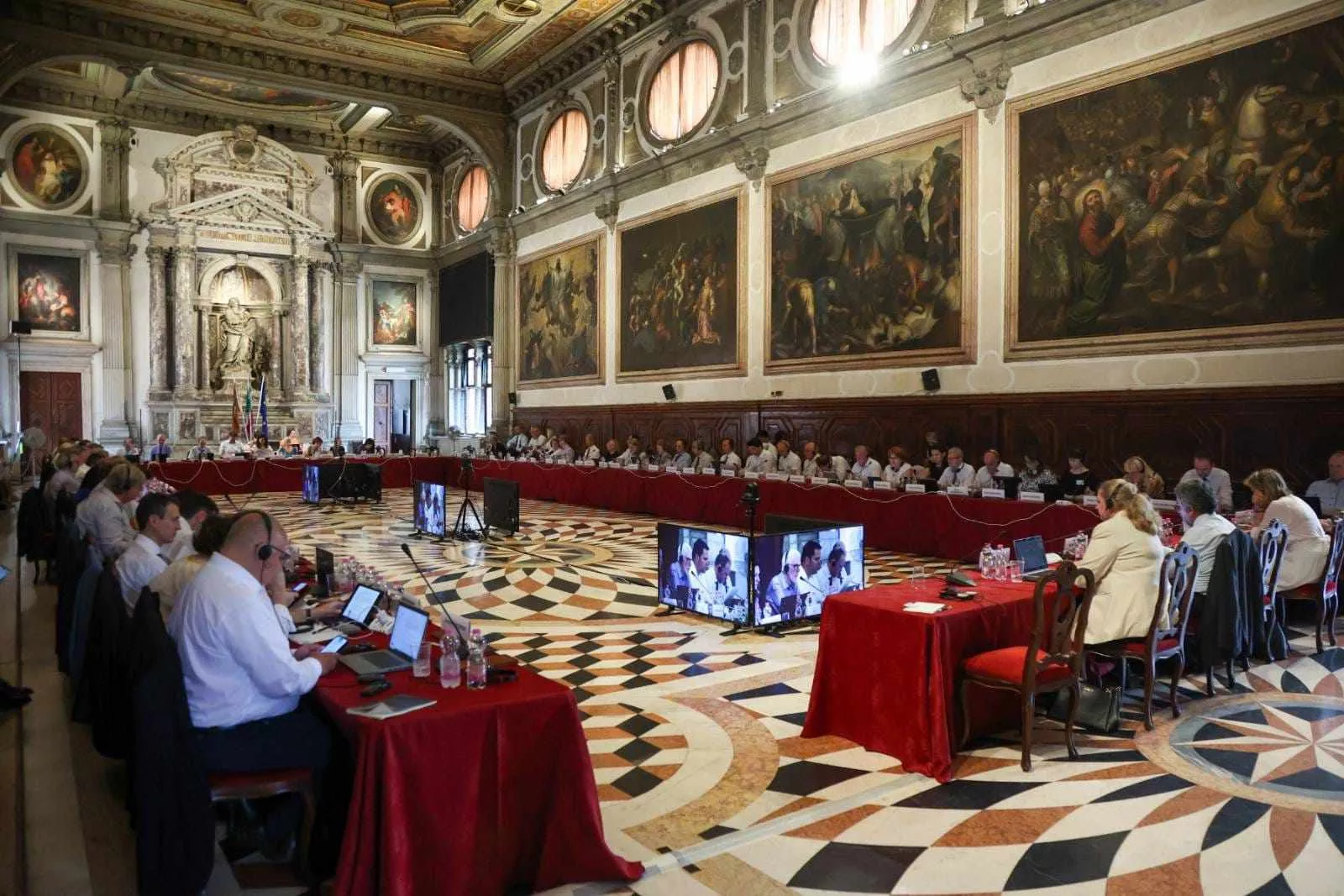
It is very difficult to implement a document written in Anglo-Saxon terms in a continental law environment, so a whole series of terms are misinterpreted based on different perceptions.
Our intention is to use exclusively terms and methods of implementation of continental law, which will be possible only when we reform the Constitution of Bosnia and Herzegovina to such an extent that it is written and adapted to continental law. Allow me, now, to briefly explain the reasons for submitting my request for the Venice Commission's Opinion.
The first reason, certainly, lies in the relatively imprecise provisions of the Constitution of Bosnia and Herzegovina that establish the minimum criteria for the election of judges to the Constitutional Court of Bosnia and Herzegovina, which, unfortunately, in previous cases has been abused to such an extent that persons without any judicial experience have been elected.
We are fully aware that there is different practice in Europe for electing judges to constitutional courts, but that there is still something we can call a prevailing practice or a practice present in the majority of European countries.
We are certainly aware that there are such specific cases in certain countries where it is possible to elect individuals as judges of constitutional courts who are not lawyers at all, but we also believe that this is not an appropriate practice that can be applied in Bosnia and Herzegovina.
It is necessary to emphasize that Bosnia and Herzegovina has a fragile democracy which, due to ethnic-based policies, is not complete nor fully established, where in such cases the Constitutional Court of Bosnia and Herzegovina should be the final judicial instance which, in addition to legal issues, should also protect democracy in Bosnia and Herzegovina.
In the previous practice of decision-making by the Constitutional Court of Bosnia and Herzegovina, in which persons elected as judges but without any judicial experience participated, decisions were made that caused significant tensions and resulted in long-term political and legal problems in Bosnia and Herzegovina.
These were most often decisions concerning the electoral system in Bosnia and Herzegovina, in which the Constitutional Court of Bosnia and Herzegovina made very strange decisions, which even contained arguments for ethnic divisions in the country that reinforced discrimination. Allow me to specifically emphasize that such a practice is unacceptable.
In addition, Bosnia and Herzegovina does not have a Supreme Court as the final judicial instance in two-tiered proceedings, so the Constitutional Court of Bosnia and Herzegovina has acted as the final judicial instance in certain cases. For such a thing to be founded, it is certainly necessary that judges elected to the Constitutional Court of Bosnia and Herzegovina have judicial or sufficiently long professional experience, so that they are able to perform the job in such a court which represents the final judicial instance.
For now, in the composition of the Constitutional Court of Bosnia and Herzegovina, among the elected domestic judges, we do not have such a practice, because candidates without any judicial experience or sufficiently long professional experience related to judicial bodies have most often been elected to the Constitutional Court of Bosnia and Herzegovina. This certainly undermines the quality of the Constitutional Court of Bosnia and Herzegovina itself and ultimately results in insufficient legal certainty for the citizens of Bosnia and Herzegovina.
It is particularly worrying that the Constitutional Court of Bosnia and Herzegovina, in terms of human rights protection, has taken over the powers of the European Court of Human Rights in such a way that it has visibly strived to create new practice for the European Court through its decisions, instead of using the case law of the European Court of Human Rights in its decision-making, which is its constitutional obligation.
The reason for this is again the insufficient quality, potential, and knowledge of the elected judges, due to the insufficiently precise criteria for the election of judges of the Constitutional Court of Bosnia and Herzegovina established by the Constitution of Bosnia and Herzegovina.
The second important issue relates to the ethnic system of electing judges to the Constitutional Court of Bosnia and Herzegovina. Of course, I am aware that the Constitution of Bosnia and Herzegovina does not establish ethnic criteria for the election of judges to the Constitutional Court of Bosnia and Herzegovina, but on the other hand, a practice has been established whereby for 6 domestic judges, in all elections, we have 2 ethnic Bosniaks, 2 ethnic Croats, and 2 ethnic Serbs.
This is a practice that comes from ethnic policies and ethnically based parties, which is absolutely unacceptable. This way of election based on ethnic parity is one of the additional reasons that undermine the quality of the Constitutional Court of Bosnia and Herzegovina.
On this occasion, I will remind you of the position of the Parliamentary Assembly of the Council of Europe from October 2002, which unequivocally stated that Bosnia and Herzegovina, within its obligations arising from membership in the Council of Europe, 'must abandon the ethnic system of representation and move to a civic system of representation'. This is an obligation of my country, and it must be fulfilled.
Finally, I want to specifically highlight the third problem that we have included in our suggestions or a minor amendment to the draft Opinion of the Venice Commission, and which we insist should be included in paragraph 35 or 36 because we consider it enormously important. This problem lies in the intention of domestic political actors to change the decision-making system of the Constitutional Court of Bosnia and Herzegovina in such a way that it is ethnically and territorially (entity-based) founded.
You will agree with me that such a thing is completely unacceptable. Therefore, we have made a small amendment to the draft Opinion of the Venice Commission, which we believe can be incorporated into paragraph 35 or paragraph 36 and which reads:
'Given that ethnic quotas or ethnic criteria for the election of judges to the Constitutional Court of Bosnia and Herzegovina represent an expression of discrimination, the Venice Commission also considers that in the decision-making system of the Constitutional Court of Bosnia and Herzegovina, neither an ethnic decision-making system nor a territorial, i.e., entity-based decision-making system can be applied.
The Constitutional Court of Bosnia and Herzegovina, as a judicial body with specific competencies that makes decisions concerning all citizens of Bosnia and Herzegovina, should make its decisions by a simple majority of the total number of judges of the Constitutional Court of Bosnia and Herzegovina. An ethnic and territorial (entity-based) decision-making system would be unacceptable.'
I believe that this amendment can be very significant and useful, and allow me to insist that it be included in the final Opinion of the Venice Commission, according to my request of March 15, 2024.
I want to once again express my deep respect for the Venice Commission, which, with its opinions, has greatly helped in correcting various legal irregularities in Bosnia and Herzegovina. Should you have any further questions, I am at your disposal," Komšić stated.
Komentari (0)
Prijavite se za komentiranje
PrijavaJos nema komentara. Budite prvi!
Minuta
Sve →Iz drugih kategorija

High Representative Not Elected: Germans, French and British Sabotaged Americans, New Attempt at End of June

ČOVIĆ WITHOUT MERCY: How Those Who Brought Ademović to Office Created a Political Hell for Him



Sunny Saturday, quite warm



Tragedy in Albanian resort: Two minors drown












