
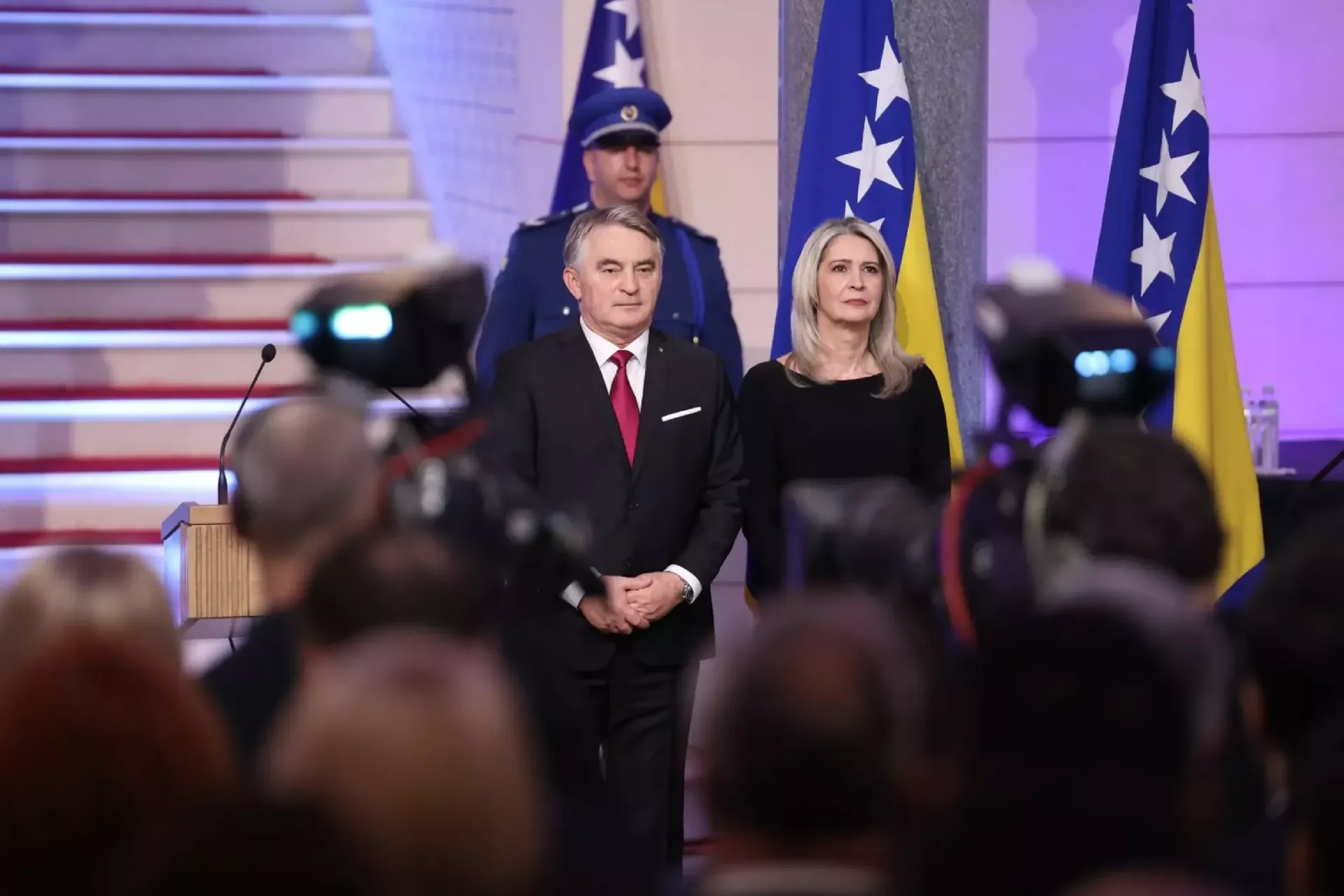
(Patria) - Chairman and member of the BiH Presidency, Željko Komšić and Denis Bećirović, hosted a formal reception at the Sarajevo City Hall tonight on the occasion of Bosnia and Herzegovina's Statehood Day.
Addressing the attendees, Komšić stated that November 25th this year, just like in previous years, is being marked as the day of the restoration of Bosnian-Herzegovinian statehood. The context in which the restoration of statehood was achieved, he added, was undoubtedly both military and political.
- For decades before the restoration of statehood, Bosnia and Herzegovina, its citizens, and peoples were in a subordinate position compared to neighboring countries, all due to the nature of the constitutional and legal order of the states of which it was a part - Komšić said.
The ideas of its division, as he stated, were not only alive but were also realized on the ground and in daily political reality.
- The emergence of the National Liberation Movement in the history of Bosnia and Herzegovina was a salvation for our country, but also for the generation of people at the time who actively opposed the division and disappearance of Bosnia and Herzegovina.
Therefore, it is quite clear why forces and individuals with different ideological and political views were part of the National Liberation Movement. Regardless of their differences, they found fundamental consensus and motivation for struggle in preserving Bosnia and Herzegovina as a unified state - Komšić emphasized.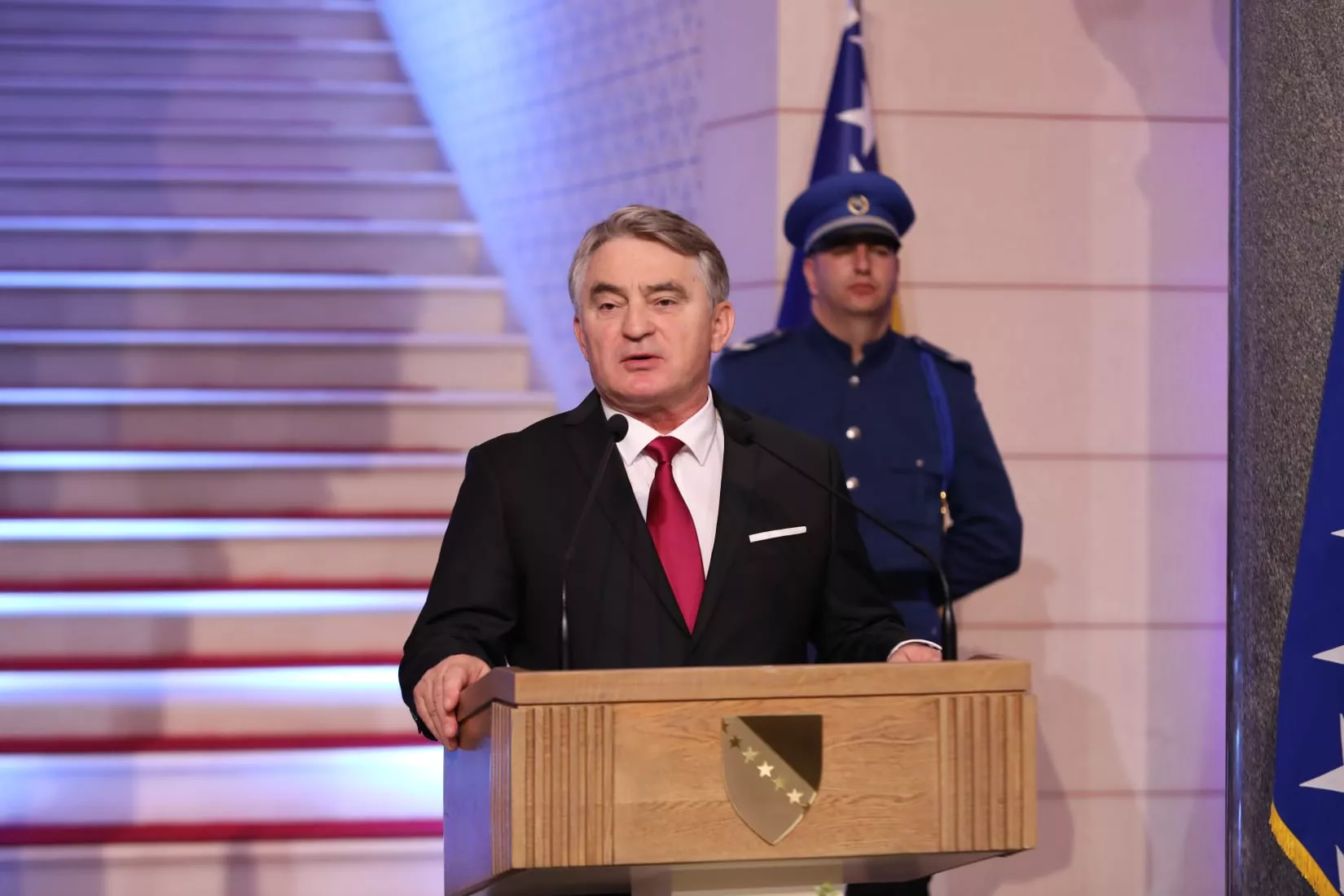
Members of the Movement for Autonomy embodied in the Yugoslav Muslim Organization, members of the Croatian Peasant Party, and members of Serbian civic parties were all part of the NOP, but the most organized political force was the Communist Party of Yugoslavia and its provincial committee for Bosnia and Herzegovina, pointed out the Chairman of the BiH Presidency.
All of them together, he stressed, created the necessary social context for the restoration of statehood through their struggle in the National Liberation Movement.
- It is historical truth that not everyone in the Communist Party was in favor of defining Bosnia and Herzegovina as a unified and indivisible Republic, but thanks to the diverse spectrum of political actors, and most importantly thanks to the patriotism of the generation of Bosnian-Herzegovinian communists, the position on the necessity of forming Bosnia and Herzegovina as a Republic prevailed at the top of the party and the movement - said Komšić.
However, he notes, nuances in opinions and approaches were not the decisive reason for such a decision. That decision was the result of the struggle of the people of this country, a struggle whose significance no one could deny, because a people who rose up in arms cannot be denied or ignored.
- Nuances, as I said, were not decisive in the decision to form the Republic, but they were decisive in characterizing and defining what that republic is. All sessions of ZAVNOBiH actually represent a whole, i.e., the unity of the process of restoring statehood.
However, the first session of ZAVNOBiH in Mrkonjić Grad emphasizes the equality of all peoples, while the second session of ZAVNOBiH in Sanski Most, through the Declaration on the Rights of Citizens, emphasizes the equality of citizens.
These two sessions of ZAVNOBiH are historical proof that the concepts of equality of peoples and equality of citizens do not exclude each other. ZAVNOBiH is historical proof that they complement each other - Komšić assesses.
Although it may sound a bit strange, he continued, the Dayton Peace Agreement itself and the Constitution of Bosnia and Herzegovina confirmed some of the fundamental principles recorded during the First and Second Sessions of ZAVNOBiH, through the expressed elements of both ethnic and civic character of our Constitution.
- Both the restoration of statehood in 1943 and the Referendum on the independence of Bosnia and Herzegovina and the Dayton Peace Agreement, in continuity, carry the same or similar constitutional principles. Both the civic and ethnic components have always been present through all our constitutional arrangements, but it is also a fact that there has almost always been a competition between these two concepts.
Those who today emphasize only one component, the ethnic one, using only what was emphasized in the First Session of ZAVNOBiH and neglecting the Second, are trying to impose some consociational arrangements, and they are nothing more than ordinary falsifiers of both ZAVNOBiH and Dayton.
Because, if the existence of broad powers of the houses of peoples is an expression of the ethnic component of the Constitution, then the election of the sovereign, the method of electing judges of the Constitutional Court, and the method of electing members of the House of Representatives are a concrete expression of the civic component of the Constitution.
There is, of course, also that somewhat abstract dimension of the civic character of the Constitution, according to which the Dayton Constitution stipulated that the European Convention on Human Rights takes precedence over the Constitution of Bosnia and Herzegovina. The values of this convention fully correspond to the values from the Declaration on the Rights of Citizens from the Second Session of ZAVNOBiH.
Therefore, no three different entities will be created here today, nor tomorrow, nor will consociational euphemisms help in that. They will not, because it is contrary to everything that Bosnia and Herzegovina is, and what is written in the declarations of ZAVNOBiH and in the provisions of the General Framework Agreement for Peace in Bosnia and Herzegovina - Komšić is clear.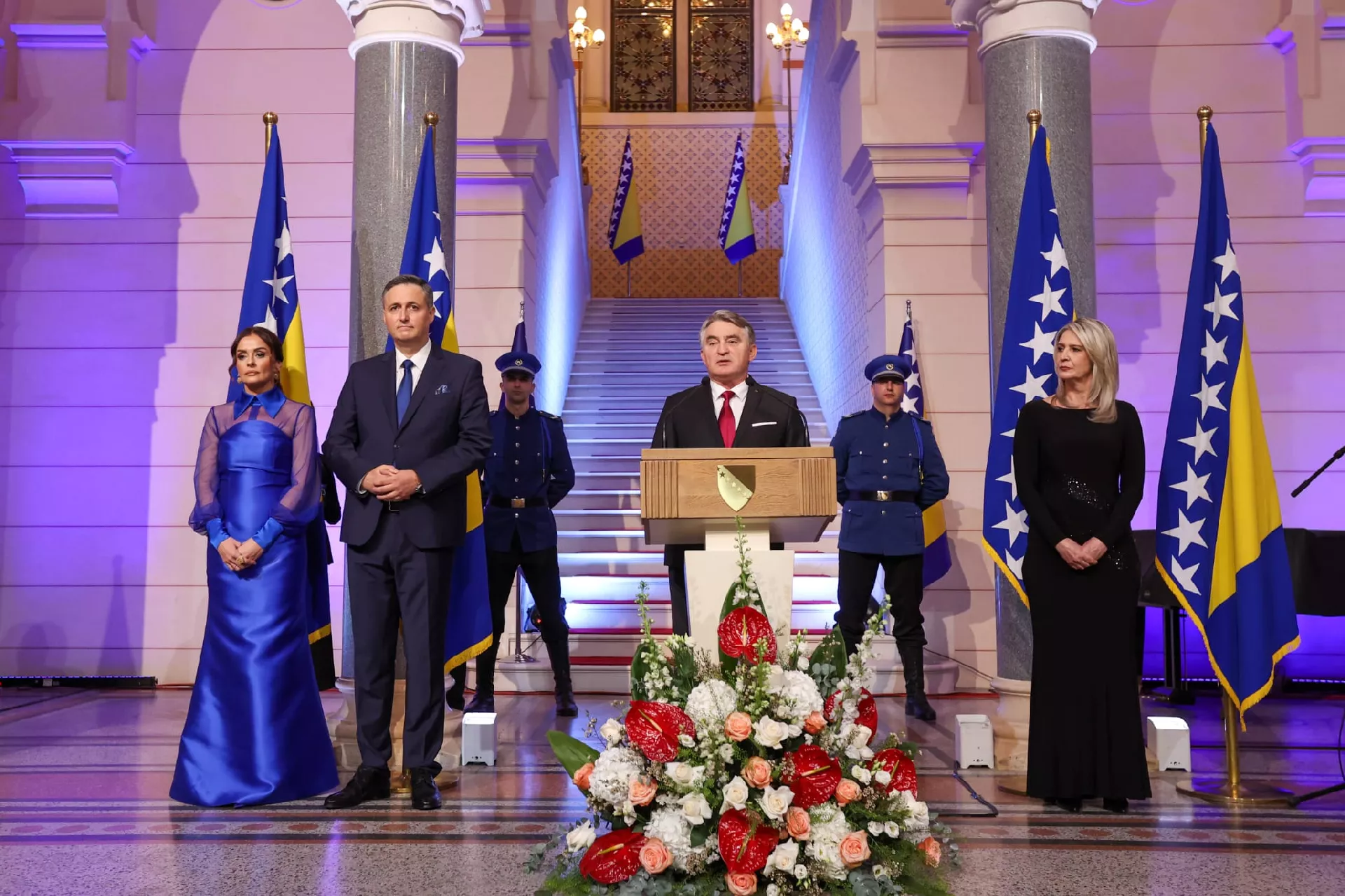
He also states that attempts to consociationally regress Bosnia and Herzegovina through further ethnic or territorialization of the electoral model on an ethnic principle are breaking against the values of ZAVNOBiH and the principles of Dayton.
- Therefore, Bosnia and Herzegovina has two paths ahead. The path of achieved values and rights for which we fought for decades from ZAVNOBiH to Dayton, and the path of democratic superstructure of achieved rights, the path of a civic state prescribed by our Constitution and general democratic values.
Two brilliant generations of Bosnian-Herzegovinian people fought for the state we have. It is, of course, not ideal, but it is ours, and the sacrifice made for it obliges us to respect and love it.
I am convinced that the generation that comes after us has the strength to preserve all that is valuable and to make this country better. The prerequisite for this is that we appreciate what we have, for which the generations before us fought, giving their lives.
There have been many difficult and somber moments in the history of our country when it seemed that all was lost, but strength was always found to move forward. Let's remain faithful to this country and believe in it as all Bosnian-Herzegovinian patriots did before us.
When almost no one in the world, except a few friends, believed in the survival of this state, we believed and fought. Let's remain as we were when it was hardest, because then we were invincible.
Allow me, and please don't mind, to use this opportunity at the end to congratulate our footballers, who recently showed faith in their homeland and the will to fight for it in the best way, on their fight, and to congratulate them on Statehood Day with a message of encouragement.
Of course, I congratulate all of you present here and all citizens on Bosnia and Herzegovina's Statehood Day - concluded Željko Komšić his address.
Komentari (0)
Prijavite se za komentiranje
PrijavaJos nema komentara. Budite prvi!
Minuta
Sve →Iz drugih kategorija

High Representative Not Elected: Germans, French and British Sabotaged Americans, New Attempt at End of June

ČOVIĆ WITHOUT MERCY: How Those Who Brought Ademović to Office Created a Political Hell for Him



Sunny Saturday, quite warm



Tragedy in Albanian resort: Two minors drown












