
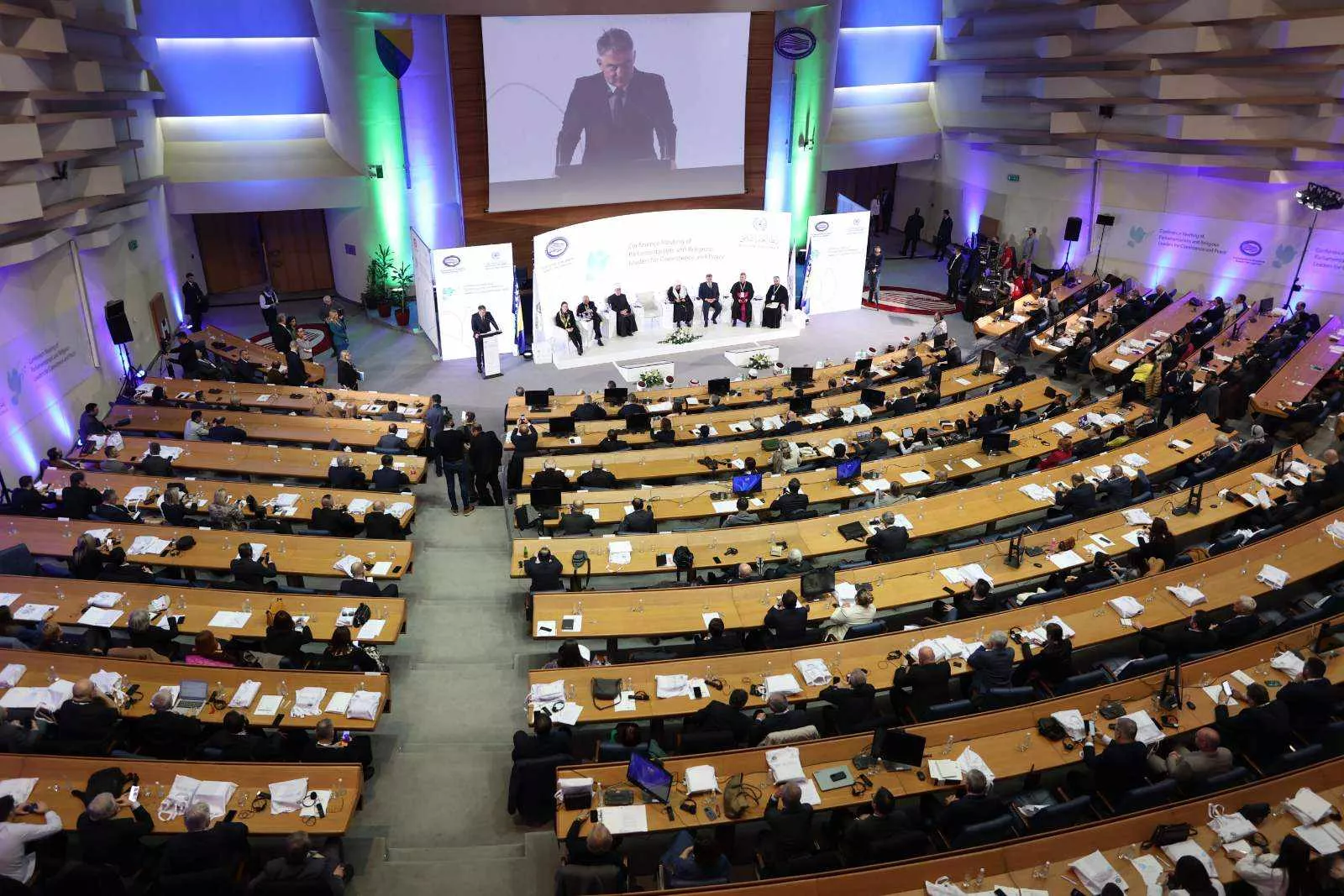
(Patria) - Chairman of the BiH Presidency Željko Komšić addressed the international conference "Members of Parliaments and Religious Leaders for Peace and Coexistence", held at the Parliamentary Assembly of BiH. We are publishing his speech in its entirety.
"I am pleased to have the opportunity to open today's international conference "Members of Parliaments and Religious Leaders for Peace and Coexistence", to discuss the topic of peace and life (I prefer this word and term over "coexistence") here at the Parliamentary Assembly of Bosnia and Herzegovina, especially since I believe that we in Bosnia and Herzegovina have something to say on this topic, regardless of how anyone views it.
The issue of life and peace, or life in peace, is still relevant today, and it was the main question that we as a society faced after the signing of the Dayton Peace Agreement in November 1995.
Given that it was also a peace agreement, the maintenance of the entire constitutional and social structure within Bosnia and Herzegovina, established through difficult compromises, depended on the state of peace.
Peace was therefore at the center of our general, or rather, common interest after the aggression and bloody war. Numerous security and other challenges, including tensions in this post-Dayton period of Bosnia and Herzegovina's history, could not overcome the basic civic need for peace and stability.
That basic civic need for peace has achieved a kind of victory in Bosnian society and enabled, at least partial, social integration, not only institutionally but also economically, culturally, and in sports.
Although Bosnia and Herzegovina remained administratively divided into entities, cantons, and a district, the movement of people, goods, and capital could not be stopped, just as numerous other encounters in various social disciplines could not be stopped. Peace gained meaning every day, and it became increasingly clear that it was the greatest value of a political agreement with which, let's be honest, no one was satisfied.
Of course, we can thank ourselves as citizens for peace, and we can also thank our friends from the international community who, hand on heart, have made a solid contribution to its maintenance.
All of this, in almost three decades of post-Dayton history, has created prerequisites for a stable life in peace in Bosnia and Herzegovina, which I am convinced can turn into lasting peace if Bosnia and Herzegovina is not threatened from the outside, as has been the case so far. The prospect of lasting peace in Bosnia and Herzegovina depends solely on this, because unrest and conflicts in Bosnia and Herzegovina did not arise on their own, but were always and as a rule initiated and brought from outside.
The state of life in peace in Bosnia and Herzegovina is most visible right here in the capital of Bosnia and Herzegovina, in Sarajevo. Although it has not yet healed all its wounds, and it is questionable whether that is even possible, the fact is that Sarajevo can be considered one of the freest and most liberal cities, not only in Bosnia and Herzegovina but in the entire Western Balkans.
By its character and nature, Sarajevo has always been like that! In Sarajevo, it is considered quite normal, almost natural, for people from all over Bosnia and Herzegovina, people of all ethnic and religious identities, to live, work, cooperate, socialize, and even more, in it. That is simply our way of life, and we see normality in it, not some spectacular fact or something new.
No matter how much some political actors try to emphasize the existence of administrative lines, practical life testifies that people rely on each other in their daily activities. This best speaks in favor of a, nevertheless, pleasant and peaceful life. If nothing else, proof of this is the thousands of people from all over Bosnia and Herzegovina who come to work in Sarajevo every day and work in peace and harmony with their colleagues, just as many people who go from Sarajevo to other parts of Bosnia and Herzegovina are proof of this.
The image of life and the prospect of lasting peace can be particularly strengthened by religious communities and their leaders. I say this for a reason that is well known to all of us, whether some want to admit it or not, the role of religious communities and religious leaders in our country is still the role of spiritual, but also generally moral authorities for a good part of Bosnians and Herzegovinians. This makes the role more important, but also the responsibility greater!
I wish we had more opportunities to hear religious officials speak about peace, life in peace, and cooperation, as actor Aleksandar Stojković did when responding to accusations regarding the Sarajevo War Theatre's performance in Banja Luka.
I will conclude my address with his words because, without being pretentious and declaring them important for everyone, they are for me some of the most important thoughts expressed after the war in Bosnia and Herzegovina.
I quote:
"Do you think that I, Aleksandar Stojković, a soldier of the Army of Republika Srpska and a war disabled veteran, should be banned from participating in any festival in the Federation of Bosnia and Herzegovina because I was a member of the Army of Republika Srpska, lost my best friends and my hometown, lost my best youth... should I justify myself to anyone because we invited our colleagues to come and perform here, 30 years after the war. Two governments, the Government of the Federation of Bosnia and Herzegovina and the Government of Republika Srpska, met the other day, did anyone ask them? Maybe there is a Golden Lily there, maybe there is someone who wounded me in 1992, so what? Should I live in that world? Should I tell my Marko, don't you dare cross into Sanski Most, should I do that?", Komšić stated.
Komentari (0)
Prijavite se za komentiranje
PrijavaJos nema komentara. Budite prvi!
Minuta
Sve →Iz drugih kategorija

High Representative Not Elected: Germans, French and British Sabotaged Americans, New Attempt at End of June

ČOVIĆ WITHOUT MERCY: How Those Who Brought Ademović to Office Created a Political Hell for Him



Sunny Saturday, quite warm



Tragedy in Albanian resort: Two minors drown












