
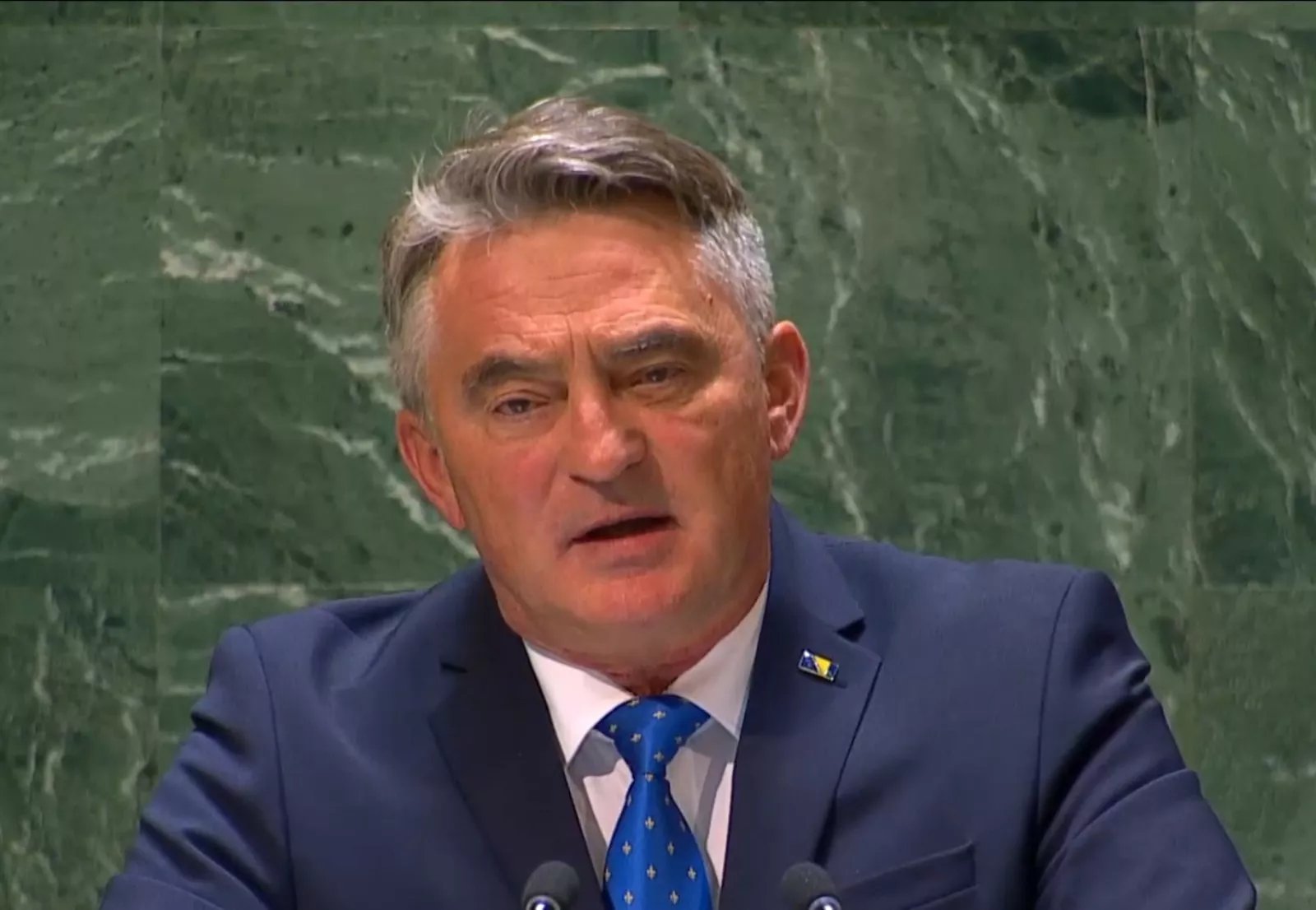
(Patria) - Chairman of the Presidency of BiH Željko Komšić addressed today the general debate of the 78th session of the United Nations General Assembly in New York.
We present Komšić's speech in full below.
Mr. President Francis, Mr. Secretary-General, Excellencies, Ladies and Gentlemen!
Starting from the theme of this year's session of the United Nations General Assembly, which is Rebuilding Trust and Reigniting Global Solidarity: Accelerating Action on Agenda 2030 and the Sustainable Development Goals Towards Peace, Prosperity, Progress and Sustainability for All, allow me to speak from this significant platform about important elements from the perspective of a small but proud country, Bosnia and Herzegovina.
For its part, Bosnia and Herzegovina has supported Agenda 2030, especially its goals that largely concern the creation of a world and environment within United Nations member states, in such a way that we, as states and our societies, are prepared and particularly capable of implementing all steps that will lead us to sustainable development.
However, in today's world, where war and various geopolitical goals often dominate, it will be very difficult to achieve this, at least as planned in Agenda 2030.
Therefore, I want to emphasize that we must begin our activities with the first step that will lead us to lasting peace, as the world's number one priority, and then to other mutually linked activities, so that our countries and societies are prepared for solidarity and progress.
These activities are certainly not easy and require a lot of wisdom, planning, and good management of all processes and procedures that can lead us to the implementation of Agenda 2030.
If we start from the premise offered as the theme of this year's session of the United Nations General Assembly, which speaks of building trust and fostering global solidarity, then I am free to point out in a few sentences the elements that may hinder the realization of the goals.
At the very beginning, I take this opportunity to remind you that migration is one of the elements of Agenda 2030, which is being addressed systematically and with certain management.
Although the Agenda for Sustainable Development by 2030 recognizes migrants as "agents of change" and "development" in countries of origin, transit, and destination," the Agenda primarily focuses on migrants as beneficiaries of sustainable development goals (e.g., through a higher level of protection, their rights, and transparency).
Furthermore, the Agenda does not refer to the broader concept of diaspora nor to the role it plays as a potential means of development.
This statement, taken from one of the IOM (International Organization for Migration) documents, is certainly true, but when we reach the starting point of migration, i.e., the ground in certain countries, we will certainly see several things that are undeniably happening.
The current form of migration management has reached a stage where large and stronger countries, for their own benefit, carry out a certain type of selection of migrants, by choosing the best and most educated among them, such as doctors, engineers, scientists, and other highly qualified individuals, and directing them to larger countries where their knowledge and abilities are exploited, but exclusively for the benefit of those larger systems.
In larger countries and larger systems, such selected migrants can be "agents of change" or drivers of various improvements, but at the same time, the potential and capacity of smaller countries from which migrants come are weakened.
Small countries, in addition to losing their most qualified personnel, also lose all investments, including financial ones, that were invested in creating these highly qualified profiles.
Of course, it is completely clear that there is a form of migration in which large groups of people try to escape war and its horrors, but there is also what we call economic migration, through which migrants are directed based on their potentials and capacities.
In both cases of migration, large countries and their larger systems are the ones that select and choose the most qualified profiles of migrants according to their own needs and aspirations, while at the same time, smaller countries from which migrants come are systematically weakened. What do I mean by this?
In short, it is difficult to talk about building trust when larger countries and their large systems take the population of smaller countries through migration, when at the same time smaller countries are being emptied, which results in the creation of an environment in which poverty develops and any form of economic and social development is completely hindered.
This directly undermines the possibility of creating conditions for sustainable development in smaller countries.
From the perspective of my country, Bosnia and Herzegovina, this is easy to argue and further prove.
In my country, there is a significant outflow of population, who leave for larger and more developed countries, mostly those we consider Western democratic.
Investigating why our people, Bosnians and Herzegovinians, decide to leave their country and seek better living conditions in other countries, we have concluded that the fundamental reason for their departure is actually the conviction of a lack of perspective in Bosnia and Herzegovina.
When we considered what our people cite as one of the main shortcomings of perspective in their country, we saw that it is precisely the political system in Bosnia and Herzegovina that does not contain full democracy, but rather a form of ethnocracy, or a system in which elections for government institutions, the exercise of power, and the distribution of jobs in the state, and even in the private sector, are mostly based on ethnic affiliation as a prerequisite.
In such a system, you often do not have the best people in key positions, people who, with their knowledge and abilities, can build the political, economic, and social system in Bosnia and Herzegovina, but on the contrary, you have ethnically and politically suitable cadres from whom it is difficult to expect them to lead the overall progress of the country.
This value system has existed for a very long time. In such a system, key jobs are not performed by the best and most qualified people, but by those who are politically and ethnically suitable.
The current political system in Bosnia and Herzegovina, based exclusively on ethnic and then political affiliation, completely degrades democracy as an important principle for creating an environment where people have equal opportunities.
Such a system, which guarantees participation in power to certain political actors and their ethnically based political parties, resembles past and present totalitarian systems, in which power is exercised autocratically, through autocratically inspired political actors.
As a consequence of this unfinished political system, we have slowed down the country's development, with such policies obstructing what, in my opinion, is one of the key goals of my country - its path to membership in larger supranational systems such as the European Union or NATO.
The immutability or particularly difficult change of government leaves such an environment that even the governments themselves no longer work in the interest of their citizens, because they feel there is no need for it. The distribution of political and social power is already guaranteed to them by the system itself, which is based on ethnic affiliation.
Our current political system is skillfully used by our Western and Eastern neighbors, and through ethnic communities in Bosnia and Herzegovina, to which they allegedly claim national rights, they manage Bosnia and Herzegovina, not with the primary goal of helping members of these ethnic communities, but with the goal of dividing Bosnia and Herzegovina or rendering it meaningless as a state.
Our two neighbors, through ethnic communities in Bosnia and Herzegovina, to which they seek to claim every right, and twenty-seven years after the aggression they committed against Bosnia and Herzegovina, are thus attacking the sovereignty of our country, which almost completely prevents any democratic development of Bosnia and Herzegovina.
This practice also undermines the minimum of interstate trust, because unfortunately, our neighbors do not invest sincere energy in building interstate cooperation, but invest energy in weakening our state.
This is a visible problem that extends to the entire Western Balkan region, where there are different ideas, plans, and intentions for changing internationally recognized borders, for reorganizing the region into something that has no connection with democracy.
For such activities and policies, neighboring countries very often have, at first glance surprising and unexpected, support from countries we consider democratic liberal states and societies, but also from those that are not, and are today recognized as aggressor states with authoritarian regimes.
Unfortunately, many in both the East and the West believe that the barely hidden support for those who want to completely control, and ultimately divide Bosnia and Herzegovina, will bring stability to the Western Balkans.
We, who represent the state of Bosnia and Herzegovina here at the United Nations, believe that this will bring neither stability nor progress to the Western Balkans.
Our neighbors cannot divide Bosnia and Herzegovina among themselves without entering into conflict with each other. We will certainly not allow the division and disappearance of our thousand-year-old state, at any cost, regardless of what anyone thinks.
Therefore, we believe that it is in the interest of the United Nations, if peace is to be preserved in the Western Balkans, to support the state of Bosnia and Herzegovina and its institutions.
If the United Nations wants to preserve peace in the Western Balkans, then it should support those who have not violated democratic and civilizational norms; have not committed genocide; have not been part of joint criminal enterprises; have not destroyed people's lives because of their ethnic affiliation; have not destroyed the temples and sacred sites of others; have not advocated for revanchism and revenge.
If such support is lacking, then the responsibility and blame for destabilization do not lie with us, who will certainly not calmly and with folded arms watch another attempt to destroy our Bosnia and Herzegovina.
However, the fundamental problem of Bosnia and Herzegovina lies in the inequality of citizens in the political and electoral system, which results in an ethnic system of governance that is inherently destined to be conflict-ridden.
In addition, the ethnic system of exercising power in my country continuously creates space for nepotism and corruption in all segments of society, and most of all in government institutions.
That is, as a consequence of the ethnic system of exercising power, we have nepotism in the selection of people to perform the most important political and economic jobs. The ethnic political system in my country is what most generates and encourages nepotism and corruption, and nepotism and corruption most destroy social cohesion and trust within a society.
Therefore, for decades, we have been unable to create a society of equal people, and thus equal opportunities, when through family and corrupt employment in the most significant positions, you lose hope in the possibility of a positive future.
From this platform, I want to ask an important question – how is it possible to build trust, which will lead to the creation of conditions for development, when we actually lack sufficient democracy in our country, when our right to democracy is taken away, and when an embargo on democracy is imposed on us, which leads citizens to great uncertainty and causes them to often decide to leave the country?
The latest interventions by international representatives in Bosnia and Herzegovina, namely the interventions of the High Representative, through legal violence and the suspension of the entity constitution for twenty-four hours, which is an unprecedented precedent in the democratic world, have not removed obstacles to the normal functioning of the state, but have instead strengthened the undemocratic ethnic principle and deepened discrimination against citizens in the Constitution and election law.
Democracy is the most important segment for building trust, both in our countries and on a global level.
It is very important, for creating the conditions for sustainable development, that the transition in these societies be completed as soon as possible, by moving from former totalitarian, autocratic systems to a system based on full democracy.
Therefore, we expect support from actors in the international community, although they too occasionally resort to undemocratic tools, and occasionally, for their own goals, completely deny the possibility of developing democracy in Bosnia and Herzegovina.
Of course, we are fully aware that there is also a number of United Nations member states that have such a history and historical context that they are not interested in democracy and its development. On the other hand, some indicators suggest that over 2/3 of United Nations member states are oriented towards democracy and its development, so my perspective is oriented in that direction.
Here I want to add another important element, which is indispensable in building trust for sustainable development. This is a system of full human rights, which as its ultimate outcome offers a society of equal people, equal citizens, and as a product of this, we can also have a society of equal opportunities, with open prospects for all.
If you do not have a system of equal people, i.e., equal citizens, then it will be difficult to build trust in such a system, especially in a post-war society like Bosnia and Herzegovina. Especially considering that our society suffered aggression from its Western and Eastern neighboring countries, which directly resulted in the commission of such terrible war crimes, and even genocide.
Such scenarios towards Bosnia and Herzegovina are still being realized, but through political means, in peacetime conditions, with continuous seeking of support from various parts of the international community.
At the same time, and regardless of the mentioned scenarios, our obligation is to create internal conditions for building a society of equal people, i.e., equal citizens, as one of the basic "tools" to avoid the possibility of future conflicts. Within the judgments of eminent courts dealing with human rights protection, such as the European Court of Human Rights, there is a valuable resource for building a stable society in which the risk of internal conflict is minimized, and at the same time, aggressive policies of neighboring countries are deprived of an effective mechanism for violating the territorial integrity and sovereignty of Bosnia and Herzegovina.
In short, this means that we in Bosnia and Herzegovina will have to change the entire paradigm within society, and move from ethnic political representation to civic political representation, which is the standard in the democratic world.
Through this, we must draw the attention of the United Nations to, unfortunately I must say, in my opinion, the uncivilized stance of the Government and Prime Minister of a neighboring country who rejected the judgment of the European Court of Human Rights in the latest ruling in the "Kovačević case" and advocated for the very principles rejected by the said judgment, such as the political principle of legitimate representation on an ethnic basis, which is a generator of inequality among BiH citizens, and a means by which neighbors undermine the state of Bosnia and Herzegovina. This was done in such a way that it can also be qualified as interference in the internal affairs of Bosnia and Herzegovina.
Disregard for the judgments of international courts, as heard from the Prime Minister of a neighboring country, is reminiscent of Vladimir Putin's approach to international law in the case of Ukraine.
However, this is not only a negative attitude towards the international standards of the United Nations but also the policy that our neighbors pursue towards Bosnia and Herzegovina.
Only when civic political representation is accepted in Bosnia and Herzegovina through the implementation of the European Court's judgments, and when, in parallel, attacks on the sovereignty of the state of Bosnia and Herzegovina from the neighborhood cease, only then will we be able to engage more fully and effectively in projects such as Agenda 2030, as an equal participant and actor in all planned activities.
In that case, as a state, we will be prepared and equipped with potentials to accept all challenges that the activities on sustainable development place before us, to build our mutual social trust as a society of equal people, but also to be an active participant in building trust on a global level.
I believe you share my opinion that in societies where inequality dominates, you will not be able to be a legitimate actor who will promote the ideas of sustainable development through building trust and global solidarity for all.
For such a thing, it is primarily necessary to reform our society in such a way that it is capable of understanding the importance of solidarity for all, with people who are equal in all respects within that system and who can produce solidarity towards others on equal grounds.
In conclusion of this presentation, with all the above, I want to emphasize that Bosnia and Herzegovina will actively work on the implementation of Agenda 2030. We will work on building trust and solidarity for all.
By rejecting the discriminatory ethnic concept, we will simultaneously reject the system dominated by nepotism and corruption, thus bringing us into the ranks of democratic and mature societies.
Then we will become a society and a country that can actively participate in world processes, within the fundamental principles on which the current world order and what we call the international community are based.
The transition process of our society can and should be relatively short, because the equality of all people is the fundamental premise of every modern democratic society, and in that regard, we count on the support of that part of the international community that can help us in this.
I am aware of the existence of other parts of the international community that, for their geopolitical reasons, will resist, in order to keep Bosnia and Herzegovina, as well as the entire Western Balkan region, in a continuous state of destabilization and tension. Such entities do not want democracy, but ethnocracy, disorder, and violence.
In the end, I can say with certainty that Bosnia and Herzegovina has become a place where democracy and its values are defended. And there are only two sides here – the one that is for democracy and its values, and the other side, which is an opponent of democracy because its goal is the establishment of autocratic systems of an undemocratic nature.
Thank you, Mr. President!
Komentari (0)
Prijavite se za komentiranje
PrijavaJos nema komentara. Budite prvi!
Minuta
Sve →Iz drugih kategorija

High Representative Not Elected: Germans, French and British Against Americans, New Attempt at End of June

ČOVIĆ WITHOUT MERCY: How Those Who Brought Ademović to Office Created a Political Hell for Him



Sunny Saturday, quite warm



Tragedy in Albanian resort: Two minors drown












