
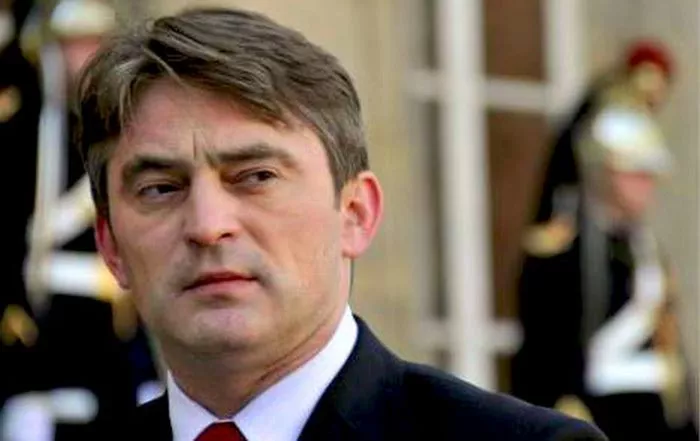
Is the Democratic Front the opposition or the government, what will this party do in the coming period, what does it think of Dragan Čović, what did he discuss with Izetbegović, these are just some of the questions answered by the president of DF Željko Komšić in an interview for the Patria News Agency.
Given that the interview is longer, we will publish it in two parts.
PATRIA: Where is the Democratic Front currently. Opposition or government?
KOMŠIĆ: DF is in power at the level of BiH and in two cantons – Canton Sarajevo and in ZDK. At other levels, it is in opposition. As is the case with almost all other parties in BiH. Except for HDZ, which is in power at all levels, including both entities. For example, SDA is in opposition in RS, and in other levels it is in power, SNSD is in power in RS, and in opposition at the state level, Party for BiH is in power in some cantons, A-sda is in power in some cantons, etc. etc. Only HDZ is in power on every inch of BiH.
PATRIA: How many times have you spoken with Bakir Izetbegović in the last month and what did you tell him on that occasion?
KOMŠIĆ: We spoke only once, at the request of some people from SDA, whom I generally respect as honest and well-intentioned people. I don't know, and I wasn't very interested, whether it was Izetbegović's personal request.
On that occasion, I told him, or rather repeated, that he had already given Dragan Čović everything that represents the economic-material basis and all resources in the territory of the former so-called Herceg-Bosnia, and that now purely political demands follow, which aim to administratively and institutionally round off that territory of the former so-called Herceg-Bosnia.
This will happen through the form of a coordination mechanism, which will give cantons decision-making power from purely state competencies, thereby bringing cantons onto the political scene as institutions with jurisdiction in foreign policy (veto right on all decisions made in that body, thus encroaching on the area of foreign policy as an exclusive competence of state institutions, because through the coordination mechanism, the country's foreign policy is implemented in the process of joining the EU), as well as through amendments to the Election Law, through which Čović will introduce ethnic electoral units.
Formally, there will be no third entity, but it will practically exist and will even be stronger than if it formally existed. I hope I am not expecting too much if I think that Izetbegović should at least know and understand that.
I also told him that if he wants any serious talks with DF, they can only happen after it becomes clear how the ministers from SDA in the Council of Ministers voted on the coordination mechanism. Our position is the same when it comes to amendments to the Election Law, but since work on amendments to the Election Law has not even begun, it is not currently relevant.
PATRIA: Have you discussed the decision of the Constitutional Court of FBiH that is to be made based on your appeal regarding the controversial Decree of the Government of FBiH?
KOMŠIĆ: Regarding the decision of the Constitutional Court of FBiH on the famous Decree of the Government of FBiH, I told him that the Court's decision is no longer important and has lost all legal meaning, because consequences have occurred in the meantime that even that decision cannot change or fix. It is simply a done deal.
I also told him that DF, after leaving the Government of FBiH, did not want to cause additional problems for that same government, nor for SDA and HDZ, nor to further complicate the situation, but to keep in mind that all decisions of the Government of FBiH made after Reuf Bajrović's dismissal by Čavara are actually unconstitutional, precisely because the constitutional representation of constituent peoples in the composition and work of the Government of the Federation was not ensured, to the detriment of Bosniaks.
PATRIA: The issue of electing a new director of OSA was very topical for a while, and now there is silence. Did you perhaps discuss that as well?
KOMŠIĆ: I did not mention the issue of the future director of OSA at that meeting, but I did mention it earlier to some SDA officials.
DF's position is that the person who will be the future director of OSA should have qualities that enable successful cooperation with our Western allies, not someone around whom we, as a state, would open a dispute precisely with those allies.
PATRIA: How do you comment on the meeting between Izetbegović and Radončić, which some called historic for Bosniaks. Were Bosniaks really in conflict and quarreling?
KOMŠIĆ: I haven't noticed so far, and I think almost no one else has noticed, that Bosniaks are quarreling. Just like other peoples in BiH. Inter-ethnic relations are even getting better and better. Politicians are quarreling, and that has nothing to do with any people, including Bosniaks.
It is a generally known fact, and it happened until a few days ago, that Radončić and Izetbegović were fiercely quarreling. Izetbegović threatened to send Radončić to prison, Radončić was for the de-Chamberlainization and de-Erdoganization of BiH and Bosniaks, he did not want to be an anti-civilizational patch for Izetbegović, etc. That happened, but there was no quarrel among Bosniaks. Everyone knows and sees that.
As for their meeting and reconciliation, I am personally glad that it happened. I generally don't like it when people quarrel!
Komentari (0)
Prijavite se za komentiranje
PrijavaJos nema komentara. Budite prvi!
Minuta
Sve →Iz drugih kategorija

High Representative Not Elected: Germans, French and British Sabotaged Americans, New Attempt at End of June

ČOVIĆ WITHOUT MERCY: How Those Who Brought Ademović to Office Created a Political Hell for Him



Sunny Saturday, quite warm



Tragedy in Albanian resort: Two minors drown












