
Written by Armin Aljović
Former German diplomat and High Representative in Bosnia and Herzegovina Christian Schwarz-Schilling writes in an op-ed for Deutsche Welle that this March “two events reminded us Europeans of the atrocities of the last century: the verdict against Radovan Karadžić and the appearance of Chetniks in Višegrad.”
The verdict of the Hague Tribunal for the former Yugoslavia, Schwarz-Schilling recalls, finally found former Bosnian Serb leader Radovan Karadžić guilty of crimes against humanity in Bosnia and Herzegovina and specifically of genocide in Srebrenica, while his original sentence, this German diplomat of Austrian origin emphasizes, was commuted to life imprisonment.
„It is hard to imagine a different sentence for this severity of crimes, the planned killing of thousands of innocent people,“ Schwarz-Schilling points out.
But Schilling, as we have seen, is not surprised by the severity of Karadžić's sentence, but he is certainly frustrated, as he will show later in his text, by the fact that some politicians in Bosnia and Herzegovina criticize the verdicts of the high court in The Hague and trivialize or even completely deny war crimes and human rights violations that rank among the worst crimes in Europe after World War II. Of course, the experienced Schilling tries to understand this, recalling that in Germany after World War II there was a similar situation where some denied the crimes of the Holocaust even though they were established before the war crimes tribunal in Nuremberg, after which the German Bundestag, the highest parliament of the Federal Republic of Germany, passed a law making Holocaust denial punishable, thus putting an end to it. Since such a law cannot be passed in Bosnia and Herzegovina due to politicians who prevent it with their votes in parliament, Schilling proposes that the High Representative in BiH, Valentin Inzko, who oversees the Peace Process, should himself enact a law banning the denial of crimes and protect the rule of law.
Can the OHR impose a law that would more or less protect victims? The High Representative, to whom his former colleague proposes a more decisive policy in sanctioning genocide deniers, will explain that he currently does not have the consent of all member countries of the Peace Implementation Council in BiH to impose such a solution, so it would be best for domestic authorities to show humanity and a civilizational pulse and create legal prerequisites that would punish the revitalization of war criminals, as, for example, Inzko's Austria has done.
But as things stand now, such a law cannot be passed in BiH, neither with the current set of politicians in the country nor with the current mood in the Peace Implementation Council.
Representative of the Bosnian Serbs Milorad Dodik does not want any law that would ban the denial of crimes. When recently asked by journalists whether he would support such a law, he proudly announced that any initiative to adopt a law at the level of Bosnia and Herzegovina that would punish those who deny crimes and court verdicts would be rejected. „It wouldn't be the first time we reject something like that,“ Dodik told reporters in Banja Luka.
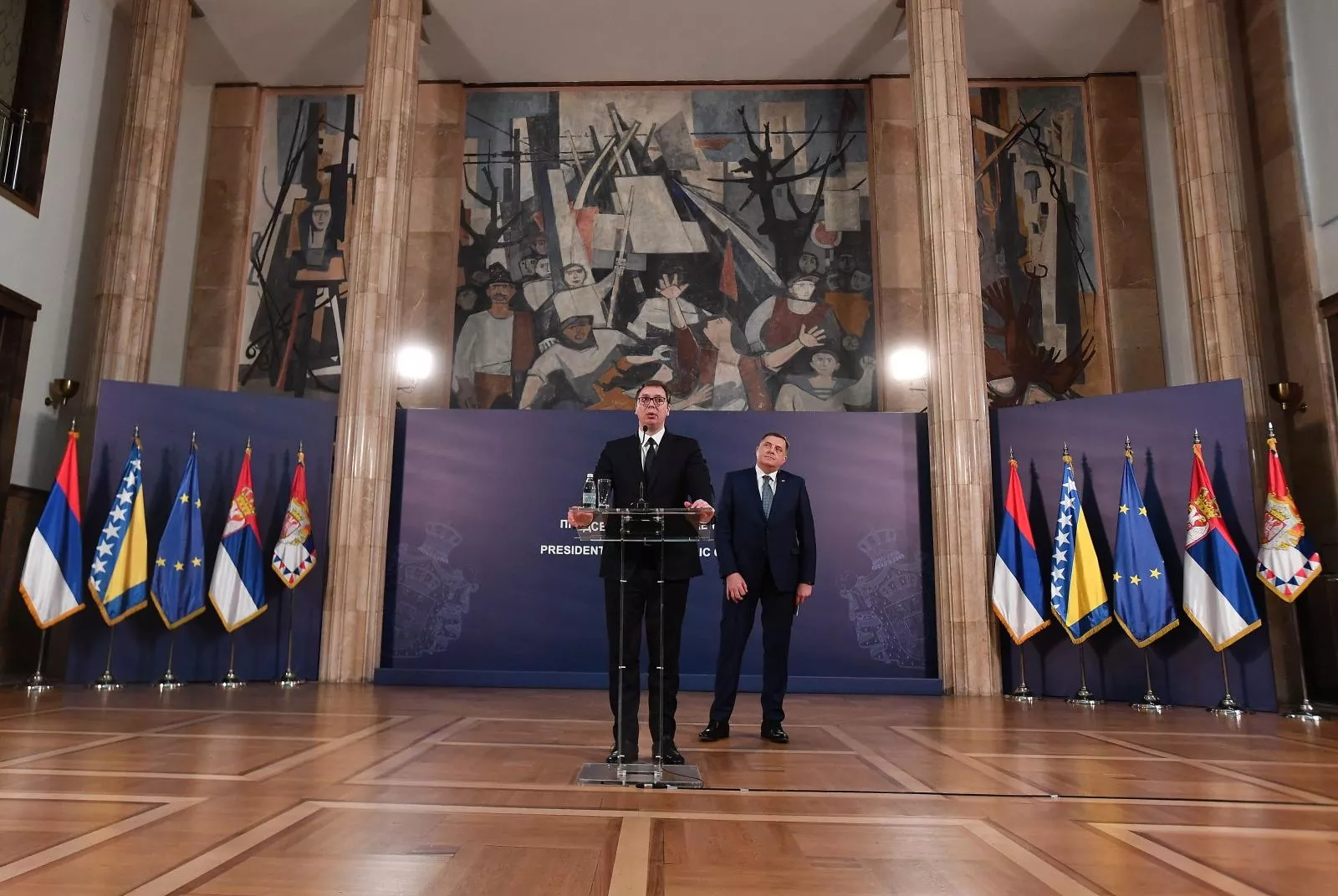
Given that there is no catharsis in BiH society, as we see, not even close, what is the solution for Bosnian-Herzegovinian politicians who not only deny war crimes but also glorify the creators of those crimes, like Milorad Dodik who says that Radovan Karadžić and Ratko Mladić are heroes to him? Or, what is the solution for the best student of the Faculty of Philosophy at the University of East Sarajevo, Department of Political Science, Filip Matić, who says „we will always be proud to stay in the House named after Radovan Karadžić.“ European Union member states, and beyond, can simply ban fascists from entering their territories so they do not contaminate their societies as well. Because, we have seen, right, that the attacker on two mosques in New Zealand, terrorist Brenton Tarrant, before the bloodshed in Christchurch was in Bosnia and Herzegovina where he was inspired by Balkan executioner Radovan Karadžić. Such a decision by Western countries would be a quite decent blow to Bosnian-Herzegovinian fans of criminals. For starters, as a basis for such actions, the amendment by Slovenian MEP Igor Šoltes, included in the European Parliament Resolution of November 29, 2018, can serve, which requires Serbia to recognize the Srebrenica genocide as a condition for entering the European Union. Because, if Serbia cannot join the EU until it recognizes the Srebrenica genocide, why should, for example, Dodik or Vučić, as carriers of that ideology, be able to walk on the soil of the European Union?
Komentari (0)
Prijavite se za komentiranje
PrijavaJos nema komentara. Budite prvi!
Minuta
Sve →Iz drugih kategorija

High Representative Not Elected: Germans, French and British Sabotaged Americans, New Attempt at End of June

ČOVIĆ WITHOUT MERCY: How Those Who Brought Ademović to Office Created a Political Hell for Him



Sunny Saturday, quite warm



Tragedy in Albanian resort: Two minors drown












