
By: A. Čorbo-Zećo
In the document of BH Telecom, which we are publishing, a public company owned by the Federation of Bosnia and Herzegovina, it is clear who actually receives the multi-million dollar advertising budgets. Based on the public call for 2025, most of the outdoor advertising contracts have been awarded to companies from Banja Luka, while companies from Sarajevo, the capital city and the center of the Federation, have been reduced to an almost symbolic presence.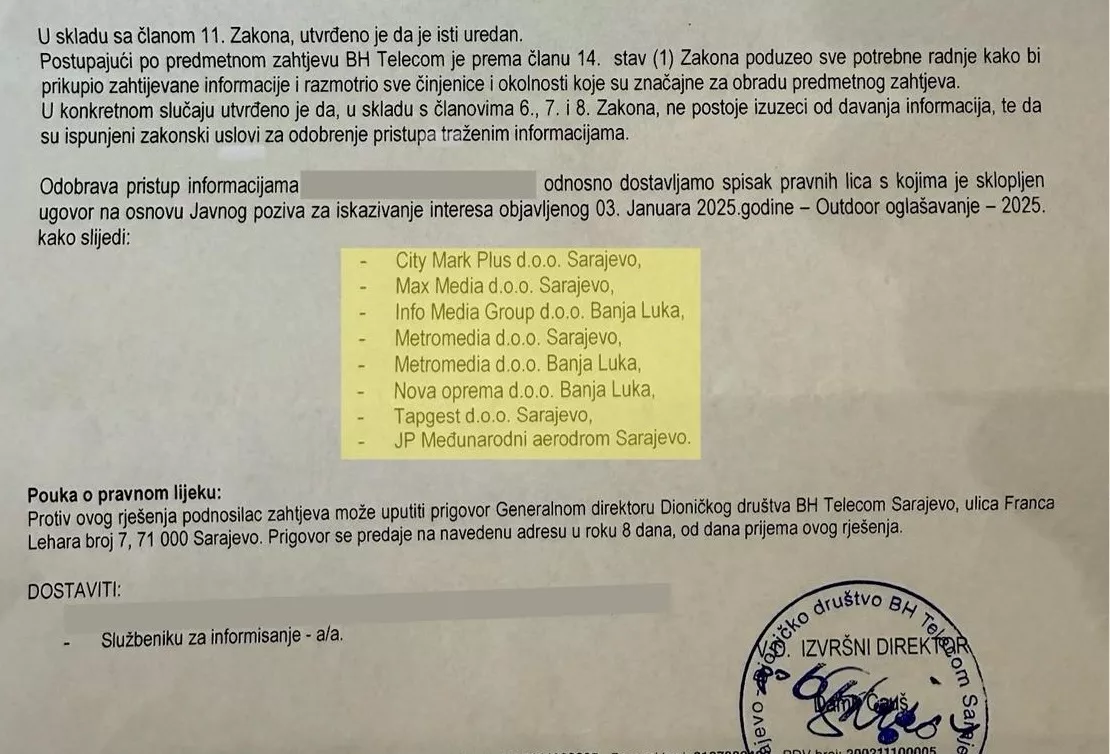
Out of a total of eight companies that have signed contracts with BH Telecom, three are from Sarajevo – City Mark Plus d.o.o., Max Media d.o.o., and Tapgset d.o.o., three from Banja Luka – Info Media Group d.o.o., Metromedia d.o.o., and Nova oprema d.o.o. A contract has also been signed with a public company, JP Međunarodni aerodrom Sarajevo. It is particularly interesting that Metromedia d.o.o. appears in Sarajevo and Banja Luka, and one of the founders of the Sarajevo company is Svetoljub Lović from Belgrade, which indicates a connection with the Banja Luka company of the same name.
The conditions of the public call were extremely demanding. Bidders had to prove that they could offer over 50 available City Light surfaces, LED advertising in multiple locations, more than 100 billboard surfaces, as well as large format advertising such as superboards, megaboards, and wallscapes in cities like Sarajevo, Tuzla, Mostar, Banja Luka, and Zenica. Advertising via banners was also required, as well as inside and on the exterior of public transport vehicles – buses, trams, and trolleybuses – in larger cities across BiH, and advertising at tram stops.
It is known that Info Media Group from Banja Luka has already established a presence in Sarajevo, particularly within the GRAS system, using LED screens and advertising space in vehicles, allegedly thanks to the support of certain political structures, among which SDP particularly stands out.
This distribution of funds is not just symbolic. Companies from Republika Srpska receive the largest share of the budget pie, while companies from Sarajevo and the Federation are marginalized, even though BH Telecom is headquartered in the Federation and generates most of its revenue in its territory. The fact that some of the most well-known and strongest advertising companies from the Federation, such as Europlakat and others, which have been actively participating in such procedures for years, have been completely excluded also causes additional concern.
BH Telecom's documentation does not contain data on the scoring method, evaluation of bids, or explanations as to why these specific companies were chosen. The lack of transparency seriously compromises the integrity of the process itself and opens the door to doubts about its regularity and potential political influences.
It is also concerning that all of this is happening under the signature of the General Director of BH Telecom, Amel Kovačević (NIP), who often presents himself in public as a defender of state and Bosniak interests. However, when millions of convertible marks from the public budget are distributed, they end up in companies from an entity whose political leaders have been denying the sovereignty of Bosnia and Herzegovina for years.
In the end, the key question remains whether BH Telecom is acting in the interest of the citizens of the Federation of BiH, who finance it with their money, or in the interest of private and politically connected structures from the entity of Republika Srpska? This question is no longer just economic. It is also political, moral, legal, and security-related.
Komentari (0)
Prijavite se za komentiranje
PrijavaJos nema komentara. Budite prvi!
Minuta
Sve →Iz drugih kategorija

High Representative Not Elected: Germans, French and British Sabotaged Americans, New Attempt at End of June

ČOVIĆ WITHOUT MERCY: How Those Who Brought Ademović to Office Created a Political Hell for Him



Sunny Saturday, quite warm



Tragedy in Albanian resort: Two minors drown












