
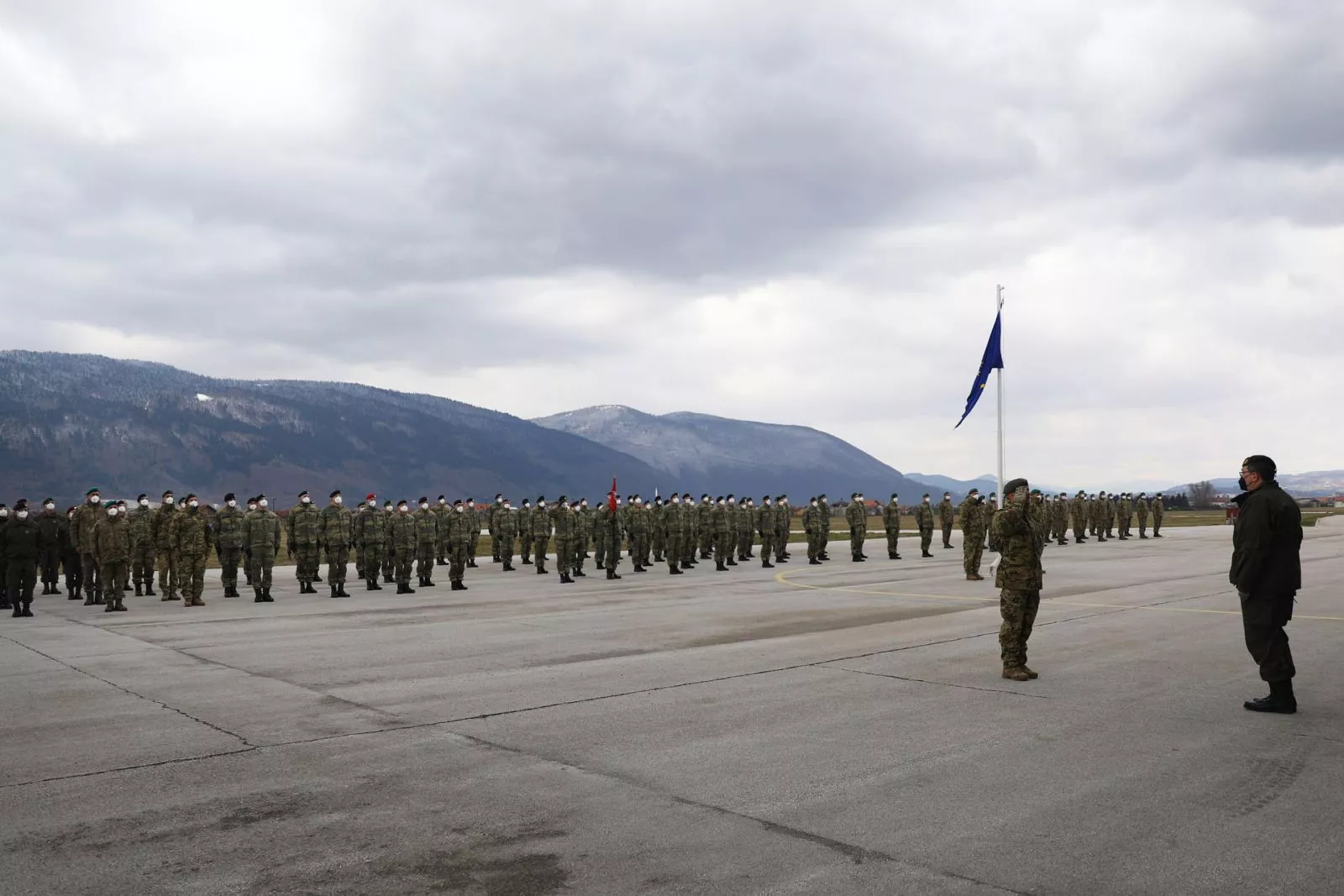
(Patria) - Commander of the EUFOR military mission in BiH, Austrian General Alexander Platzer, told Austrian Der Standard that despite the announcements by Presidency member Milorad Dodik that could mean the secession of the Republika Srpska entity, he in principle does not see "any classic military threat". He dismissed the possibility of transferring troops to Brčko, as some analysts had previously suggested.
"The general security situation in the country is stable," Platzer stated, Der Standard reports.
He emphasized that he believes sending additional troops to Brčko would "lead to escalation rather than de-escalation."
The Austrian general explained that, in addition to at least 600 people who are operational staff, additional soldiers are deployed in the mission. Furthermore, EUFOR Althea has sufficient reserve forces that can be deployed at any time if necessary. He stressed that the international community has declared itself against an occupation scenario by leaving responsibility for the country to domestic authorities.
"I don't see a need to change that," he added.
Reserve forces could come from the Balkan region, but KFOR from Kosovo could also be engaged. In addition, there is still an external strategic reserve. "It is particularly important to us because it is not located in this region," explains the commander. He adds that if necessary, another thousand soldiers can be called up, and this number can also be increased.
"We are preparing for certain scenarios. Around 700 soldiers came as a reserve force for this year's annual exercise. It was a planned exercise that showed us that the EU and the international community are capable of acting," said Platzer.
Consideration is also being given to reinforcing the local EUFOR observation post, so-called LOT teams, in order to be able to "see in more detail what is happening." Offers are already coming from countries whose troops are already there. In principle, the EUFOR commander can activate without permission from Brussels if he sees that stability and security are threatened.
"In addition, we can carry out inspections of weapons and equipment at any time and without notice. We can also make decisions if there is an additional reinforcement of military capabilities, i.e., if there is armament that is not foreseen," said Platzer.
Regarding the current discussion about extending the EUFOR Althea mission in the UN Security Council, Platzer points out that the EUFOR mandate and its tasks are "completely separate from the civilian tasks of the High Representative."
"From a military point of view, there would be no difference if references to the OHR were deleted from the text of the EUFOR mandate in order to extend our mission. Whether that would harm the Dayton Agreement is another question. I cannot assess that," said Platzer.
"But, it is completely clear to me that Dayton has an expiration date. And that expiration date is determined by the state and the international community through positive development in the formation of a stable state structure."
He also commented on the exercise recently organized by the entity's Ministry of Internal Affairs of Republika Srpska on Jahorina, and stated that he sees no problem with the use of long barrels in the exercise.
"The type of equipment used by the police in Republika Srpska meets international standards. We also have long barrels in Austria."
Regarding Dodik's threat that Republika Srpska will withdraw from the state army and create its own separate one, Platzer said that "the joint army is not based on the Dayton Peace Agreement."
"At the time of the Dayton Agreement, we had three armies depending on ethnic groups. Then a joint army was created based on national will," he said.
If the country, through a normal legislative process, agrees to have several armies again, then the international community can hardly do anything about it, Platzer adds.
However, he also said that he spoke with the involved actors and asked them what the point would be of using two armies for the basic task of national defense.
"Then there would be two ministers, two chiefs of general staff, and that is excessive in terms of the size of the country. Structurally, it makes no sense," said Platzer.
He emphasized that, in the event that the army disintegrates and two armies emerge from it, this should be preceded by a basic political and military consensus and should correspond to the primacy of political decision-making.
"From today's perspective, this is a scenario we can handle."
However, he stressed that if there is no political consensus for something like that, then the security situation would have to be assessed completely differently.
"We have to watch it carefully," said Platzer.
He also stated that he has noticed a certain level of tension among the population.
"This is related to the fact that the media constantly revolves around security issues. Politicians constantly keep the population in a state of crisis," he concluded.
Komentari (0)
Prijavite se za komentiranje
PrijavaJos nema komentara. Budite prvi!
Minuta
Sve →Iz drugih kategorija

High Representative Not Elected: Germans, French and British Sabotaged Americans, New Attempt at End of June

ČOVIĆ WITHOUT MERCY: How Those Who Brought Ademović to Office Created a Political Hell for Him



Sunny Saturday, quite warm



Tragedy in Albanian resort: Two minors drown












