
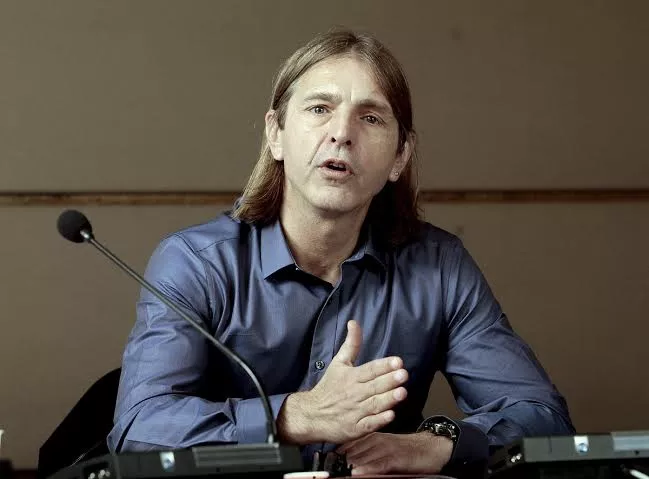
If this situation had not been going on for 20 years, I would call it a crisis, but in fact it is a situation that is the only possible consequence of dominant political ideologies and their understanding of the state, the government's relationship towards the state and citizens, says the president of Our Party, Predrag Kojović, at the beginning of an interview for the Patria news agency.
- Nationalism, I suppose it is now clear to everyone, is the final stage of communism. Both ideologies strive to establish a political monopoly in the name of some collectivity, at the expense of individual civil rights and freedoms. One seeks it in the name of the proletariat, and the other in the name of an ethnic group.
Only in such a state of permanent crisis is it possible to impoverish the country and its citizens, and still get the most votes in elections. That is why I am skeptical that those to whom the current system has enabled such fantastic political careers and personal material enrichment will change it for a European system in which not only is this not possible, but such behavior carries legal and prison sanctions.
PATRIA: At the end of September, after five years, the leaders of SBB and SDA met, announcing afterwards that Bosniak unity had been established. Do you agree with that statement? If not, how can Bosniak unity be achieved, given the fragmentation of parties with predominantly Bosniak voters?
KOJOVIĆ: The SDA came out 25 years ago with a thesis that turned Bosnia and Herzegovina from a civic state into a state of constituent peoples. Their idea at the time was that there would be three parties in BiH, Bosniak, Croatian and Serbian, which would rule in the name of the ethnic groups they supposedly represent. It is precisely such an approach to the concept of representative democracy that has brought us everything that has happened to us from the first democratic elections to today.
It would be devastating if, after so much tragedy – and I do not mean only the war, but also the wartime and post-war plunder of state and public property and money, as well as poverty and hopelessness – we returned to that tragic starting point in the history of independent BiH. What is called political fragmentation of ethnic groups in media analyses – I see as salvation, as hope for a final escape from the trap of ethnodemocracy, a system of rigid ethnic quotas, into which nationalist parties pushed us and which the Dayton Constitution, unfortunately, legally codified. I hope that this trend of fragmentation of ethnic groups according to the political preferences of citizens will continue, and even faster, and that ethnic elites will lose their legitimacy.
If this does not happen, and if the elections are reduced to an ethnic census without any ideological or political differentiation within ethnic groups – that will be the end of the kind of BiH we want to create, and I fear the end of BiH altogether. We have been living in a dictatorship of the so-called constituent peoples for 20 years, and such a trend, which is visible to the naked eye, clearly indicates that it leads to further disintegration of our society along ethnic lines. Political homogenization based on ethnic affiliation requires territorial demarcation and leads to the creation of a de facto state union in the territory of BiH. It is hard to imagine a scenario in which such a state union would avoid the fate of Yugoslavia.
PATRIA: DF and SDP have announced the unification of the left, and a joint appearance in the 2018 Local Elections. Is Our Party perhaps also on the wave of unification with these two parties, meaning a joint appearance in the elections?
KOJOVIĆ: The unification of the left – whatever the term left really means today in our region – is an internal matter of the SDP and DF. My assumption is that the unification of two parties that were one party until yesterday is not problematic. Of course, for such a thing, it is necessary to overcome personal animosities and everything that they have publicly said about each other in the last few years, but ultimately, the latest “reconciliation” of SDA and SBB has set a new, higher standard of political hypocrisy.
If that united left has an interest in a joint appearance in the upcoming elections with Our Party, then talks should start as soon as possible, because the programs and proclamations and what we have seen in practice from these parties recently are contradictory, and we need to see what kind of BiH they believe in, what kind they will advocate for, and how that will be concretely manifested in action plans in the municipalities.
PATRIA: The Ministry of Justice and Administration has stopped the submission of the Draft Law on the Reporting, Origin and Control of Property of Elected and Appointed Officials and Advisors in the Sarajevo Canton. If the Draft was unanimously adopted by the Government, how is it that the Ministry of Justice suddenly stops it? Who is not interested in this legal solution being adopted?
KOJOVIĆ: Perhaps it was adopted unanimously by those who were present at the Government session at the time of the vote. Among those who are supposed to pass this law, there are many more to whom it does not suit and who would like it not to be adopted and implemented. I also hope that the public can recognize that the status quo in the fight, or rather the non-fight against corruption and organized crime, is defended with quasi-legal arguments and other discreet strategies.
Well, do you think it is a coincidence that of all the laws that were before the Federal Parliament in the last term, only ZASKOK (Law on Combating Corruption and Organized Crime) was adopted in both houses, published in the Official Gazette, only for a decision to be made not to implement it. I have never heard of such a thing in normal countries: that a state passes a law and then decides not to implement it. Have you?
PATRIA: Our Party does not seem particularly active in the smaller BiH entity. You often do not speak out on the issue of attacks on returnees, you are not particularly vocal about the dispute over the name of the Bosnian language in the RS. Why the silence, if citizens perceive you as a party that is state-building?
KOJOVIĆ: All pro-Bosnian parties in the RS operate at the level of non-governmental organizations. Their political power boils down to press releases, and the only ones that have some degree of representation among returnees, through their work in the Federation, have not shown that they have a different treatment towards those who are numerically a minority where they hold power. You do not have a strong DF, nor even an SDP, despite years of activity there, the enormous resources they have at their disposal from positions in government that they could offer to activists.
This is the result of many factors, including the fact that the democratic atmosphere in the RS is still at a stage where political jokes are told in whispers, because people are afraid that expressing a different opinion would have consequences for their material and even life existence, over which the ruling parties have complete control.
We recently formed a committee in Banja Luka again and are determined to build up the organization of Our Party in the RS. This time we have turned to younger people who, I must emphasize, show exceptional courage in expressing their political views and a desire to work in Our Party.
Honestly, when I talk to them, I ask them how they managed to resist the aggressive war-mongering propaganda of the SNSD and the media under their control. In the RS – to return to your first question – fortunately, a process of intense ideological profiling is underway and it will, I hope, soon result in Dodik's separatist rhetoric facing serious opposition; and that right in the RS.
Also, I would not agree that we have not reacted to the problems of returnees. It was Dennis Gratz who raised the issue of a systemic solution to discrimination in education, who alone provided rational starting points for the problem of the Bosnian language, without using empty patriotic-nationalist rhetoric that leads to and serves nothing but pre-election chest-beating.
Entry into government
PATRIA: Has anyone from the parties in government so far negotiated with you about a possible entry or support? Have they also talked to other “small” parties?
KOJOVIĆ: We have stated our position on the SDA, HDZ BiH and other nationalist parties so many times and so clearly that it should be clear to everyone, including them, that talks would be a waste of time. Their policy, in our opinion, is nothing but a continuation of war by other means. We are fighting for BiH to become a civic state, that is, to be organized like all functional European representative democracies.
SDA is most responsible for the water supply problem
PATRIA: The problem of water supply for the city of Sarajevo is burning (although there are plenty of burning issues). Who, in your opinion, is most responsible for the situation in the public utility company ViK, as well as other utility companies? We have had the opportunity to see that the salaries of directors in these companies are enormous, that there is no control, and the owner is the Assembly of the Sarajevo Canton.
KOJOVIĆ: The most responsible is the one who has had the most power in the Sarajevo Canton in the last 20 years. The SDA, I have often said that. It is not a political party in the sense of the theoretical definition you can find in books or when you type that term on the internet. I perceive it, as strange as it may sound, more as an interest-religious organization whose members, in addition to personal enrichment, work in parallel on establishing a legal and judicial system that will absolve them of the illegalities they have committed in the past 20 or more years.
Some are in the SDA for 150 marks a month; some because they think that is the only way to keep their job; some because their party's participation in government enables them to get million-dollar deals. And some are there again because they think they can fight, from within, to turn that joint criminal undertaking into a political party. In any case, to return to your question, the situation in the Sarajevo Canton, and of course the situation with water supply, is mostly their doing.
The referendum is not a harmless story
PATRIA: The referendum in the RS is by no means a harmless story. What is your stance regarding the referendum?
KOJOVIĆ: Of course it is not harmless, and I look with disbelief at the indifference of the PIC and other guarantors of the peace agreement.
If the referendum actually happens, it will mark the entry of BiH into uncharted territory, where the Dayton Constitution does not apply, and a new one has not been adopted. Our constitution allows a referendum as a form of decision-making, but only on matters for which the one calling it is competent. This is not the case here, and that is why the referendum is unconstitutional.
But even though the referendum question is formulated so as not to produce legal consequences, its holding is an attack on the very statehood of BiH, because as every law student knows: the state is above all a monopoly of force, and if that monopoly is violated, that is, if there is someone on its territory who has greater force than the state and can openly violate the constitution, then...
Komentari (0)
Prijavite se za komentiranje
PrijavaJos nema komentara. Budite prvi!
Minuta
Sve →Iz drugih kategorija

High Representative Not Elected: Germans, French and British Sabotaged Americans, New Attempt at End of June

ČOVIĆ WITHOUT MERCY: How Those Who Brought Ademović to Office Created a Political Hell for Him



Sunny Saturday, quite warm



Tragedy in Albanian resort: Two minors drown












