
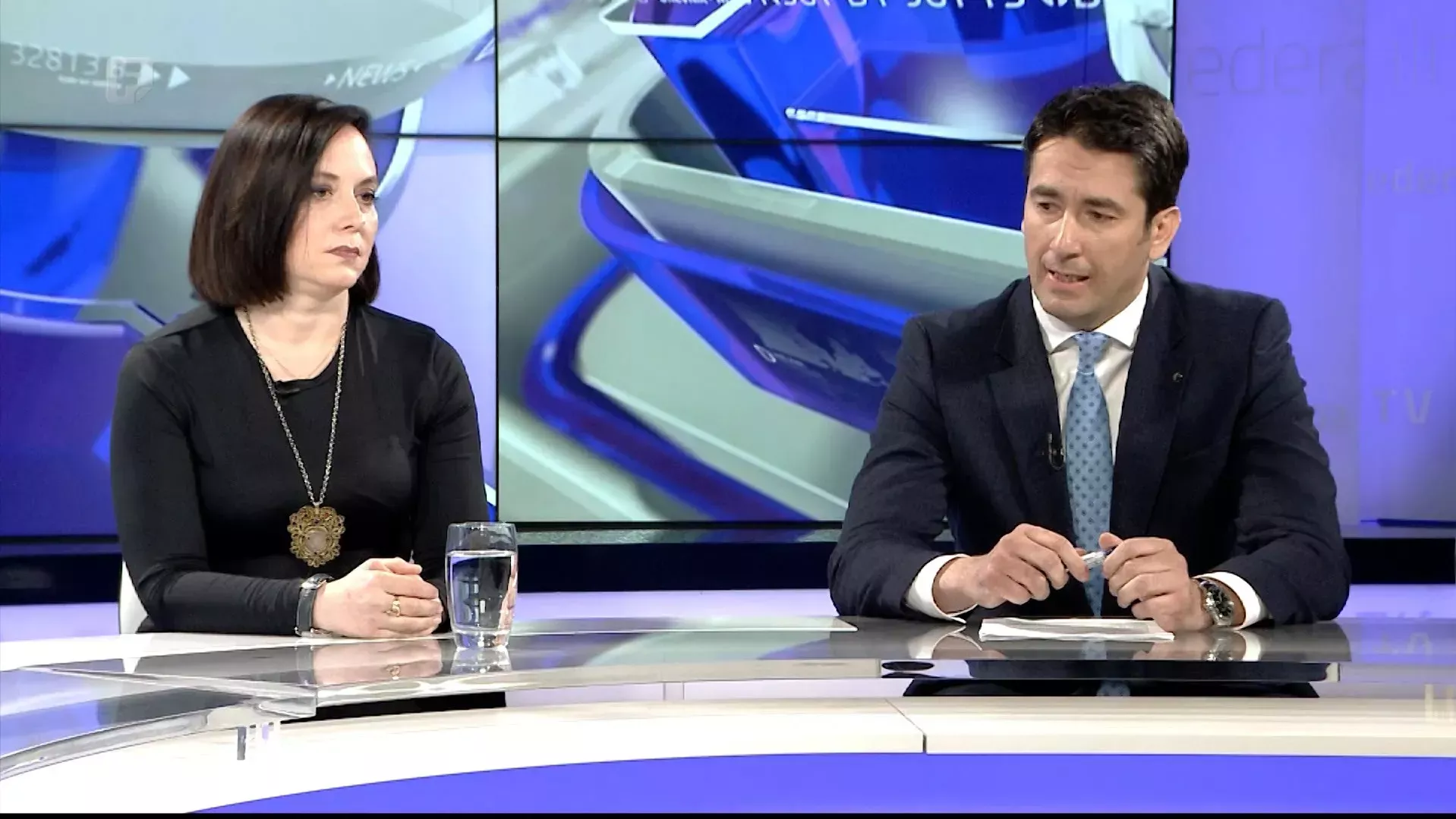
(Patria) - After BHRT shut down the signal, i.e., the program of Federal Television last week, the Business Board of that company filed criminal charges against the Supervisory Board and Management of BHRT. Who will be held responsible for the interruption of broadcasting? The Dnevnik D FTV program discussed an unprecedented attack on that company and possible legal consequences. The guests of the show were the lawyers for Federal Television in this dispute - Nina Kisić and Goran Dragović.
Ms. Kisić, there is a court injunction in effect prohibiting BHRT from reducing services to Federal Television and shutting down the signal. What are the legal consequences if they decide to endanger our program in the same way while such a legal measure is in effect?
Kisić: The legal consequences would be twofold. Not only would they repeat the criminal offense for which they have already been charged - abuse of official position and association for the purpose of committing criminal offenses - but they would also commit the criminal offense of non-compliance with a binding court decision, i.e., a ruling issued by the Municipal Court in Sarajevo. The ruling of the Municipal Court in Sarajevo, which we analyzed and attached to our criminal complaint, clearly specified the conduct of the so-called opposing party to enforcement ordered by the Municipal Court, i.e., BHRT, and BHRT, as long as that ruling is in effect, is obliged to absolutely respect every provision of that ruling, i.e., not to prevent the broadcasting of Federal Television in any way. In that context, it would be very interesting to read the appeals against that ruling, because I really don't understand what the legal basis for such an appeal would be, as the temporary ruling, in our understanding, was made to prevent further commission of a criminal offense. If I had to write an appeal against that ruling - I don't know what I would write.
It is also interesting that other media outlets published news about the court's temporary measure before BHRT even broadcast it.
Kisić: That is something that was also mentioned in our criminal complaint, although it is not necessarily reported yet - it is something we are still considering. The ruling of the Municipal Court was received at 4:10 PM and it is applied, according to the text of the ruling - immediately. I am truly astonished that they waited until 7:30 PM before Federal Television was allowed to broadcast again. That someone did not officially receive it - that is, in a way, an avoidance of complying with a binding court ruling, it was not something that would be a legal justification for non-compliance.
Mr. Dragović, who is covered by the criminal complaints?
Dragović: As authorized representatives of Federal Radio Television, we have filed criminal complaints with SIPA and the Prosecutor's Office of BiH. It concerns multiple individuals. These are members of the BHRT Supervisory Board - Rajko Radovanović, Valentina Rupčić, Slavko Rolih, General Director Belmin Karamehmedović, Elvir Lemeš, as well as BHT Director Mario Vrankić and BH Radio Director Dejan Kerleta. What is very interesting and important - a criminal complaint has also been filed against several unidentified persons. This group of individuals is certainly a bit wider than those reported. We have left the identification of these individuals who undoubtedly participated in the commission of this criminal offense to the investigative authorities.
Ms. Kisić, TV signals were not shut down even during the war. What criminal offenses are suspected of having been committed?
Kisić: At this moment, we have opted for the legal qualification of abuse of official position or authority, and association for the purpose of committing criminal offenses. Of course, investigative bodies always have the possibility to potentially assign additional legal qualifications, although our position is that this legal qualification precisely covers legally what happened in the specific case. What is astonishing to me - it is completely unacceptable in a society to act in this way towards even a private media outlet, let alone a public broadcaster, considering, even for BiH, specifically thanks to our constitutional provisions, binding case law of the European Court, which concretizes the right to pluralism - both in reporting and in receiving information. Here, the actions of BHRT since last week have not only harmed the employees and Federal Radio Television, but also the citizens of BiH who have not had the opportunity to watch the programs they are used to. We must not view this solely as a problem of Federal Television; it is also a problem for the citizens of BiH. It is a social problem.
Mr. Dragović, what penalties are prescribed for the criminal offenses - association for the purpose of committing criminal offenses and abuse of official position?
Dragović: Here we would focus on abuse of position and authority. By its nature, it is a serious criminal offense for which penalties are prescribed depending on the threshold or damage caused - from six months to five years, in paragraph two it is from one to ten years, and in paragraph three, if the damage exceeds 50,000 KM, at least three years. Therefore, the prescribed penalties in this specific case are extremely high because the legislator has recognized the societal harm of such conduct. The specificity of this offense is one of its essential elements - there must be intent, i.e., awareness and intention to commit the criminal offense. Because of this, it is sometimes difficult to prove, but both of us who worked on this criminal complaint were quite shocked because this is one of those cases, blatant examples of how to commit a criminal offense. For the simple reason that from every submission and statement by BHRT officials, from their actions, this intent or intention to commit a criminal offense emanates. I will remind you - the criminal offense was announced in February, then on May 6th, and on May 8th, this criminal offense was committed at 6 AM when the signal was interrupted. Later, in somewhat unfortunate public statements, it seems to me that the responsible persons from BHRT even admitted to this criminal offense. The offense is specific, difficult to prove, however, the accused here have done a job for the Prosecutor's Office.
Ms. Kisić, what rights have been violated for the employees of Federal Radio Television?
Kisić: First and foremost, the right to information has been violated. I do not want to talk about labor rights now, because that is a specific right, and I believe that employees of BHRT have been harmed by this act, and that BHRT has undoubtedly harmed itself with such conduct. Not only the reputation of that company but also financial damage. On the other hand, so-called passive rights, freedoms of expression, have also been violated, which is the right of citizens of FBiH and the whole of BiH to receive information. If we are striving for the EU and its standards, I think this move is diametrically opposed to all standards, which primarily include enabling pluralism in reporting.
Mr. Dragović, the essence of the problem is the refusal of the General Director of BHRT to sign the RTV fee collection agreement that was in effect until December last year without a new model for collecting fees for public broadcasters being found. They insist on a different agreement, even though the law prescribes the ratio of RTV fees. Would an agreement with a different ratio, while this legal solution is in effect, be illegal and how dangerous is it to embark on such an adventure?
Dragović: According to our legal understanding, the answer is very simple. It would not be possible because the legal solution is as it is. That ratio is 50 percent in favor of BHRT, and then 25 and 25 in relation to entity broadcasters. Any change and different type of agreement between these broadcasters would be contrary to the law and that would be a new problem for both Federal Radio Television and BHRT. According to this understanding, which my colleague and I advocate, it would not be possible to regulate it differently until the relevant legal provisions are changed. What Federal Radio Television insists on, at least from the correspondence we used in this criminal complaint, is aimed at finding a compromise solution until better days come. It seems to me that the responsible persons at BHRT are not inclined towards such a solution.
Ms. Kisić, would you advise RTVFBiH to sign such an agreement with a different ratio?
Kisić: Absolutely not. Entering into an agreement that is contrary to the existing legal provision - firstly, it makes that agreement invalid and such an agreement could be overturned in court. And entering into an agreement that would regulate an issue that the law resolves in a way different from the law - potentially leads to additional criminal liability. Even on the part of Federal Television and Elektroprivreda, because they would collect RTV fees in a manner not prescribed by law.
What actions do you propose to SIPA and the Prosecutor's Office of BiH?
Kisić: The first action we proposed and which we consider most important is the questioning of all witnesses whose names we have specified in the criminal complaint. These are individuals who have specific knowledge about BHRT's actions, as well as about the exchange of correspondence and discussions held between Federal Television and BHRT. What is important is that we have attached all the correspondence exchanged with the criminal complaint, in which the commission of this criminal offense was announced. We also proposed that an expert examination of the financial damage incurred be carried out, which we have determined through discussions and estimates to be over 50,000 KM, which makes this offense one for which a prison sentence of at least three years is prescribed. Therefore, an extremely serious criminal offense. As the last action we proposed - questioning all reported individuals and possibly other individuals whose responsibility SIPA finds in the capacity of suspects.
Mr. Dragović, do these criminal offenses expire?
Dragović: Criminal offenses of this nature expire, but only after 20 years. That is what is very specific and it speaks to the thesis that it is a serious criminal offense. I can say that Federal Radio Television acted promptly, immediately took all possible measures to reduce the damage. We must not forget that damage has also occurred to third parties. These are your marketing partners.
Ms. Kisić, BHRT employees constantly warn that their contributions have not been paid since 2015. How does labor law treat such serious violations of labor rights, is that also criminal liability?
Kisić: Labor law treats this as a violation of labor rights, and the competent court can issue decisions, orders, and judgments that workers' rights have been violated. On the other hand, non-payment of contributions and taxes constitutes criminal liability. And the statement 'we don't have money' does not necessarily represent an excuse in terms of criminal liability. The question arises whether the BHRT management prioritized other things over paying contributions and taxes to employees - investigative bodies could also deal with that in a separate procedure.
Komentari (0)
Prijavite se za komentiranje
PrijavaJos nema komentara. Budite prvi!
Minuta
Sve →Iz drugih kategorija

High Representative Not Elected: Germans, French and British Against Americans, New Attempt at End of June

ČOVIĆ WITHOUT MERCY: How Those Who Brought Ademović to Office Created a Political Hell for Him



Sunny Saturday, quite warm



Tragedy in Albanian resort: Two minors drown












