
Written by: doc.dr.sc.iur Nermin Alihodžić
The height of the chimney at the Kakanj Thermal Power Plant is 300 meters, while its width at the top is 12.5 meters. This impressive structure is this tall for a reason. Namely, at this height, the "wind roses" blow, carrying all the smoke generated in the process of electricity production by burning coal in the power plant itself to as far as Budapest, among other places, in just a few hours.
Namely, while there are borders on the ground and states have established mechanisms to control the flow of people and material goods, this does not exist in the atmosphere. The atmosphere behaves as a single unified system in which the movement of air cannot be limited or controlled. This means that all CO2, one of the biggest culprits of global warming, remains in the atmosphere and has nowhere to go except to move from one place to another, i.e., to "travel" carried by air currents from one end of the planet to the other. Regardless of this fact, CO2 is still part of a single ecological system. It has not left it; it has only changed location, but it still significantly affects the warming of our planet.
When we add to this the so-called phenomenon of the "long memory of the climate system," which means that if 1 ton of CO2 is emitted into the atmosphere every second, one-quarter of it will remain in the atmosphere for the next hundred thousand years.
Since the first industrial revolution began in England two hundred years ago, people have continuously increased the amount of greenhouse gas emissions into the atmosphere, so that today humanity emits an average of 51 billion tons of these gases annually, i.e., just over 37 billion tons of CO2, and all of this amount will remain in the atmosphere for thousands of years without the possibility of being absorbed by oceans or rainforests.
It is precisely because of all this that it was necessary, within the EU, currently the world's largest leader in the energy transition to renewable energy sources, to find mechanisms for unified and coordinated action by all its members and partners, in order to persuade them to reorient their economies from dirty fossil energy to clean green energy obtained from renewable sources. The task is extremely complex and demanding, but the positive benefits of the green transition for the population, economy, and planet are immeasurable.
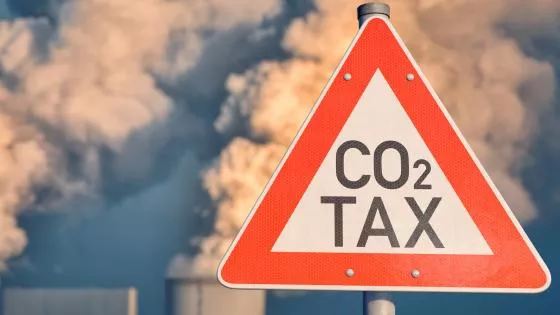
The mechanism was found in the form of taxing "dirty energy," i.e., introducing a tax on electricity obtained by burning fossil fuels. More precisely, starting from the assumption that every process of any production or service requires energy, those products and services produced using dirty energy will be burdened in the final price of the product with a tax due to the "carbon footprint" they leave in the atmosphere.
This will result in such products and services not being able to be competitive on the demanding European market, which will largely weaken their market position and reduce the profits of such companies.
On the other hand, those companies that recognized this danger to their earnings and profits in time, by implementing various energy efficiency measures and mastering the process of electricity production from a renewable energy source, have eliminated this tax from the product price and also reduced or eliminated their electricity bills because they now produce it themselves and consume it, selling the surplus.
To create a distinction on the market between products obtained using clean energy in the production process and those produced by burning fossil fuels, the so-called guarantee of origin was introduced.
A guarantee of origin for electricity means a document, proof, or certificate, either in electronic or written form, confirming to the end user that the amount of electricity or a given share of it was produced in a facility using renewable energy sources. In today's business world, the business model of operating with a reduced carbon footprint in the final product is becoming increasingly dominant. This model implies socially responsible business, active fight against climate change, and suppliers are increasingly required to ensure that the goods they deliver to the market are produced from renewable energy sources.
Where is BiH?
Now we come to the real question, which is where does the state of Bosnia and Herzegovina stand? The state of Bosnia and Herzegovina is a signatory to the Green Agenda for the Western Balkans, a document that is an integral part of the Sofia Declaration, adopted in Sofia on November 10, 2020, at the Western Balkans Summit within the Berlin Process initiative. This Agenda directly builds on the European Green Deal (the so-called Green Plan) adopted by the EU in 2019, which should make Europe the first "climate-neutral" continent by 2050.
To achieve this ambitious goal, all signatory states must work on introducing clean energy to drive all economic processes. In this regard, the Action Plan for the Implementation of the Sofia Declaration was adopted in October 2021, and of course, all signatories committed to adhering to it. Any delay in implementing the measures from this plan produces significant negative effects on the Bosnian-Herzegovinian economy.
On the other hand, the orderly and timely fulfillment of assumed obligations will have multiple positive effects on the economy and the health of the population.
One of the measures that was foreseen and announced in time to the authorities of Bosnia and Herzegovina is the introduction of the carbon tax (CBAM) on January 1, 2026, on all products imported from third countries into the EU territory, including products from Bosnia and Herzegovina. This means that every exporter will have to have a guarantee of origin for electricity when exporting their goods and will have to prove it by presenting a certificate, or if they do not have one, they will have to pay an additional tax on the products they export to the EU territory, which puts our exporters in a very unfavorable position.
That the current political authorities in the state of Bosnia and Herzegovina are incompetent is something we have had the opportunity to witness many times so far. The worst example of their inability and incompetence in leading socio-political processes is the attack on the constitutional order of the state of Bosnia and Herzegovina that is underway and the introduction of the state into the greatest political crisis since the end of the war in 1995, the direct culprits of which are the parties from the federal troika.
(Re)sourceful Nikšić
The latest statement by the imposed Prime Minister of FBiH, Nermin Nikšić, in which he tries to justify and whitewash himself in the eyes of the public due to the obvious delay in the energy transition and the introduction of guarantees of origin for electricity in Bosnia and Herzegovina, which results in putting our exporters in a very unfavorable position on January 1, 2026, seems at the very least pathetic and miserable. How long will we, as citizens of this country, be humiliated by the current federal government, which is unable to recognize and prioritize its work and make timely decisions and solutions, but will, for who knows how many times, invent excuses and beg EU leaders to turn a blind eye, all due to its own incompetence?
When Nikšić says that "there are indications that the deadline for the start of the application of the taxes could be extended, but we cannot rely on that," it only means that he will beg the EU to accommodate him and postpone the deadline for the start of the implementation of the measures.
The Prime Minister only now remembered to say "that we must create the preconditions to have sufficient amounts of energy from renewable sources, which will then ensure that our economic entities do not pay taxes when exporting these products"?!
He remembered such an important measure six months before its entry into force, and until then he dealt with the ban on smoking in facilities, non-working Sundays, a minimum personal income of 1,000 KM, and other cosmetic and populist measures.
It is as if he lives in a parallel universe or assumes that we do not understand the processes, so with his statements he tries to defend what cannot be defended. And that is that he is directly responsible for why we are late, as he says, "with creating the preconditions" to have sufficient amounts of energy from renewable sources.
In any case, if the imposed Nermin Nikšić does not succeed in fawning and pandering to EU leaders to accommodate us once again and postpone the introduction of the carbon tax, may God help us from January 1, 2026, because that is all that is left to us when it is evident that there is no expertise, knowledge, or competence among those who currently present themselves as the current government.
Komentari (0)
Prijavite se za komentiranje
PrijavaJos nema komentara. Budite prvi!
Minuta
Sve →Iz drugih kategorija

High Representative Not Elected: Germans, French and British Sabotaged Americans, New Attempt at End of June

ČOVIĆ WITHOUT MERCY: How Those Who Brought Ademović to Office Created a Political Hell for Him



Sunny Saturday, quite warm



Tragedy in Albanian resort: Two minors drown












