
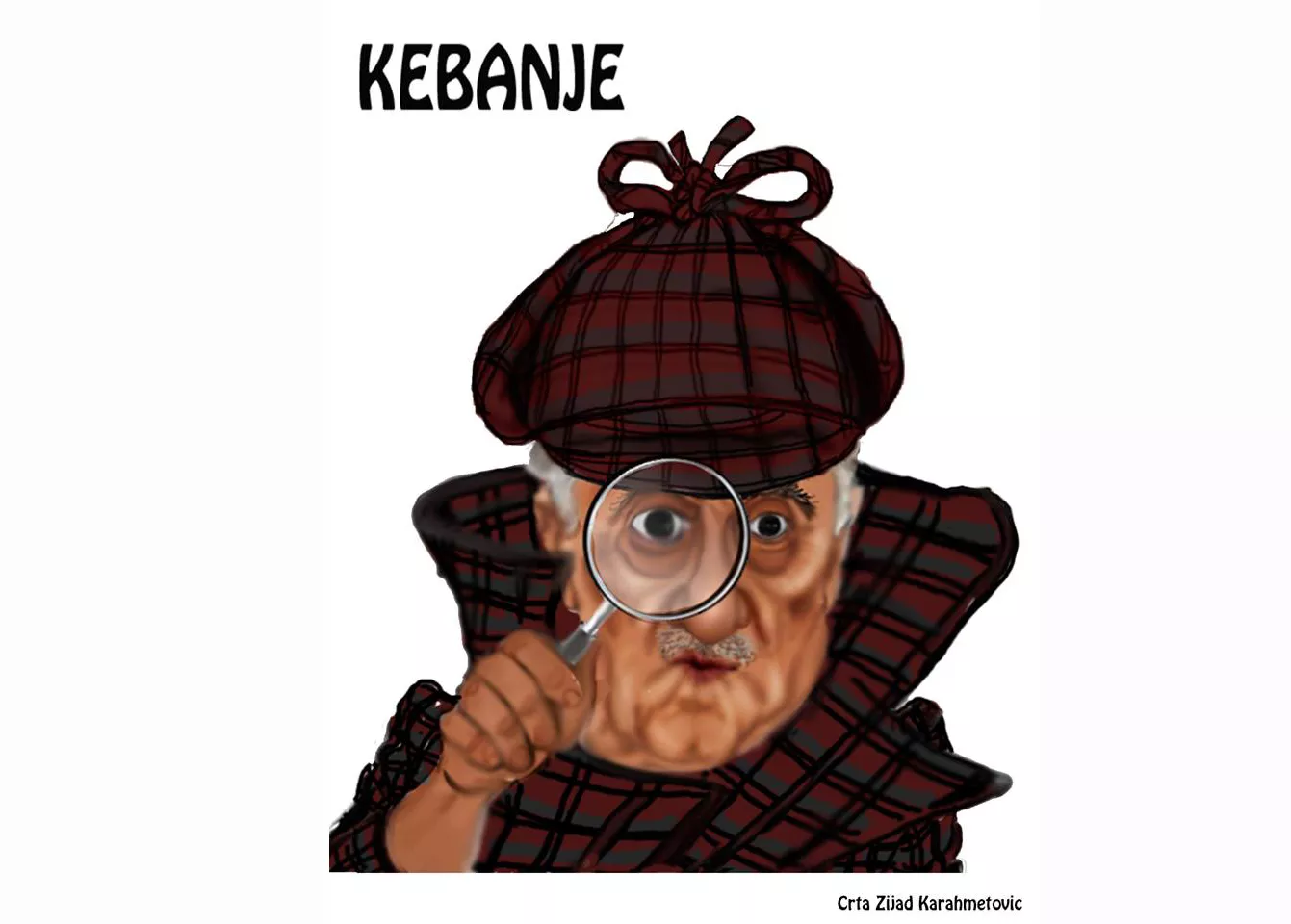
Among the latest works of Bosnian cartoonist Zijad Karahmetović (56) is a caricature of Mirsad Kebo, the Vice President of the Federation of BiH, which Karahmetović called 'Kebanje'.
Kebo submitted documentation to the BiH Prosecutor's Office concerning alleged crimes of the Army of RBiH against Serbs during the conflict in BiH in Vozuća near Žepčа in 1994, which triggered a wave of criticism from former Army members, who deemed Kebo's move shameful. As a former member of the Army of BiH, Karahmetović did not sit idly by either.
- I react to everything that touches me in society, positively or negatively. More often negatively. Caricatures are fiercer, or even have a dose of malicious mockery if people from this political dung heap of ours dare to insult two things: Bosnia and my intelligence. That's why Dodik is a frequent guest. And Kebo, although a pale and fundamentally insignificant person, thus broke through to the top of my electronic pen. (If this angers him, I will admit to him that I am also an insignificant cartoonist, with the caveat that I have never sold my patriotism.) - says Karahmetović in an interview for the BiH news agency Patria.

Emil Vlajki, representative of Croats in RS, of Jewish origin.....in short, a GMO phenomenon
He previously drew caricatures of former SDP president Zlatko Lagumdžija, SBB leader Fahrudin Radončić, Denis Zvizdić, Nikola Špirić, Dragan Čović... However, he jokes that he hasn't had the luck of some powerful figure threatening him over his caricatures, so he could become famous for it.
- I draw my buddies and those I think do something for other people, not just themselves, affirmatively, adorned, enthusiastically... and I make politicians uglier, darker, and grayer, because I figure, if caricaturing people is a sin, then when it comes to them, that sin is the smallest, if not forgiven, automatically. This shows that I am not a professional, that I am in a way a corrupt cartoonist - says Karahmetović with a laugh.
Karahmetović was born in Lukavac, under the coke plant chimneys. Because of this, his friends and he were called Koksarčani (coke plant workers). Karahmetović says that this is understandable considering they grew up in the coke plant's cinema, cultural center, football field, the first television he watched was the coke plant's...
And, they were all members of the coke plant's pioneer firefighter squad from the age of seven. Of course, their first workplace was also in the coke plant.
When the first conflicts in BiH began, Karahmetović, like other Bosnians and Herzegovinians, had to squeeze every kind of energy out of himself to feed his family.
He remembers, he says, that people liked to read a magazine that he and his friends printed on a typewriter in high school and drew caricatures of professors by hand, in a single copy. Back then, he says, it was fun for people, and then came the time when he started earning money from caricatures.
His first caricatures were published by Sadik Salimović, who was then editing the wartime edition of Sarajevo's Večernje novine in Tuzla. For one caricature, he received 2.5 DM (former German mark). It took him five or six caricatures to buy a liter of cooking oil. Tuzla-list also bought several of his caricatures.
- After all that, Rešid Ahmetović, the owner of the bi-weekly Bosna Est from Tuzla, hired me as an illustrator, cartoonist, and later as a journalist and finally as an editor. I worked there with an excellent team of people whose names still mean a lot in the world of Bosnian journalism today. Back then, newspapers without a news caricature were hard to imagine, the hunger for information was great, so there was enough work for cartoonists, even though the territory where the newspapers were sold was small, and limited by weapons and hatred.
Karahmetović stopped drawing caricatures when his daughter was born at the end of the conflict in BiH, and she had serious health problems. That, he says, directed his life in another direction. He put aside, he explains, the jokes, pens, and inks, and began a serious life battle for his Sabina.
Karahmetović now lives in Sarajevo, on a street named after Adija Mulabegović, next to Hasan Fazlić, the best Bosnian, and for him, Yugoslav cartoonist. It was, he says, an unusual fate, unprovoked.
Today, he draws caricatures for his own pleasure. Some portals still publish his caricatures, which he gives away for free, and some, he says, won't even take them for free because they recognize the owners in them, writes Patria.
You can see more of Karahmetović's caricatures on his Facebook profile.
Komentari (0)
Prijavite se za komentiranje
PrijavaJos nema komentara. Budite prvi!
Minuta
Sve →Iz drugih kategorija

High Representative Not Elected: Germans, French and British Sabotaged Americans, New Attempt at End of June

ČOVIĆ WITHOUT MERCY: How Those Who Brought Ademović to Office Created a Political Hell for Him



Sunny Saturday, quite warm



Tragedy in Albanian resort: Two minors drown












