
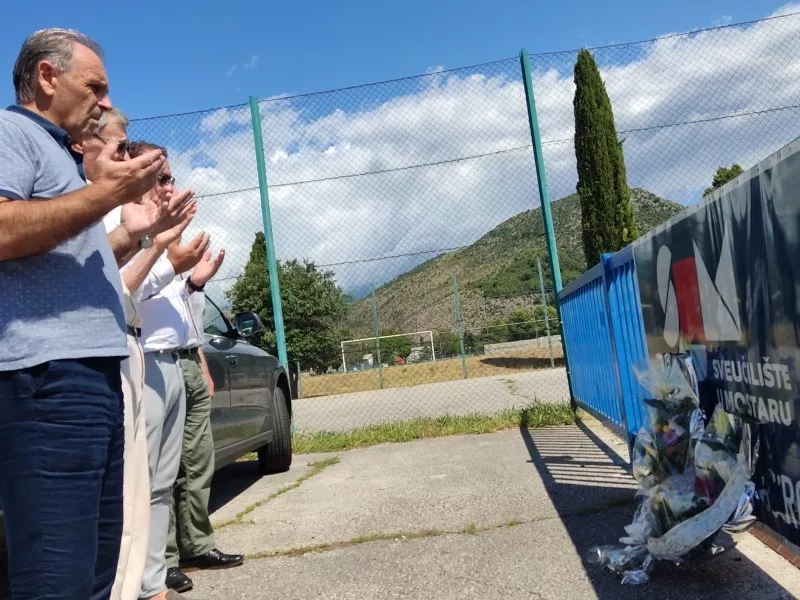
(Patria) - A delegation of the Association of Camp Survivors (UL) of Mostar, the Association of Intellectuals Krug 99 from Sarajevo, which included David Pettigrew, a professor of philosophy, Holocaust and genocide studies at Southern Connecticut State University from the USA, was today denied access to the building of the former camp of the Croatian Defence Council (HVO) Heliodrom, in the settlement of Rodoč, near Mostar, reports mostarski.ba.
As previously announced by the Association of Camp Survivors of Mostar, “this activity represents a protest against the uncivilized construction of the HVO Museum on the site of the suffering of camp survivors from the City of Mostar and Bosnia and Herzegovina.”
“For us, this was not a political stance, but a human one – to send a signal that it is not right to think about establishing some kind of museum for the HVO in such circumstances, in such a place, where such heinous crimes were committed,” Bojan Šošić, a member of the Presidency of the independent Association of Intellectuals 99, told the media.
At the gate of the complex of the pre-war JNA barracks in Rodoč, now part of the University of Mostar campus, a guard informed the delegation that they did not have permission to enter the building where the construction of the HVO museum is planned. The Association of Camp Survivors of Mostar stated that they had informed the rector of the University of Mostar, Prof. Dr. Zoran Tomić, of their intention to lay flowers seven days earlier.
UL Mostar has previously expressed opposition to the construction of a museum in the building they claim was the central building of the camp through which about 10,000 people, mostly civilians, predominantly of Bosniak ethnicity, passed.
“We came here to the Heliodrom complex to pay tribute to all the camp survivors who suffered and to show the true face of those who are building a museum in this area today and the true face of those who rule this area,” said Emir Hajdarović, president of UL Mostar.
He said that today's ban on laying flowers in front of the site of the camp survivors' suffering is a policy that is merely “a continuation of everything that happened in 1993 and 1994.”
Prof. David Pettigrew, among other things, said that by his presence at Heliodrom he remembers the victims of war crimes committed at that place, war crimes “that were part of a joint criminal enterprise aimed at creating Herceg-Bosna in pursuit of a Greater Croatia.”
“I also condemn the plan to create a museum that will in any way commemorate members of the HVO, who committed crimes right here,” Prof. Pettigrew said, among other things.
The HVO Museum is supposed to be opened in the “Stanislav Baja Kraljević” barracks in the Mostar neighborhood of Rodoč, with co-financing from the Ministry of Defence of Bosnia and Herzegovina.
This is the area where, according to former camp survivors, the central prison of the Heliodrom camp was located, where HVO members imprisoned Bosniaks during the war in the 1990s.
The HVO camp Heliodrom in Mostar was one of the most notorious during the past war in Bosnia and Herzegovina, and it was open from September 1992 to April 1994.
The International Criminal Tribunal for the former Yugoslavia, in November 2017, for crimes committed in the 1990s, finally convicted the leaders of the so-called Herceg-Bosna to a total of 111 years in prison. The verdict also mentions the establishment of camps for Bosniak civilians.
The Hague Tribunal also convicted members of the HVO Punishment Battalion, Mladen Naletilić to 20 years in prison and Vinko Martinović to 18 years in prison for crimes committed at Heliodrom.
Former camp guards, Miroslav Marijanović and Ante Buhovac, were sentenced to seven years in prison by the Cantonal Court in Mostar in 2007. The Appellate Chamber of the Supreme Court of the Federation of Bosnia and Herzegovina issued a final verdict sentencing Marijanović to two and a half years and Buhovac to two years in prison.
The Court of Bosnia and Herzegovina, on February 24 this year, sentenced three former HVO members in the first instance. By that verdict, Nedžad Tinjak was sentenced to 13 years in prison, Jure Kordić was sentenced to three years, and Dražan Lovrić to one year in prison.
The Prosecutor's Office of Bosnia and Herzegovina charged them with persecution and abuse of the Bosniak population of Mostar, and imprisonment in camps, including Heliodrom.
During the 1990s, Mostar was the scene of fierce conflicts between the Army of the Republic of Bosnia and Herzegovina and the HVO.
Heliodrom is one of about ten camps that, according to the records of the Association of Camp Survivors of Mostar, were established at the time by the self-proclaimed Croatian Republic of Herceg-Bosna.
It was a para-state entity from 1991 to 1994, founded by the Croatian Democratic Union (HDZ) of Bosnia and Herzegovina and the HVO, which was abolished with the signing of the Washington Agreement in February 1994.
According to data from Mostar camp survivors, about ten thousand residents of Mostar passed through Heliodrom, including citizens of Bosniak and Serbian ethnicity from other parts of Bosnia and Herzegovina.
Komentari (0)
Prijavite se za komentiranje
PrijavaJos nema komentara. Budite prvi!
Minuta
Sve →Iz drugih kategorija

High Representative Not Elected: Germans, French and British Sabotaged Americans, New Attempt at End of June

ČOVIĆ WITHOUT MERCY: How Those Who Brought Ademović to Office Created a Political Hell for Him



Sunny Saturday, quite warm



Tragedy in Albanian resort: Two minors drown












