
The shortest path to a stable government after the 2014 elections would lead through the SDA, towards a broad coalition of reform forces. However, the parties favored by diplomatic circles as reform-oriented, namely the SBB and DF, will not enter a coalition with an unreformed SDA!
In the same context, one can also speak of an unreformed SDP, but the SDP is less attractive due to its electoral debacle. However, the principle is the same.
Both the SDA and the SDP were, even just before the elections, marked as parties lacking flexibility, mobility, and the capacity to inject freshness into processes that should be broadly reformist, from fighting for disenfranchised and humiliated citizens to combating corruption, first within their own ranks.
Important Parties
Nevertheless, both parties are important, so their role cannot be denied because they have ossified in negative trends; rather, the imperative should be "democratization on the go," in order to simultaneously preserve and utilize their electoral legitimacy, but under the condition of changing things within the SDA and the SDP.
This would mean identifying those points within the SDP and SDA that need to be urgently changed or neutralized. And these points are easiest to recognize and determine through the key criticisms leveled at each party by political opponents.
The situation is clear: on one hand, we have a possible coalition of the SDA and SDP, with a few additional supporters, and on the other, a coalition of the SBB and DF, also with a few additional supporters. These would be very fragile coalitions, prone to crises, party defections, and collapses, given that the stability of the majority varies from canton to canton.
A Firm Coalition
The interest lies in forming a broader, firmer, long-term oriented coalition, in which party legacy would be subordinated to expert engagement. We immediately encounter a problem, since the electoral legitimacy that the SDA possesses does not obligate this party to any expertise, care, or responsibility, simply because the votes came "sight unseen."
The SDA's electoral victory was achieved through old marketing models that aim for ethno-national homogenization, in the name of dangers threatening from left and right.
Apart from Bakir Izetbegović's vague slogan about creating 100,000 jobs, nothing happened in that SDA campaign that would indicate concern for the people in economic and social categories.
And the votes arrived, more numerous than in the past ten years, which is an additional factor distancing the SDA from the imperative for change. Why would the SDA strive for change if, exactly as it is, static and unreformed, it managed to achieve a better result than in the previous and pre-previous elections? This difficult question can only be addressed through conscience and long-term interest.
Today, the SDA finds itself in a position to bear the greatest responsibility for blockades of reform processes, which will, in the long run, take on the dimension of historical responsibility for everything BiH could have achieved but did not.
The International Factor
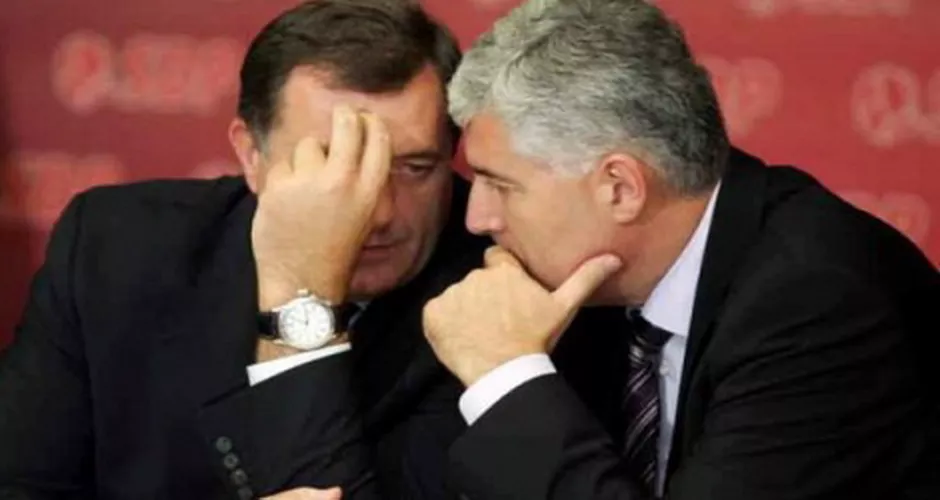
The true obstructers, located at Greater Serbian and Greater Croatian addresses, could be absolved, precisely in the name of the SDA's inability to change and represent a reform course. Simply put, Čović and Dodik will play the blockade game, and the SDA, i.e., the Bosniaks, will bear the responsibility.
It need not be repeated that the international factor focuses its interest on areas with a Bosniak majority, precisely in the context of this exaggerated so-called Islamic danger supposedly threatening Europe from Bosniaks.
We may know that this is a manipulation, used to strengthen Greater Serbian and Greater Croatian positions, but what we know does not affect the reality that is what it is. It must finally be understood that in political perception, one thing is what it is, and another is what it is made out to be.
Thus, the international factor wants to see reforms among Bosniaks, over Bosniaks, and only then from left and right. If Bosniaks remain, without any rational need, trapped in patterns of the past, in the oligarchic rule of Bakir Izetbegović, they will suffer various insults, untruths, blockades, and humiliations in the coming years... Without reason. Why?
So that Bakir Izetbegović would be first among Bosniaks. Is the position of "first among Bosniaks" worth the (self-)isolation of Bosniaks?
The same applies to the SDP, whose reform imperative has been reduced to the ultimate necessity that Zlatko Lagumdžija finally leave the party leadership.
It is clear, it is obvious, everyone agrees on this – the SDP cannot move forward as long as Lagumdžija is at the head of the party. The Democratic Front will not work with Lagumdžija's SDP, nor will the SBB, nor will prominent SDP members, meaning the SDP membership faces a clear dilemma: either the SDP will move forward without Lagumdžija, or the SDP will disappear in the name of Lagumdžija's utterly senseless playing at being a lifelong leader?
The NDI (American National Democratic Institute) recognized this, as did the diplomatic mentors, who refused to give the usual support to the SDP before the elections. Even then, it was known that Lagumdžija had to go, and the electoral debacle only sealed it.
Isolation of Bosniaks
In the context of the SDA and the rising rule of Bakir Izetbegović, this story is even more drastic. Precisely because the stakes are higher and the losses greater.
There is no chance whatsoever that a reform government in BiH can be formed through Bakir Izetbegović. To put it directly: the SDA is desirable, but Bakir Izetbegović is not. The SDA is a factor, but Bakir Izetbegović is not.
This is not about any animosity from someone or something towards the son of Alija Izetbegović, but about a rational calculation, according to which individuals with various mortgages cannot be legitimate as reformers. Bakir Izetbegović, for example, has electoral legitimacy, but he lacks the kind of legitimacy that would make him trusted as a man who can guarantee and implement a reform course.
The international factor does not want him, nor do the SBB and DF, nor does the SDP, except by force of interest, which means the doors are closed to Bakir Izetbegović everywhere. With him, the SDA cannot get anywhere, except into its own isolation, and the isolation of Bosniaks.
Komentari (0)
Prijavite se za komentiranje
PrijavaJos nema komentara. Budite prvi!
Minuta
Sve →Iz drugih kategorija

High Representative Not Elected: Germans, French and British Sabotaged Americans, New Attempt at End of June

ČOVIĆ WITHOUT MERCY: How Those Who Brought Ademović to Office Created a Political Hell for Him



Sunny Saturday, quite warm



Tragedy in Albanian resort: Two minors drown












