
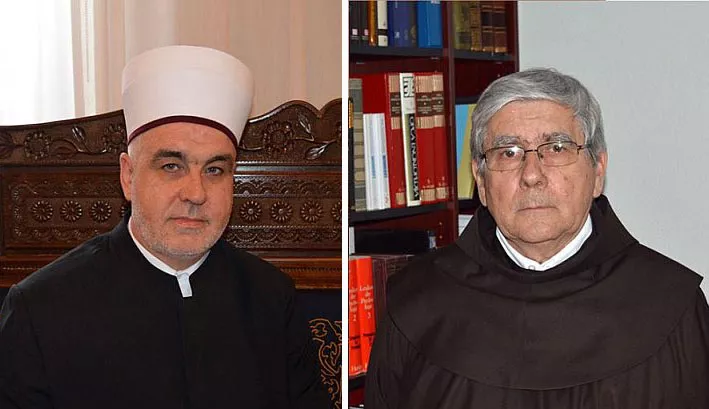
Mufti Kavazović was captured by the HVO in 1993 near Konjic, so the guardian of Tuzla, Matanović, embarked on a rescue mission.
It is a story of the kind that certainly existed during the war of the '90s in the former Yugoslavia, but not much was said about them. Especially in wartime. Rescuing the "other and different" could cost one their head back then.
This is precisely the case with Father Petar Matanović, who in the evil war times was the guardian of the Franciscan Monastery of Saints Peter and Paul in Tuzla, and with the story of how, at the height of the Bosniak-Croat conflict, he tried to extract Imam Husein ef. Kavazović from captivity, who had just assumed the position of mufti of Tuzla.
Father Petar is now in well-deserved retirement, and ef. Kavazović is the reisu-l-ulema of the Islamic Community in Bosnia and Herzegovina.
- Father Petar Matanović is a man whose image I will fondly remember throughout my life. He, by his moral character, by his habitus, could at the same time be a Muslim, a Christian, and a Jew. He could unite all of that within himself. He is truly a man of very high moral qualities," says reisu-l-ulema Kavazović to Al Jazeera journalist Mladen Obrenović, reports the Patria news agency.
Religious leader arrested
At the beginning of 1993, just as the conflict between the former allies from Bosniak and Croatian ranks flared up, the still young Imam Husein ef. Kavazović from Gradačac arrived to take up the position of mufti of Tuzla. And just after assuming the position, on his way back from an official trip, the new mufti was captured in the Konjic area.
- Those days, it was mid-March of that 1993, Mufti Kavazović and Prof. Dr. Salih Kulenović, president of the Party of Democratic Action for the Tuzla region, officially went to Zagreb and Croatia. There were about ten of them in that delegation, and after the clashes in Jablanica and Konjic, they were returning home via a roundabout route. They were told in Jablanica that the road to Konjic was clear. They set off, not counting on the Croatian Defence Council holding one part of the main road at the entrance to Konjic. They ran into HVO soldiers, who captured them and took them to prison - begins Father Petar's story.
About everything that happened 22 years ago, just like every detail of his life rich in people, events, and situations, Father Petar tells with incredible precision. He remembers every date, every detail, and every character on the stage.
He recounts how the story spread through Tuzla and all of Bosnia and Herzegovina that the mufti, as well as one of the SDA leaders, had been captured.
- A really ugly story was created, because a religious leader was arrested. Just as it would be for Catholics if a bishop were captured, or for Orthodox if a bishop were captured, that's how it looked - adds Father Petar.
- They knew well who they had captured, but I was treated like all the other prisoners who were in the camp at the time. There were people who were in worse conditions than I was. I also had some work obligations, but some were taken to the front line to clear the terrain. There were also people who were literally beaten in the camp. They were constantly beaten. Some people were handed over to the Chetniks as prisoners, so the Chetniks beat them, and some were killed. I was only beaten once - says ef. Kavazović.
Guardian Matanović immediately got involved in attempts to secure the mufti's release from the HVO, addressing many addresses, "but days and months passed, and nothing happened."
- One day, Selim Bešlagić (then president of the Tuzla Municipality) came to me and said they had to give me a police escort, because a problem had arisen - some extremist groups were planning to capture me, as the guardian, and exchange me for the mufti. If that had happened, it would have been a terrible problem in the Tuzla region. I replied that I would not like police officers to follow me when I go to mass and other official and unofficial visits. Nevertheless, they assigned two police officers - a Croat and a Muslim - who were in front of the monastery day and night - Father Petar tells Al Jazeera.
Prisoner exchange
The agony of the captured mufti, Kulenović, and other Bosniaks lasted for half a year when the idea was born to send Father Petar to Konjic on a rescue mission. Via the so-called hotline, a connection was established between the Army of Bosnia and Herzegovina and the HVO in the Konjic area, and Father Petar soon, together with Pejo Banović from the civilian structures of the HVO, set off on an uncertain journey.
Upon arrival in Konjic, he immediately asked to see the mufti and Kulenović. He greeted them cordially, and then he and Banović were taken to the HVO command, where negotiations began.
- I didn't know Father Petar Matanović that well before. We met once or twice before in Tuzla, but those were very brief conversations. Those were war times and everyone had their own obligations. I heard that he also had some pressures in Tuzla, because it was wartime, difficult times, in which people think differently - points out ef. Kavazović.
At the same time when a group of about ten Bosniaks from Tuzla, who were captured in villages near Konjic, about 450 captured Croats were in the sports hall at Konjic's Musala. Knowing who they had captured, the HVO believed they could get all their comrades in exchange.
- They considered that having the mufti gave them capital value, because at that time people were not seen as individuals, but how best to achieve some interest. I knew they were asking for too much, so we tried to persuade them to reduce that number. We managed to agree on a number of 150 people who would be exchanged, as it was said, 'one for one'. Since they had only ten people for exchange near Konjic, it was necessary to get consent from Mostar to release 140 Muslims from their 'collection centers'. The HVO representatives agreed to this agreement with great difficulty, but when we returned to Konjic, it didn't work with the representatives of the Army of Bosnia and Herzegovina - adds Father Petar.
His attempts to free the mufti and the captured Tuzla residents with him, as well as the captured Croats on the other side, lasted a full eight days. He crossed from one side to the other. He also experienced unpleasantness, so during mass, some individuals would taunt him that he was "Alija's spy" or ask "why don't you stay with them if you're some kind of Croat and friar." They did not confuse him and he did not give up.
"There was some municipal leader there, in Konjic, a real grey eminence among the Muslim civilian and military authorities, without whom nothing could be done. Although everything had been agreed upon at the military command, and even in Sarajevo, we still did not accomplish the job we came for - Father Petar states with regret.
'The message was important'
A month after his mission, Kulenović was released first, then Mufti Kavazović.
- It seems to me that that trip was not in vain. The message sent by my going to Konjic was important, because I went there and tried something. I simply tried to help to the extent that it was objectively possible to help in such situations at that time - states Father Petar.
- Regardless of how it all ended, it was very noble and it testifies to a man like Father Petar Matanović, to the moral character of a man who constantly helped people in the Tuzla region, not looking at whether they were Bosniaks, Croats or Serbs, whether they were Muslims, Catholics or Orthodox - ef. Kavazović speaks of past times.
After returning from captivity, Mufti Kavazović contacted him, they often saw each other while Guardian Matanović was serving in Tuzla, and afterwards as well.
For everything he did in the war, not only in the attempt to rescue ef. Kavazović, but also in various humanitarian actions, mediating to calm tensions, helping to overcome certain political and inter-ethnic crises, rescuing other people from captivity, Tuzla thanked Father Petar Matanović with a special charter.
- I feel that gratitude from the people of Tuzla, and not only from them, at every meeting with them. I consider everything I did positive, and whether I would have the strength to repeat it all - I think I would. If my homeland Bosnia and Herzegovina and all its good people, God forbid, found themselves in a similar situation, I would not leave this region, especially if I knew I could contribute in any way to more easily overcoming difficulties and challenges. I cannot change - concludes Father Petar Matanović one of his life stories.
THERE WAS NO RETURN
- I must admit that I thought about everything. I cannot say that I did not feel some form of fear. There was a well-founded suspicion that the story for which the police were guarding me would happen and come true, according to which I was threatened with kidnapping, especially if we failed. Nevertheless, I entered that very dangerous game and it was all over: there was no return... It was human to try something - Father Petar recounts the events of August 1993.
- When it comes to Father Petar, he is a noble man, a man who lived and lives his faith the way a true believer should live. All the residents of Tuzla know this noble man well, who helped a great many people. I am personally grateful to him for the initiative to try to free people - states ef. Kavazović.
'THE MUFTI CALLED ME TO THE FIRST ROW'
- I remember a funeral in Brčko, many years after I left Tuzla, when victims from a mass grave found near Gorica were buried. One of the victims was a Croat, my relative. When I came to the farewell, I stood not far from the place that was marked and prepared for the imam's prayer. Then Mufti Kavazović saw me, approached me with respect, and we cordially greeted each other in front of all the participants. He called me and offered me a place next to him, as they say - in the first row. I said I would, nevertheless, stay a little to the side, because it is not right that while they are praying, I sit or stand. I don't know how to pray, and if I did, I would also pray and pray to God in that way, because prayer is prayer - Father Petar recounts post-war meetings with ef. Kavazović.
Komentari (0)
Prijavite se za komentiranje
PrijavaJos nema komentara. Budite prvi!
Minuta
Sve →Iz drugih kategorija

High Representative Not Elected: Germans, French and British Against Americans, New Attempt at End of June

ČOVIĆ WITHOUT MERCY: How Those Who Brought Ademović to Office Created a Political Hell for Him



Sunny Saturday, quite warm



Tragedy in Albanian resort: Two minors drown












