
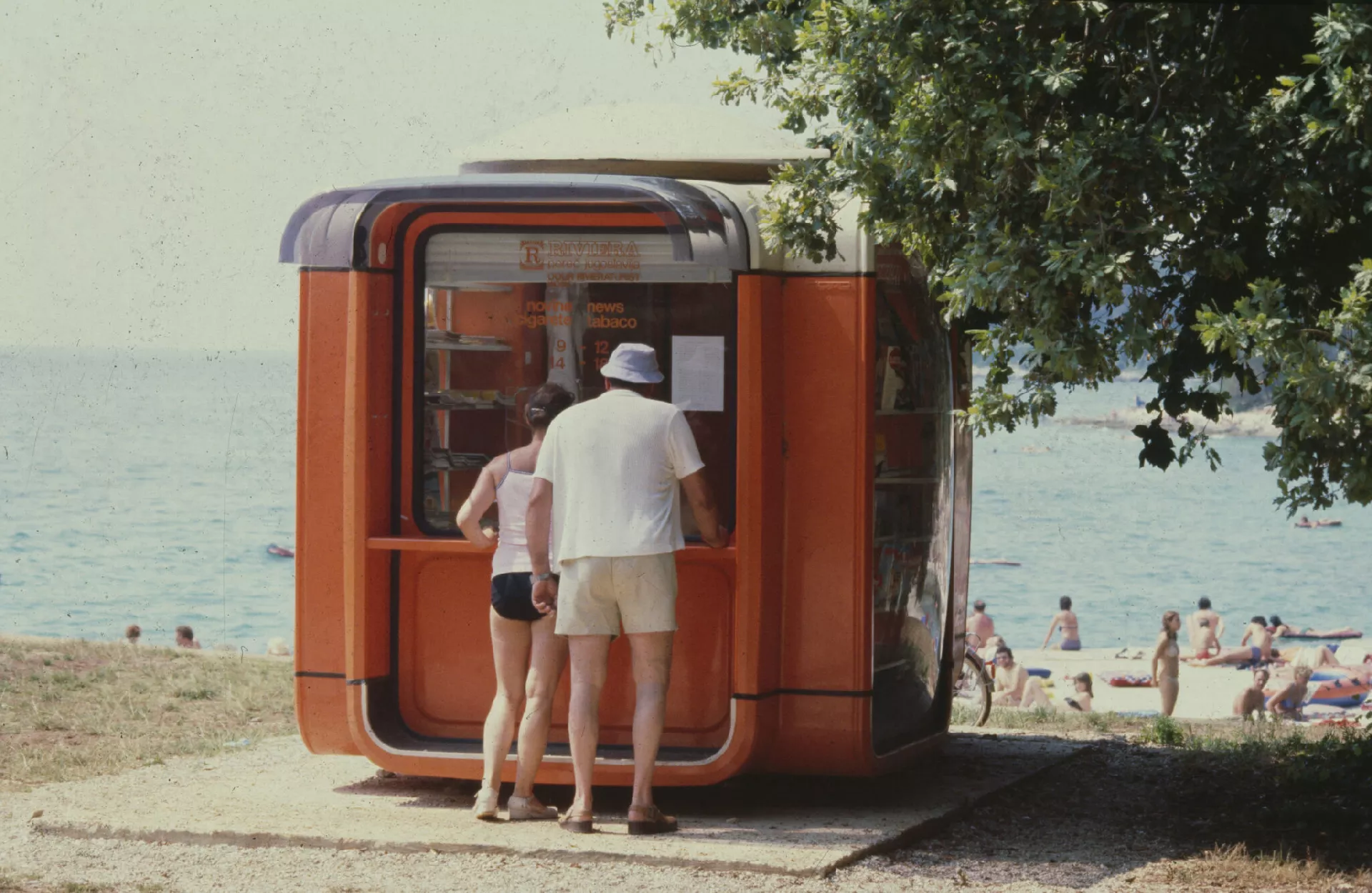
(Patria) - You could buy newspapers, cigarettes, lottery tickets, tickets, sandwiches, flowers, and much more there.
The recognizable cube with rounded edges, white, orange, blue, yellow, or red, was a part of everyday life across former Yugoslavia for decades.
The K67 kiosk remains an icon of Yugoslav design to this day, and it still has a place in the modern world, writes Punkufer.hr.
The K67 kiosk, by Slovenian architect and designer Saša Mächtig, a simple plastic "house", transformed the urban landscape of Yugoslavia with its timeless design and boundless functionality, as well as the collective identity of its contemporaries in the 70s and 80s of the last century.
Saša Janez Mächtig, born in 1941, graduated from the Academy of Fine Arts in Ljubljana, and the so-called competition B, an interdisciplinary program by Edvard Ribnikar inspired by the Bauhaus and the Ulm School of Design, certainly left its mark on his work.
He designed the K67 kiosk in 1966, patented it in 1967, and it entered mass production in 1968. It was produced by Imgrad from Ljutomer in Slovenia, and by 1999, when production was stopped, about 7,500 kiosks were produced.
The modules were designed for use as individual units or in combination, and the initial scheme consisted of five basic supporting elements, while the additional equipment included canopies, shelving systems, and interior lighting.
The K67 kiosk traveled from Ljutomer to New York as early as 1970. It was supposed to be exhibited at MoMA at an exhibition of recent acquisitions, but as the transport was delayed, it did not make it into the gallery, so it remained on the street in front of it, on the sidewalk of 53rd Street, where it actually belonged.
This episode inspired Mächtig to present a second-generation model as early as 1971 - this one could be completely disassembled into its component parts.
The most produced K67s remained in Yugoslavia, but some also "went" abroad - to Poland, Japan, New Zealand, Kenya, Iraq, the Soviet Union, and the USA.
The simplicity and adaptability of the K67 kiosk, which balances somewhere between urbanism and design with its modularity and functionality, have secured it cult status and a long life.
The K67 can literally be anything, but it is unlikely to be forgotten. In recent times, the Museum of Architecture and Design in Ljubljana revived the memory of it with a retrospective exhibition of Mächtig's work in 2015.
Komentari (0)
Prijavite se za komentiranje
PrijavaJos nema komentara. Budite prvi!
Minuta
Sve →Iz drugih kategorija

High Representative Not Elected: Germans, French and British Sabotaged Americans, New Attempt at End of June

ČOVIĆ WITHOUT MERCY: How Those Who Brought Ademović to Office Created a Political Hell for Him



Sunny Saturday, quite warm



Tragedy in Albanian resort: Two minors drown












