
Written for NAP by: Prof. Dr. Hazim Bašić
The project of building the Southern Gas Interconnection has opened an important strategic question for Bosnia and Herzegovina: is the country building energy security or entering a project that in the long term weakens its sovereignty and distances it from the European energy strategy? Through the recently adopted amendments to the law in both houses of the Parliament of the Federation of Bosnia and Herzegovina, public management of the project (BH-Gas) has been handed over to a newly established private American company, without references in this field. And this by introducing this 'company' into the very text of the law!
The Southern Interconnection gas pipeline project could have been realized even without amending the existing legal solution, and with the engagement of a foreign investor! The question justifiably arises: who needed such amendments? It is known to the public that the Croatian Democratic Union of Bosnia and Herzegovina strongly advocated for the exclusion of BH-Gas from the project. The animosity towards BH-Gas (read 'the state') is also evident from the very text of the amendments to the law, in which even the mention of the name BH-Gas is avoided. Namely, wherever in the text of the amendments to the law (even in their explanation) the name BH-Gas should have appeared, the clumsy term 'operator of the existing transport system' was inserted.
For comparison, these days (without media fanfare) a contract was signed for the construction of the Zvornik - Bosanski Novi gas pipeline, approximately 500 km long and worth approximately 1.3 billion BAM. The entity that is economically significantly weaker did not seek an 'American investor'! The project holder is the public institution Sarajevo-gas from East Sarajevo, and the consortium consists of five companies from Bosnia and Herzegovina and Serbia. Likewise, when Bosnia and Herzegovina signs a contract with Croatia, on the other side will be the public company Plinacro.
The amendments to the law also foresee a sudden significant expansion of the gas network, without prior economic analyses, cost assessment, analysis of consumers and required gas quantities, investment payback period, etc. This indicates that the entire project is not driven by well-conceived professional planning, economic logic and primarily domestic energy strategies, but by (unknown) foreign interests. The argument of 'diversification' is called into question due to the fact that the bidirectionality of the pipeline is foreseen only for the section controlled by BH-Gas (from Novi Travnik to Kladanj). The obligation to make this section reversible has been imposed on BH-Gas.
European Context
This project of strengthening gas infrastructure is happening at a time when the European Union is strategically reducing its reliance on fossil fuels. According to current plans, climate neutrality should be achieved by 2050. Already from 2030, a strong and accelerated withdrawal of fossil fuels from transport, heating and electricity production follows. EU energy institutions warn that the expansion of gas infrastructure in the Western Balkans can 'lock in' the countries of the region into long-term dependence on fossil fuels and hinder the energy transition.
Studies on the energy transition emphasize that the EU strategy for the Western Balkans implies a transition from fossil fuels to renewable sources. The EU considers gas as an energy source to be a transitional solution, and funding for cross-border gas projects is also being phased out. In other words, while the EU is rapidly transitioning to renewable sources and climate neutrality, Bosnia and Herzegovina is considering an investment that strengthens gas infrastructure as a long-term foundation of the energy system. Whoever plans energy solely around gas today risks planning for the past instead of the future.
To make the paradox even greater, by accepting the Reform Agenda, Bosnia and Herzegovina committed to the full implementation of the Third Energy Package, which is among the key priorities. Every country must have an independent regulatory agency for energy that oversees the market, tariffs, network access and consumer protection. Failure to fulfill obligations from the Energy Community Treaty creates a deviation from European integration.
Sovereignty or Geopolitical Compromise
The new law does not foresee only a gas pipeline, but also a broader energy transformation. The planned capacity of the gas pipeline far exceeds the needs and current consumption, because the project is conceived as a basis for the construction of gas power plants and a new energy structure of the country. This means that it is not only a matter of supply diversification, but a strategic choice of energy model for the coming decades. In this context, the decision on who manages the infrastructure becomes a matter of state sovereignty, not just a technical solution. It is still not known who will be the 'operator of the new transport system', after the investor recovers the invested funds.
Energy policy today is, more than ever, a matter of sovereignty. In a world where geopolitical influence is measured by control over energy flows, the decision on who builds and manages key infrastructure becomes a strategic decision. In such circumstances, the Southern Gas Interconnection ceases to be just an infrastructure project through which we get significantly more expensive electricity and significantly more expensive gas. It becomes a test of political maturity and state sovereignty. A test we did not pass.
If Bosnia and Herzegovina wants a European energy future, decisions on strategic infrastructure projects must be aligned with the long-term transition. Otherwise, the gas pipeline presented as a symbol of energy security could become a symbol of strategic dependence and a factor slowing down EU integration.
Komentari (0)
Prijavite se za komentiranje
PrijavaJos nema komentara. Budite prvi!
Minuta
Sve →Iz drugih kategorija
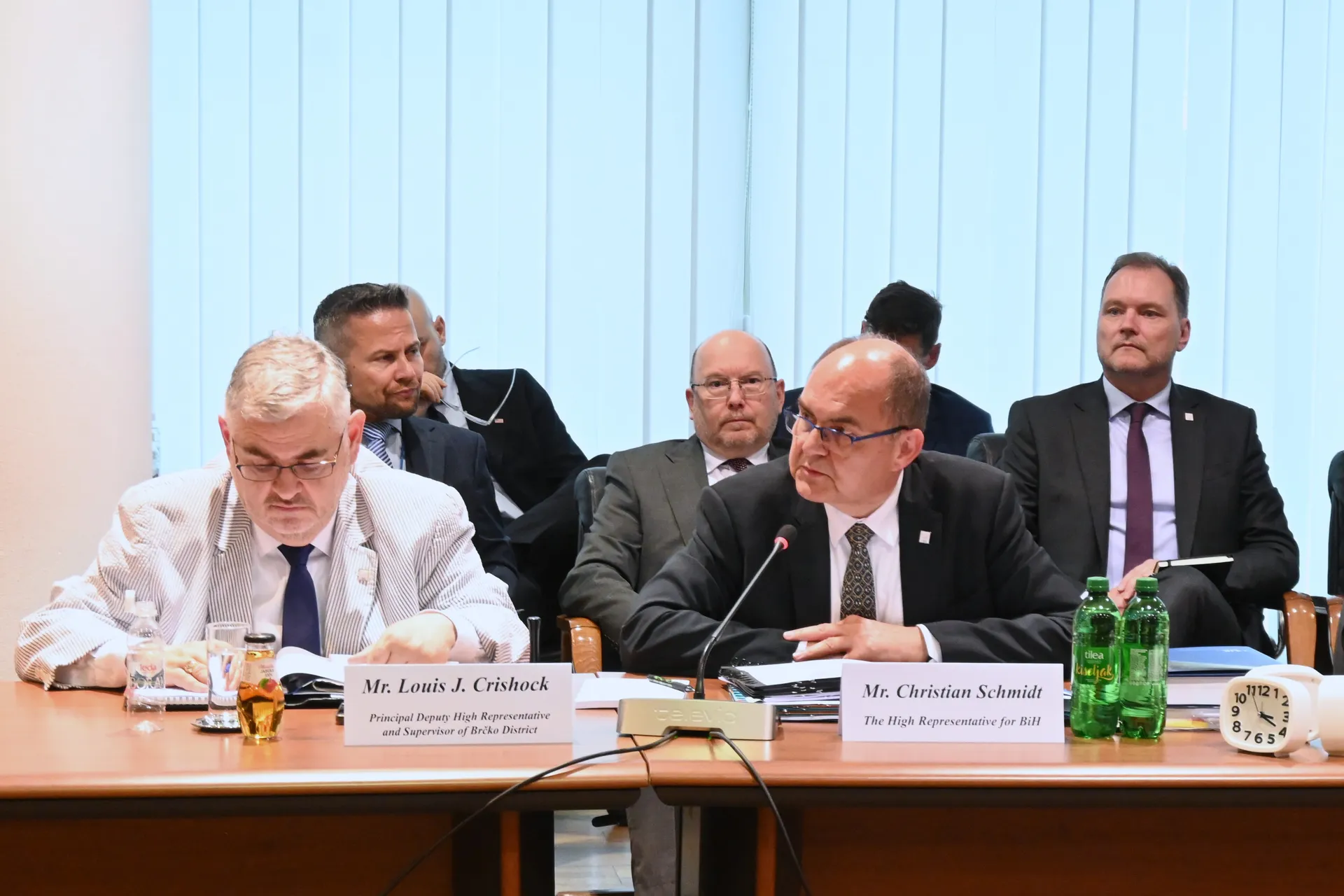
High Representative Not Elected: Germans, French and British Sabotaged Americans, New Attempt at End of June
ČOVIĆ WITHOUT MERCY: How Those Who Brought Ademović to Office Created a Political Hell for Him


Sunny Saturday, quite warm
Tragedy in Albanian resort: Two minors drown