
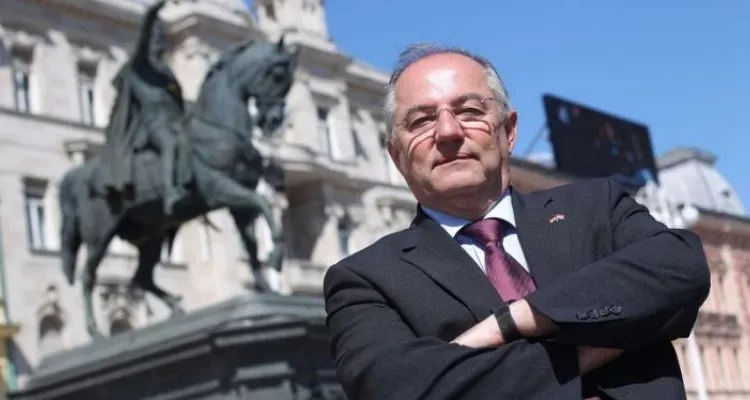
Josip Juratović, a Member of the German Social Democratic Party (SPD) and a member of the Bundestag's Foreign Policy Committee, spoke in an exclusive interview with the Patria News Agency about the political situation in BiH, our country's European path, the referendum in RS....
PATRIA: How do you assess and see the current political situation in BiH?
JURATOVIĆ: BiH is a divided country with a huge administrative apparatus, a country where 50% of the population does not cheer for the national football team, a country where the anthem is not sung but booed. The divisions are supported by the existing Constitution, and BiH is thus slowed down on the path to reforms. The political climate in BiH has a significant impact on the entire region, and all disagreements are reflected in the relations within the region.
Therefore, it is of great importance for all countries in the region to support the earliest possible entry not only of BiH but of all remaining members into the EU, because the European path is the only solution for BiH but also for the entire region if BiH is to act unitedly on that path. Currently, there is a pre-referendum toxic climate in RS, with which Dodik, using a proven method, tries to cover up the economic fiasco of RS with a repeated nationalist story about the referendum. Dodik also plays into the hands of his political colleagues in BiH who benefit from destabilizing the already unstable Balkans, and who, despite the devastating results of their governance, are once again eager for power and rule without responsibility, without accountability to the citizens. The citizens of BiH are the ones who can alone decide whether they want to join the EU or remain trapped in the ethno-national enclaves of their great leaders, while the youth leave to seek a better future in organized societies.
PATRIA: There are positive signals coming from Brussels for BiH regarding progress on the European path. How realistic are these signals in your opinion (or are they just a sign of encouragement that work must be done) and has BiH, apart from the declarative talk about EU integration, made concrete progress that is expected of it?
JURATOVIĆ: Judging by the latest reports, all vital economic parameters in BiH have increased. The 25,000 new jobs in the last 16 months, as stated in the reports, contribute to optimism, and this will certainly be recognized by the EU Commission. All three conditions set before BiH 18 months ago have been successfully realized, including the Coordination Mechanism, which took more time.
All of this shows how quickly some processes in BiH can be realized when there is political will. BiH has embarked on a good path and now needs the support of everyone, and a call for the preparation of an Opinion on BiH's application for membership will certainly come soon if the trend continues, provided that activism such as the referendum in RS does not drag society back again.
PATRIA: The pre-election campaign in Croatia and BiH, the talk about the referendum in RS has led to a boiling point in the region. Relations between Belgrade and Zagreb are strained, and it seems that everything is happening at the expense of BiH, including the referendum story, which benefits Serbia and Russia more than Milorad Dodik. How do you predict the unraveling of this Balkan knot, considering that citizens in all these countries fear potential armed conflicts?
JURATOVIĆ: The situation is not only tense in BiH with the referendum in RS. When we look at Macedonia, it is a country in disarray; in Kosovo, politics is still conducted on the streets; Russia's efforts to increase its influence in Serbia; the exchanges between Croatian and Serbian politicians are a real everyday occurrence in the Western Balkans. A society trapped in the past, combined with poverty, is a ticking time bomb that only needs a small spark to blow everything up. The only solution is the European path. However, one cannot join the EU without reconciliation in the region.
The political clique, aware that they will be held accountable for their misdeeds, is not very ready for the EU and fears the Sanader syndrome, regularly serving Balkan stereotypes about others being more dangerous, thereby hindering the path to European integration for the remaining Western Balkan countries. Therefore, peace initiatives in the region by networks of youth, veterans, intellectuals, religious communities, and parliamentarians are extremely necessary to find solutions and a path to coexistence, following the example of the EU.
If you elect national leaders on Sundays and complain about them to the international community on Mondays, and if you continue to build on the postulates that your nationality is more important than your job skills, I think it is clear to everyone that such a situation cannot bring any bright future. BiH's greatest strength lies in its citizens, who, by choosing a modern, pro-European civic state, can ensure a peaceful and prosperous future for BiH. No one outside BiH can influence that.
PATRIA: What about the implementation of the German-British initiative in BiH? How far has its implementation progressed?
JURATOVIĆ: It is difficult for me to assess the extent of the initiative's implementation, but in any case, the initiative was necessary given the high unemployment in BiH. It is a good attempt to support economic development and implement reforms simultaneously, and I want to emphasize that the international community can provide support and assistance for implementation, but the responsibility for implementation lies with the politics and institutions of BiH. Citizens must set different criteria when voting and not be carried away by national emotions.
PATRIA: After Milorad Dodik, who embarked on a political adventure called a referendum, Dragan Čović is increasingly advocating for the revival of the so-called HRHB. Does Čović have the support of any European country in this endeavor?
JURATOVIĆ: The EU has always had a clear stance regarding the European future of BiH, which is a unified, civic, democratic BiH, because only as a united entity can it have a chance to enter the fold of European integration; there is no alternative to this, and it is the only way.
BREXIT IS A LESSON FOR ALL EUROPEAN COUNTRIES
PATRIA: How do you see the situation in the EU after Brexit? Will there be changes, are there countries showing similar intentions?
JURATOVIĆ: Of course, Brexit was a strong blow to the EU, but Europe must move on after Brexit. The British will feel the consequences of leaving the EU most keenly, and the effects are already being felt, but it will also be a good example for all other member states of what it looks like when they decide to leave the EU. I believe that Brexit has shaken the EU, but the EU will emerge even stronger from this crisis. If there was any doubt about leaving the EU among some member states, I think that with this English example, everyone has understood the price of leaving and who loses and who gains by leaving.
Komentari (0)
Prijavite se za komentiranje
PrijavaJos nema komentara. Budite prvi!
Minuta
Sve →Iz drugih kategorija

High Representative Not Elected: Germans, French and British Sabotaged Americans, New Attempt at End of June

ČOVIĆ WITHOUT MERCY: How Those Who Brought Ademović to Office Created a Political Hell for Him



Sunny Saturday, quite warm



Tragedy in Albanian resort: Two minors drown












