
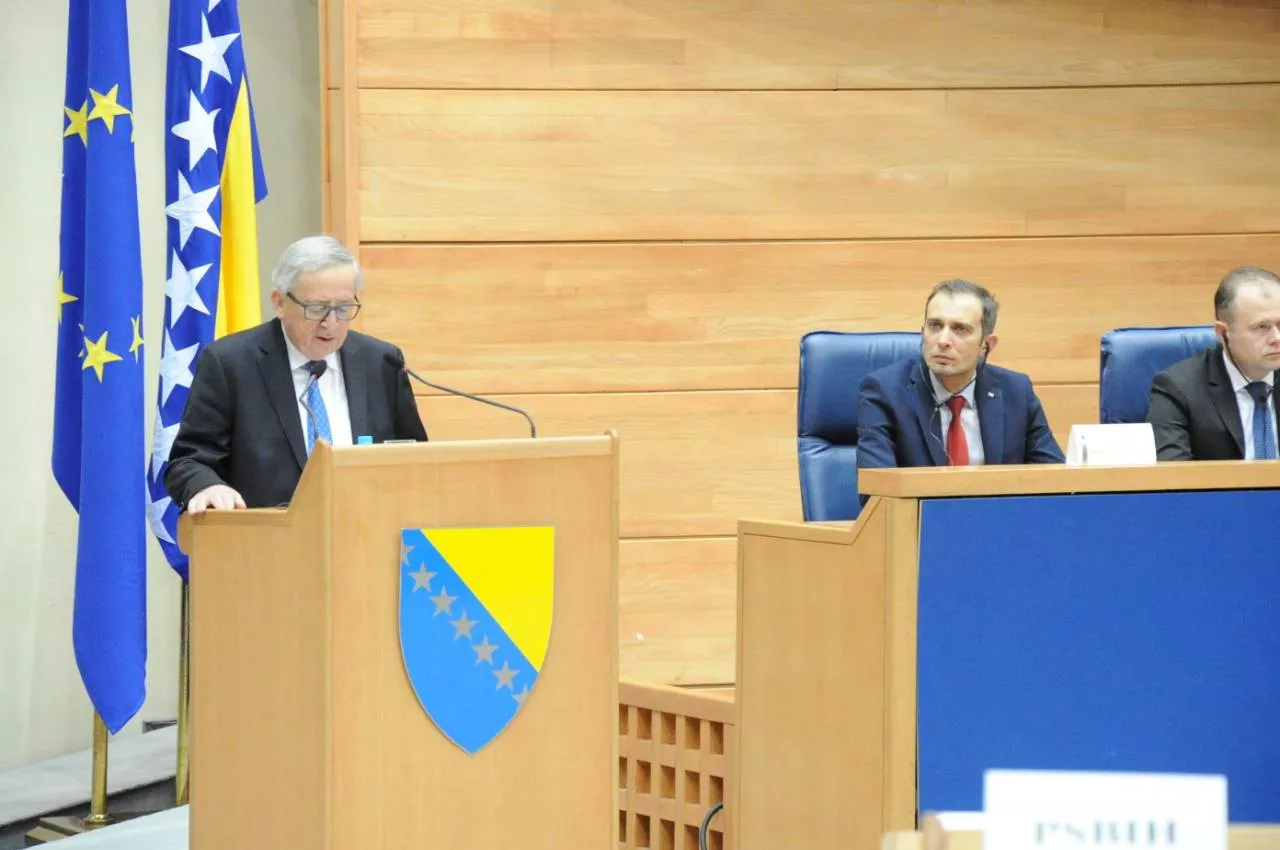
The arrival of Johannes Hahn and Jean-Claude Juncker and the ceremony marking the submission of Bosnia and Herzegovina's answers to the European Commission's questionnaire have evoked some old memories.
Namely, in May 1991, the European Union completely opened its doors for the urgent and unconditional admission of the then Yugoslavia. Everything was supposed to take only four months.
During a visit to Belgrade in May 1991, the President of the EC Commission Jacques Delors, the Prime Minister of Luxembourg Jacques Santer, as well as Hans van den Broek, presented the following spectacular proposal: "Yugoslavia can become an associate member of the EC "immediately" and bypassing the usual rules. 5.5 billion dollars in financial aid would be allocated for this purpose. Of course, the prerequisite for this would be a peaceful resolution of the crisis.".
The dollar was stronger then than it is today against the euro, so that aid was close to 9 billion euros in today's value.
But, two men immediately, almost frantically, rejected it: Slobodan Milošević and Franjo Tuđman. The European visitors were shocked.
In January 2007, the former president of Macedonia, Kiro Gligorov, testified about how the war could have been avoided if it hadn't been for these two leaders, who were later convicted of genocide, crimes against humanity, aggression, and a joint criminal enterprise.
Milošević died in the Scheveningen prison, where he spent five years behind bars. Tuđman was treated for stomach cancer for three years, and then fell into a coma for 40 days from which he never woke up.
According to Gligorov's testimony, the presidents of Serbia and Croatia brutally rejected Delors' plan:
"After Jacques Delors read the proposal that had been agreed upon by the EU Council of Ministers, Milošević spoke up and said: 'I believe we should create a strong and modern federation with a center in Belgrade.'
Then Tuđman also spoke and said: 'I feel I have a historic mission to restore the Croatian kingdom. We had a state, and now it must be restored. And I am not interested in anything else.'
And then poor Alija Izetbegović said: 'Please, don't be like that, let's accept this as a basis for discussion, and there will be various suggestions. And if that doesn't happen, there will be blood up to our knees in Bosnia,'" Gligorov recalled the meeting with the European trio.
The question was often asked: what would have happened if the presidents of the republics had accepted the famous offer for quick entry into the EU and aid of five and a half billion dollars?
Gligorov believed that if that plan had been accepted, things in the Balkans would have taken a completely different direction.
"If the former Yugoslavia had remained intact, avoiding the devastating wars of the nineties, and joined the European Union, not only would people in the region have been better off, but the European Union would also have been better," concluded a project by Cornelius Adebahr, a fellow at the German Council on Foreign Relations (DGAP), who examined what would have happened if the European Union had invested greater efforts, primarily through financial incentives, in the survival of Yugoslavia and its admission to membership.
When the war against Bosnia and Herzegovina began, Jacques Delors was still the President of the European Commission. He soon became a staunch advocate for joint actions for Bosnia and Herzegovina and was considered someone who clearly understood who had started the war against our country and why.
Hans van den Broek, as a member of this delegation, was an advocate for military action for Bosnia from the beginning. He publicly accused Owen of a "strategy of capitulation" and "legalized aggression." He said that Owen and Stoltenberg could have asked him for and received broader powers for a credible threat of the use of force.
When Jacques Chirac was elected President of France, replacing François Mitterrand, the tragic and devastating anti-Bosnian policy immediately turned into a correct attitude towards the legitimate Bosnian government. In the days when it was decided whether France would join the American initiative for a military solution in Bosnia and Herzegovina, the key person next to President Chirac was Jacques Santer, then the new President of the European Union.
A Franco-American meeting, which had bilateral relations as its topic, was held on June 14, 1995, in Washington. Bosnia overshadowed all other topics. Moreover, after talks with Santer, Chirac came with an explicit stance that the Americans should start an action in BiH and that France would follow them. This was only three weeks before the start of the genocide in Srebrenica.
It is interesting that both Delors and Santer were absolutely in favor of an independent European policy, openly telling the Americans that they did not want any external interference. However, thanks to just one meeting with the Yugoslav leaders, they precisely deciphered the roots of the Bosnian tragedy caused by the Milošević-Tuđman duo.
The submission of the Questionnaire and the opening of European hope for Bosnia and Herzegovina only opened the long-standing key question: How long will Europe allow its future and current members, Serbia and Croatia, through their stooges, as Milošević and Tuđman once were, to destroy the European, multi-ethnic, tolerant being of Bosnia and Herzegovina.
A question for the Western Balkans: Why did it take a quarter of a century longer to reach Europe? /S.O./
Komentari (0)
Prijavite se za komentiranje
PrijavaJos nema komentara. Budite prvi!
Minuta
Sve →Iz drugih kategorija

High Representative Not Elected: Germans, French and British Sabotaged Americans, New Attempt at End of June

ČOVIĆ WITHOUT MERCY: How Those Who Brought Ademović to Office Created a Political Hell for Him



Sunny Saturday, quite warm



Tragedy in Albanian resort: Two minors drown












