
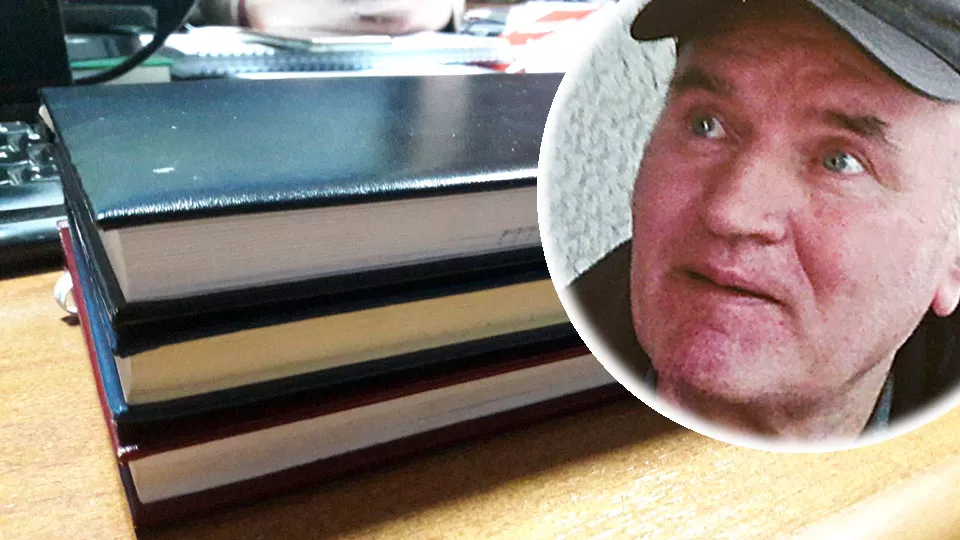
There are a number of details that were not used at the International Court of Justice in The Hague, following BiH's lawsuit against Serbia. Among the most significant new evidence are the famous Mladić diaries, which are currently not being mentioned for these purposes. An official of that court once stated: "Had the material found in Mladić's house been available to the International Court of Justice in The Hague (ICJ) during the trial against Serbia for genocide in Bosnia, it is questionable whether that court would have acquitted Serbia of the charge of participating in genocide and blamed it "only" for failing to prevent genocide."
"Those diaries are stronger evidence than if Mladić, by some miracle, personally appeared and agreed to testify," said that Tribunal investigator. "His sincerity would be more easily called into question than the authenticity of the notes."
"The Army must remain on the territory of the Republika Srpska of BiH, because the JNA units were also brought to that area."
"We have become completely dependent on the FRY. There will be questions, what about the goal 'All Serbs in one state'," Mladić wrote.
General Manojlo Milovanović, who was Mladić's assistant during the war, confirmed the authenticity of the diaries, which became one of the most powerful pieces of evidence about the essence of the war against Bosnia and Herzegovina. Karadžić once tried to prove they were a forgery, but he soon gave up on that futile task.
After Mladić's diaries, the war against Bosnia and Herzegovina held no more secrets. The judges at the Tribunal were completely shocked by the amount of open and loyal cooperation that existed between the Croatian Army and the Croatian Defence Council, on one side, and the JNA and the Army of Republika Srpska on the other.
Serbia and Croatia fought together against the Army of RBiH and Bosnia and Herzegovina, and tried to definitively destroy and ethnically cleanse Bosniaks from their homeland. Throughout the war, General Mladić met with Croatian generals, agreed on ceasefires, deliveries of weapons and oil, and joint action against Bosniaks. Mladić's diaries were used as evidence in the trial against Prlić and others for the joint criminal enterprise of the so-called Herceg-Bosna.
A year before the outbreak of war in BiH, Mladić had information that Croatia would do everything to provoke conflicts in BiH as soon as possible.
In his diaries, he practically reveals Croatia's duplicitous position against BiH and Bosniaks: "ZNG groups have been infiltrated into BiH, a sabotage operation is being prepared. The targets are military facilities, bridges, personalities (generals)..." After that prediction, the destruction of the remaining bridges over the Sava began, and on April 3rd in Mostar, Croats caused a tanker explosion that destroyed several buildings. Mladić made notes in his diaries of meetings with General Slobodan Praljak, Jadranko Prlić, Ante Roso, Milivoj Petković, and others, in Pécs, Hungary, Njivice near Herceg Novi, in Montenegro, and several meetings in the vicinity of Bosanski Grahovo.
The first meeting, which the Hague Prosecution singled out, was on August 5, 1992, when Mladić met with a delegation from Croatia and Herceg-Bosna in Pécs. Slobodan Praljak himself published documents from those meetings in his memoirs.
Croatian media reported that Croatian Finance Minister Jozo Martinović participated in a meeting near Herceg Novi in February 1994. He was minister from August 1991 to August 1992 and transferred hundreds of millions of DM to finance Herceg-Bosna. When Croatian weekly magazines revealed his role and the total plunder of the Croatian budget, he moved to another position and continued to send money to Herceg-Bosna through secret channels.
Croats constantly supplied Serbs with fuel for the war against the Army of RBiH, sometimes charging them more, and sometimes giving it for free. On the other hand, Serbs charged Croats for some "services". On July 8, 1993, Mladić met with General Milivoj Petković, Chief of the General Staff of the HVO, in Njivice near Herceg Novi. He recorded at the time that in exchange for weapons and "services rendered", 1,191,246 German Marks were paid, and two tankers of diesel for tanks were handed over. It was agreed that the Croats would pay 8,092,032 German Marks within a week. All that money was paid from Croatia, as the HVO was financed directly from Zagreb at the time.
What were the "services rendered"? Croats also duly paid Serbs for their involvement in rescuing HVO units that were mostly fleeing in disarray from the Army of RBiH. "I am saving that rabble from the Muslims and transferring them back and forth," Mladić shouted in front of TV SRNA cameras in Vareš. He added that he no longer wanted to do that. But, new foreign currency soon arrived, which probably calmed him down.
No matter how many defeats they suffered, the Croatian side expected that the besieged Army of RBiH would have to give in due to ammunition shortages. With such ideas, Praljak once told Mladić that it was not in the Croats' interest to go to war with the Serbs, that the war would end with an agreement between Croats and Serbs, and that the real danger were the Muslims.
"Our goal is Banovina from 1939," Mladić recorded Praljak's words. Even after the Washington Agreement, Praljak convinced Mladić that the agreement between Tuđman and Izetbegović was only formal, made at the insistence of the Americans, in order to appease the Islamic world.
How much the surrender of Posavina was part of the complete agreement between Tuđman and Milošević is shown in several of Mladić's notes about those agreements. After the fall of Posavina on October 26, 1992, Praljak told him: "We are on the right track to force Alija to divide Bosnia. We will force Alija to sit down at the table with Boban and Karadžić. It is in our interest for the 'Muslims' to have their canton so they have somewhere to move out." Thus, Praljak, as a Croatian general, almost rejoices over the fall of Posavina.
Mladić's diaries are one of the greatest pieces of evidence about the essence of the war against Bosnia and Herzegovina. It is a miracle that the teams for renewing BiH's lawsuit before the Court of Justice have not even mentioned it.
Komentari (0)
Prijavite se za komentiranje
PrijavaJos nema komentara. Budite prvi!
Minuta
Sve →Iz drugih kategorija

High Representative Not Elected: Germans, French and British Sabotaged Americans, New Attempt at End of June

ČOVIĆ WITHOUT MERCY: How Those Who Brought Ademović to Office Created a Political Hell for Him



Sunny Saturday, quite warm



Tragedy in Albanian resort: Two minors drown












