
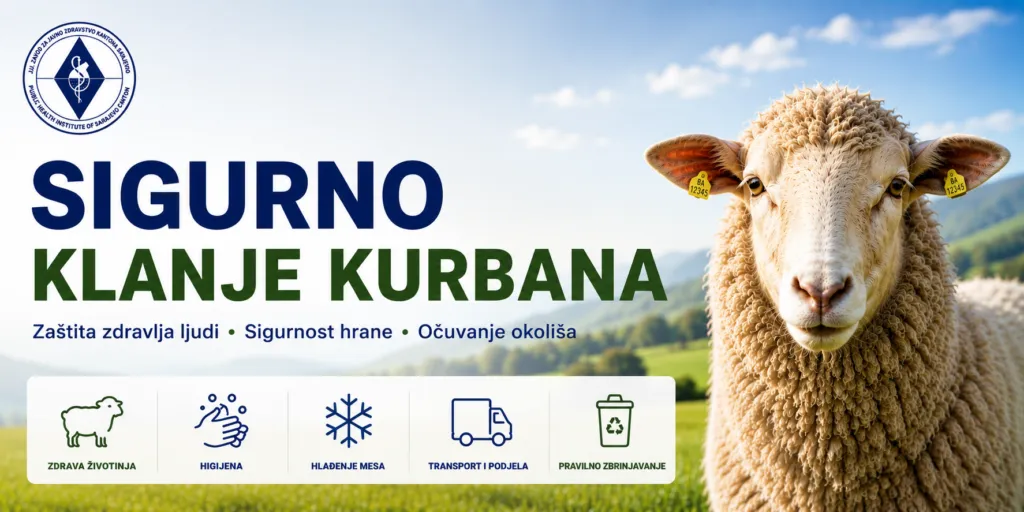
(Patria) - High air temperatures, inadequate processing and storage of meat, and improper disposal of Qurbani remains can pose a significant public health risk during Kurban-Bajram, warns the Public Health Institute of Sarajevo Canton, calling on citizens to responsibly and safely perform the ritual of sacrificing Qurbani animals.
Appreciating the significance and purpose of the Qurbani sacrifice ritual for believers, the Public Health Institute of Sarajevo Canton, on the occasion of the upcoming Kurban-Bajram, issues health recommendations to citizens with the aim of preserving human health, protecting consumers and the environment, and ensuring appropriate sanitary-hygienic and veterinary conditions during the preparation and distribution of Qurbani meat.
Animal Selection
Believers should choose only healthy animals. It is not permitted to sacrifice an animal that is not properly marked, is unhealthy, or has been treated with medications for which the withdrawal period (minimum time that must pass from the last administration of medication to the animal's slaughter) has not expired.
We particularly emphasize that animals should not be purchased or slaughtered without a proper veterinary certificate confirming their health status.
Veterinary Certificate
The document confirming the animal's health status is a veterinary certificate issued by an authorized veterinary station or the competent veterinary inspection.
This certificate is issued by authorized veterinarians of competent veterinary stations at the owner's request, confirming that no infectious diseases have been detected in the animal's place of origin or residence, that the animals are properly marked, that prescribed preventive and diagnostic measures have been carried out, that they have not been treated or that the prescribed withdrawal period has expired, that they have not been treated with prohibited veterinary medicinal products, and that there are no obstacles to their trade and slaughter.
The certificate is valid for ten days from the date of issue or renewal. Its validity can be extended free of charge by a veterinarian's endorsement on the back of the document, provided that the animals' health status has not changed in the meantime.
Sanitary-Hygiene Conditions During Slaughter, Processing, and Distribution of Meat (Slaughter at Home)
The slaughter site at home should be prepared in advance, clean, and hygienically appropriate. Utensils, equipment, and persons involved in the process must also meet basic hygiene requirements.
Individuals with symptoms of respiratory infection or gastrointestinal problems, such as diarrhea, nausea, and vomiting, should not participate in the process of slaughter, processing, and distribution of meat.
Slaughter should be performed by a person trained for the procedure, ensuring that the carcass and meat are not contaminated. After processing the carcass and separating edible parts, the meat needs to be cooled as soon as possible.
Given that Kurban-Bajram falls during a period of high air temperatures this year, which promote the rapid multiplication of microorganisms, the meat must be moved to a cool place as quickly as possible and protected from insects and other pests. Meat should not be left at room temperature longer than necessary for its processing and distribution.
During the processing and preparation of meat for distribution, hygienic measures must be consistently applied to prevent meat contamination and the occurrence of foodborne illnesses. Special attention should be paid to thorough hand washing with soap and water before and during handling meat, maintaining the hygiene of utensils, work surfaces, and packaging, and preventing cross-contamination between raw meat and other food items.
It is recommended to first cool the meat to a temperature of up to 4°C, and then package it for distribution. Otherwise, due to the heat of the meat and closed packaging, rapid development of microorganisms and changes in the organoleptic properties of the meat (color, smell, and taste) can occur, leading to its health unsuitability and unfitness for consumption.
Transport and distribution of meat also represent potential critical points for contamination. Therefore, meat must be transported and delivered as quickly as possible, preferably in cooling bags or portable refrigerators that maintain the appropriate temperature.
Waste and By-product Disposal
Non-edible organic waste generated after animal slaughter, if not disposed of properly, can pose a significant public health and environmental problem and increase the risk of infectious diseases. Such waste must be disposed of in a prescribed and hygienically acceptable manner.
Unfortunately, it is common for individuals to improperly dispose of Qurbani remains, along roadsides, in or next to waste containers, as well as along riverbeds or in sanitary protection zones of drinking water sources.
Improper disposal of unused parts of Qurbani animals, i.e., leaving them on the ground, poses a significant hygienic-epidemiological hazard to human and animal health and the environment.
Qurbani hides should be preserved by salting, and if possible, by cooling, and handed over as soon as possible to an authorized collector who ensures appropriate storage and transport conditions, in accordance with current veterinary regulations.
It is particularly emphasized that Qurbani remains must not be disposed of in watercourses, along watercourses, in sanitary protection zones of water sources, in public areas, green areas, or other places that may pose a risk to human and animal health and the environment. Disposal of animal by-products must be carried out in accordance with current veterinary, sanitary, municipal, and environmental regulations.
Appeal to Citizens
Consistent application of veterinary-health and sanitary-hygiene measures during animal selection, slaughter, processing, storage, and distribution of meat, as well as proper disposal of animal by-products, are of crucial importance for preventing foodborne illnesses, protecting public health, preserving environmental quality, and protecting water resources.
The Public Health Institute of Sarajevo Canton appeals to citizens to perform the Qurbani sacrifice ritual responsibly and in accordance with current veterinary, sanitary, and municipal regulations, applying recommended hygienic measures and proper waste disposal, in order to minimize potential public health and environmental risks and ensure that the upcoming Kurban-Bajram is safe for individuals, families, and the community.
Komentari (0)
Prijavite se za komentiranje
PrijavaJos nema komentara. Budite prvi!
Minuta
Sve →Iz drugih kategorija

High Representative Not Elected: Germans, French and British Sabotaged Americans, New Attempt at End of June

ČOVIĆ WITHOUT MERCY: How Those Who Brought Ademović to Office Created a Political Hell for Him



Sunny Saturday, quite warm



Tragedy in Albanian resort: Two minors drown












