
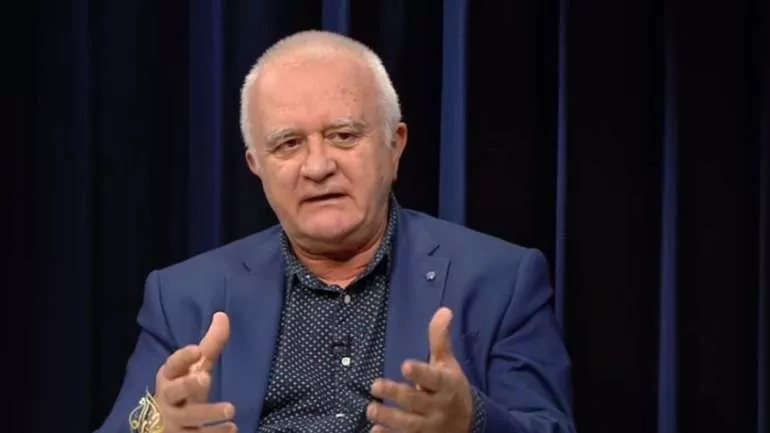
SARAJEVO, (Patria) - Milorad Dodik is currently surviving on the fact that he has no alternative in Republika Srpska. As soon as he shouts - Serbdom is threatened, everyone falls in line [the opposition]. They criticize Dodik, but they vote for everything he says, said Dušan Janjić, a member of the Forum for Ethnic Relations from Serbia, in an interview with Al Jazeera.
“The time for Dodik’s politics is over, his personal energy is spent. Dodik has been talking about a referendum [secession of the RS entity from BiH] since 2011, or whichever year it was, but he isn’t moving things forward anywhere. When will Dodik leave the political scene? Clearly, Mirko Šarović and the opposition are not at a level where they can change the situation in Republika Srpska. If anyone expects Dodik to step aside on his own, or for someone from the outside to do it, that will not happen,” says Janjić, a sociologist and chronicler of socio-political upheavals in the Western Balkans in recent history.
Member of the Presidency of Bosnia and Herzegovina Milorad Dodik blocked the work of state bodies of BiH after the Constitutional Court of BiH challenged part of the Law on Agricultural Land in the RS entity and declared public agricultural land to be the exclusive jurisdiction of the state of Bosnia and Herzegovina.
Dodik, who is also the president of the currently largest political party in the Bosnian-Herzegovinian entity of Republika Srpska, the Alliance of Independent Social Democrats [SNSD], announced the disintegration of Bosnia and Herzegovina if foreign judges remain in the Constitutional Court of BiH, accusing them of bias towards the Bosniak side in their decisions, which has increased concern in the country and exacerbated tensions that could spread to the entire region in case of escalation.
The opposition Serbian Democratic Party [SDS] and its president Mirko Šarović asked Dodik to reveal the names of the members of his SNSD “who were given the disputed land,” alluding to the fact that Milorad Dodik is instigating the latest political tensions due to his personal interests.
Representatives of the international community in BiH, including the High Representative, the guarantor and interpreter of the Dayton Peace Agreement that stopped the war in the country in 1995, condemned Dodik’s crisis-mongering, emphasizing that “decisions of the Constitutional Court of BiH are final and binding,” while the US Ambassador to BiH Eric Nelson threatened that “all those who work against the peace of this country will face real consequences,” likely stronger than the US sanctions already seen against Dodik since 2018 when he was placed on the US Treasury Department’s blacklist.
“Too much is expected from the international community, too much is being misused and responsibility is being shifted to foreigners,” says Janjić.
“It’s all well and good – mediations, advice… But there is no money. You will not find a single American diplomat, businessman, or company that will say – perhaps the right way to drive the Russians out of the Balkans is by investing in the energy sector in the Balkans. You will see their prohibitions on Chinese investments, they get angry when Russians are there. Even the Germans will get angry about Russians and Chinese investing in Bosnia or Serbia, while Russians hold 60 percent of their energy market,” says Janjić, author of several books on political turbulence and wars in the former Yugoslavia, such as books like BiH between War and Peace, Serbia between Past and Future, Conflict or Dialogue on the Serbian-Albanian Conflict, Ethnic Conflicts and Their Management – The Case of Yugoslavia…
Serbia’s relations with neighboring countries, which many see as a key player in the region, and even responsible for most of the problems in Bosnia and Herzegovina, have been truly bad in the last decade, says Janjić. However, with the general invocation of Serbia and himself personally as the protector of Serbs and Republika Srpska, Janjić does not see a direct connection between the latest crisis in Bosnia and Herzegovina and President Vučić.
“I would rather say that he was drawn into it. I think his reaction is insufficiently thought out. Clearly, there is some new moment in the game,” says Janjić, commenting on Vučić’s statement “first it will be about RS land, forests, then schools, kindergartens, churches…” which was assessed as proof of Vučić’s involvement in instigating the crisis in BiH.
“Vučić can do a lot but he is not the key person in the region. I don’t see who is twisting whose arm – whether Dodik is twisting Serbia’s and Vučić’s arms, or if Vučić can do more with Dodik,” says Janjić.
“Signs of reconciliation are visible with [North] Macedonia, after serious crises between the two countries, which were caused by two factors – the strong influence of the extreme right in Serbia, initiated from Moscow, and intelligence structures and their policy of denying Macedonia’s statehood. Vučić supported this type of intervention, only to withdraw later, after which a change occurred in Macedonia. He even seriously angered Moscow at that moment.”
“As for the new attack in Montenegro, we have a political, ideological alignment between the church’s demands to defend property, to change the law, and the denial of Montenegro’s statehood, and if you will, national identity, which is very strong in Vučić’s party and in himself. Although he formally separates the state from the ethnic issue, and claims that Montenegro as a state is not problematic for him, it is clear that he finds it problematic that Montenegro is building a new identity that is not Serbian.”
“Serbia is held by lobbies from Republika Srpska, the Serbian lobby from Kosovo, and the so-called Greater Serbian lobby from Montenegro – they control Serbia’s economy, they control the criminal underworld…,” says Janjić, adding that the region can only be reformed step by step.
“If Kosovo stops being food for Serbian nationalists, Serbia will develop more easily.”
“It is certain that Croatia’s relations with BiH will also relax after the election of Zoran Milanović as President of Croatia [a social democrat], because the potential for blackmail by Dragan Čović [President of HDZ BiH] in BiH will be reduced, and thus relations within Bosnia and Herzegovina itself will also relax.”
Komentari (0)
Prijavite se za komentiranje
PrijavaJos nema komentara. Budite prvi!
Minuta
Sve →Iz drugih kategorija

High Representative Not Elected: Germans, French and British Against Americans, New Attempt at End of June

ČOVIĆ WITHOUT MERCY: How Those Who Brought Ademović to Office Created a Political Hell for Him



Sunny Saturday, quite warm



Tragedy in Albanian resort: Two minors drown












