
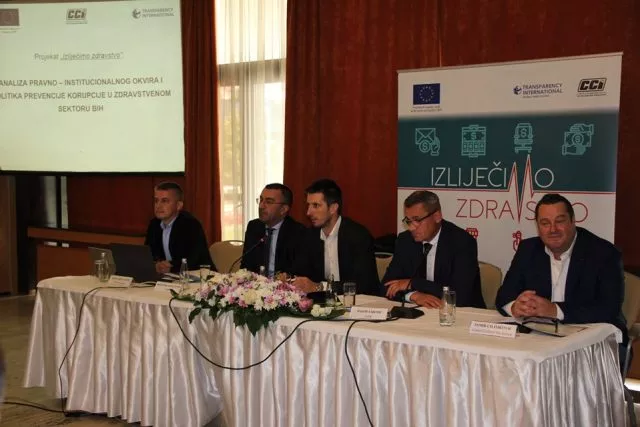
Transparency International Bosnia and Herzegovina (TI BiH) and the Centers for Civil Initiatives (CCI) today in Sarajevo presented the „Analysis of the legal-institutional framework and corruption prevention policies in healthcare in BiH“ developed within the project Heal Healthcare, funded by the European Union. The analysis provides an overview of the legal and sub-legal framework, as well as practices of healthcare institutions in preventing corruption, focusing on areas susceptible to corruption (public procurement, human resource management, conflict of interest, financial management).
The conducted research indicates a series of deep systemic problems in the health sector, which rests on fragile foundations and inadequate capacities for developing and implementing quality anti-corruption measures. Regarding the establishment of internal financial control and audit, all levels in BiH are in the early stages of system establishment. The research showed that more than half of the surveyed public health institutions (54% in the Federation of BiH, 67% in the Republika Srpska) have no established internal oversight.
In public procurement, one of the areas most susceptible to corruption, the research findings indicate that public health institutions do not meet professional and ethical standards, nor do they have sufficient capacity. In the Federation of BiH, slightly less than half of the surveyed public health institutions have a public procurement officer/department, while in the Republika Srpska this is the case for half of those surveyed.
The selection and appointment of management bodies in public health organizations are deeply politicized and subject to bargaining aimed at forming and functioning of political coalitions. Current legal solutions do not guarantee the selection and appointment of the most qualified and competent individuals to the management bodies of public health organizations. The research showed that there are no regulated employment policies in the health sector.
In BiH, waiting times for certain non-urgent health services are very long (for some even up to 10 months), which can affect the health and lives of patients. Unclear procedures for creating and non-publication of waiting lists can influence the occurrence of corrupt and illegal actions in the form of encouraging bribery by healthcare workers or self-initiated bribery by patients to expedite health services.
Through the project “Heal Healthcare“ TI BiH and CCI will directly work with 15 selected health institutions to improve their internal legal acts regulating areas susceptible to corruption, in order to demonstrate that it is possible to significantly improve the situation in individual institutions and generally in the health sector.
Komentari (0)
Prijavite se za komentiranje
PrijavaJos nema komentara. Budite prvi!
Minuta
Sve →Iz drugih kategorija

High Representative Not Elected: Germans, French and British Sabotaged Americans, New Attempt at End of June

ČOVIĆ WITHOUT MERCY: How Those Who Brought Ademović to Office Created a Political Hell for Him



Sunny Saturday, quite warm



Tragedy in Albanian resort: Two minors drown












