
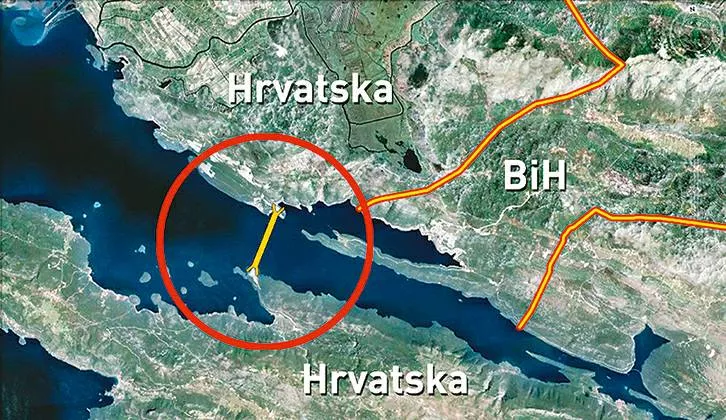
Media in Bosnia and Herzegovina, as well as in Croatia, do not stop with the story about the Pelješac Bridge, and the texts published by Croats are based on attempts to politicize the entire matter, so for days they have been writing that it is not the state of Bosnia and Herzegovina that is against the Pelješac Bridge, but only the SDA and individuals from that party, which is an absolutely incorrect claim. Unfortunately, colleagues in Croatia often receive such stories from the Ministry of Transport and Communications of Bosnia and Herzegovina itself, from people employed by the HDZ BiH in this institution, who persistently work for the interests of neighboring Croatia, betraying their own state!
Večernji list published a text regarding claims that only part of the SDA is against the construction of the bridge, and in a part of the text with the subtitle „All conditions met“, referring to the statement of the Chairman of the Presidency of Bosnia and Herzegovina Dragan Čović regarding „fulfilled conditions“ for the construction of the Pelješac Bridge, in support of that statement, it is stated „...Izet Bajrambašić, who in 2013 sent a response to the European Commission that Bosnia and Herzegovina has no intention of building a port in Neum.“ The text continued without interruption: „It was precisely this reason that Bosniak politicians wanted to cite as the main argument for halting the Pelješac Bridge project.“
- The aforementioned text is not correct. I submitted the response to the project leader Adam Pokropowicz, not to the European Commission, and the original of my response in the context of the Port of Neum reads: „B&H government have not planned construct Port of Neum.“ That response „...that the construction of the Port of Neum was not planned“ (grammatically: an action in the past continues into the present when expressed) is not, nor can it be, support for anyone's claims that conditions for the construction of the Pelješac Bridge have been met, nor can it be a counter-argument to those who oppose the construction of this bridge, as was intentionally stated in the text of Večernji list – said Bajrambašić.
The conditions for the construction of the Pelješac Bridge are not related to the Port of Neum and construction plans in that regard, but are related to navigation and waterways, as established by the provisions of adopted laws and laws in continuous effect, such as the laws necessary for the proper interpretation of the required conditions for the construction of the Pelješac Bridge, namely the laws in force: the Law on Inland and Maritime Navigation of SR Bosnia and Herzegovina and the Law on Maritime and Inland Navigation of the SFRY (pursuant to Article 1, paragraph 2 of the previous Law). Related to this is the UN Convention on the Law of the Sea.
The Law of SR Bosnia and Herzegovina (continuously) defines that: „A waterway on the coastal sea... means a part of the Adriatic Sea in the Republic.“, then „For loading and unloading goods, i.e., embarking and disembarking persons, inland navigation ports and maritime ports are used.“ Additionally, it is established that „Ports and harbors can be on the waterway (open) or outside the waterway (basin).“ and that „...they serve, as a rule, public traffic.“ The Law also states that inspection tasks are carried out through the Port Authority in Neum, which currently exists at the level of the Federation of Bosnia and Herzegovina. The Port of Neum does not exist, nor does spatial planning documentation for it exist. It is certainly impossible for it to be in the town of Neum, which is settled on the mainland coast for a length of at least 10 km. However, the remaining over 12 km of the mainland coast of Bosnia and Herzegovina have exceptionally suitable locations for a passenger port, as provided for by law.
- According to the above, the regulations of Bosnia and Herzegovina and the UN Convention on the Law of the Sea have clearly defined these issues. This regulates waterways, navigation, ports, and other matters, and the necessary activities and their implementation must be in accordance with the said regulations. Everything established by law is a strategic commitment of the state of Bosnia and Herzegovina and its authorities. If by-laws, plans, etc. do not exist, they should be prepared in accordance with the law – Bajrambašić further states.
Unfortunately, Bosnia and Herzegovina was not involved, nor was it consulted for anything, in the preparation of the Feasibility Study for the construction of the Pelješac Bridge (2015), which is a key document, along with the Environmental Impact Study of the Pelješac Bridge (2015), for the application to the European Commission for EU funds, in this case for the Pelješac Bridge.
- This is a great damage to the Pelješac Bridge project and the decision of the European Commission to approve funds for the implementation of this project, because the Feasibility Study certainly did not address the legal aspect in a professional and necessary manner. Had this been done, the conflict between the two legislations of the Republic of Croatia and Bosnia and Herzegovina, and the conflict between two state sovereignties, would have been clearly presented, because the Maritime Code of the Republic of Croatia (1994) annexed part of the Adriatic Sea of Bosnia and Herzegovina, as established by the Law on Inland and Maritime Navigation of SR Bosnia and Herzegovina, to the internal waters of the Republic of Croatia, over which the Republic of Croatia has full sovereignty.
Based on this, the consultant would have unequivocally determined that the sovereignty and territorial integrity of the state of Bosnia and Herzegovina in this part of the Adriatic Sea had been violated and would have timely informed the European Commission, and as a conscientious consultant, advised the authorities in Croatia to make corrections to the Maritime Code.
In relation to the essence of the problems related to the construction of the Pelješac Bridge and the need for good neighborly relations between Bosnia and Herzegovina and the Republic of Croatia, such ambiguous political speculations with the work and performance of professional state officials, with confirmed experience and knowledge, should be avoided – added Bajrambašić.
Komentari (0)
Prijavite se za komentiranje
PrijavaJos nema komentara. Budite prvi!
Minuta
Sve →Iz drugih kategorija

High Representative Not Elected: Germans, French and British Sabotaged Americans, New Attempt at End of June

ČOVIĆ WITHOUT MERCY: How Those Who Brought Ademović to Office Created a Political Hell for Him



Sunny Saturday, quite warm



Tragedy in Albanian resort: Two minors drown












