
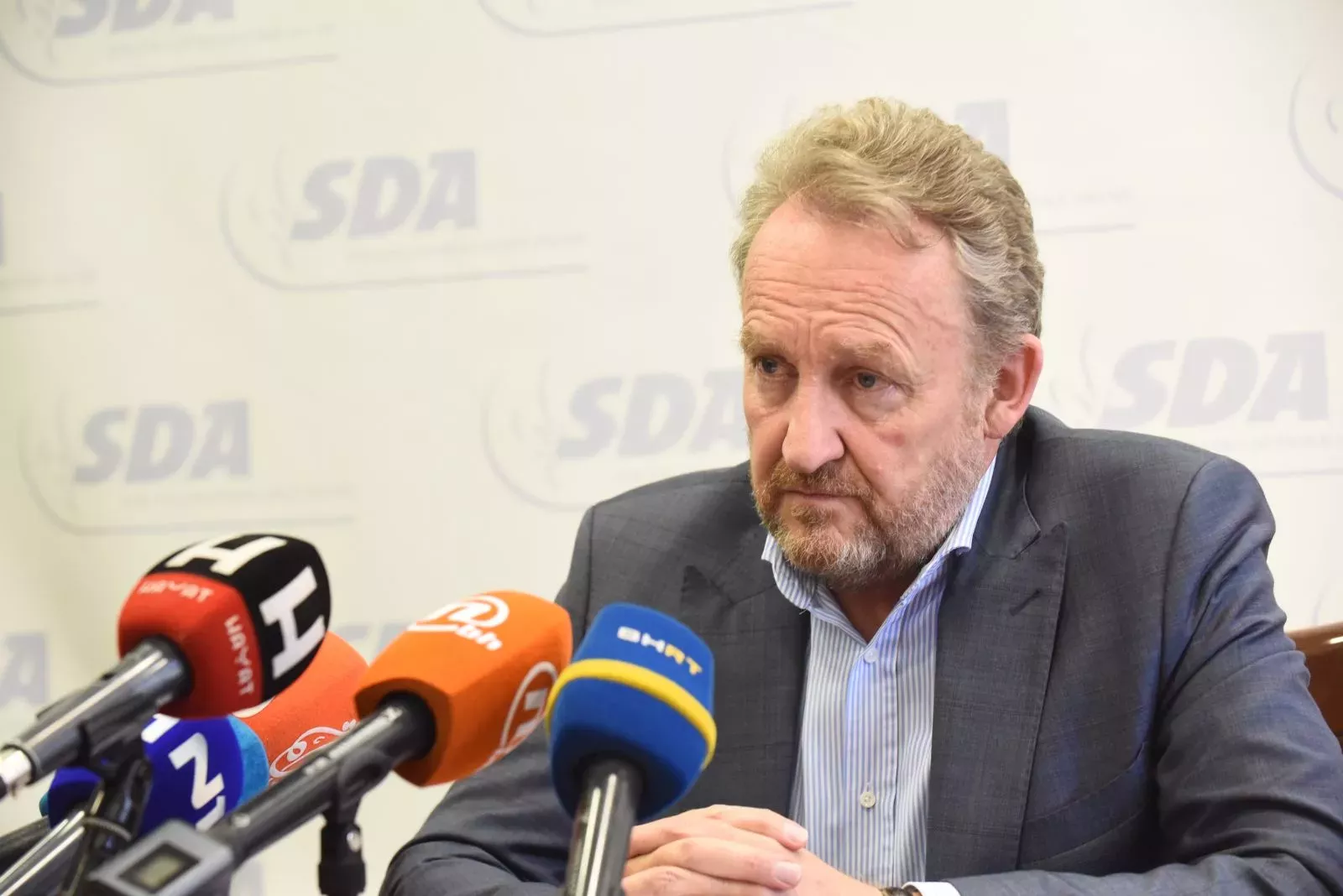
(Patria) - SDA President Bakir Izetbegović sent letters to the foreign ministers of all United Nations member states, in which he requested support for the adoption of the Srebrenica Resolution in the UN General Assembly.
Izetbegović addressed the ministers in his capacity as a former member of the Presidency of Bosnia and Herzegovina for two terms, as the president of the largest political party in our country that largely articulates the political will of Bosniaks, but above all as a human being and a member of the nation that was subjected to genocide in 1995.
The full text of the letter follows.
"I am addressing you as a former member of the Presidency of Bosnia and Herzegovina for two terms, from 2010 to 2018, and as the president of the largest political party in Bosnia and Herzegovina, which largely articulates the political will of Bosniaks. But, above all, I am writing to you as a human being, and as a member of the nation that was subjected to genocide in 1995.
As you know, the United Nations General Assembly will soon vote on a Resolution that would permanently preserve the memory of the victims of the genocide committed in July 1995 in the 'UN Protected Area – Srebrenica', condemning the denial of genocide and the glorification of the perpetrators of this terrible crime.
Bosnia and Herzegovina was exposed to brutal aggression from 1992 to 1995, accompanied by the most severe war crimes. In an attempt to annex a part of Bosnia and Herzegovina to Serbia, supported by the then Serbian regime led by Slobodan Milošević, Bosnian Serb forces systematically carried out mass crimes in the territory they controlled, including ethnic cleansing of the population not belonging to the Serb people, mass rapes, and internment in concentration camps.
During the criminal campaign, all places of worship of Bosniaks (Muslims) and Croats (Catholics) were destroyed. Crimes were committed in all parts of Bosnia and Herzegovina. The capital city of Sarajevo was under siege for almost four years, during which more than 11,000 people were killed by shells and snipers, including 1,601 children.
The genocide in Srebrenica was the culmination of a criminal project carried out by the political and military leadership of the Bosnian Serbs, led by Radovan Karadžić and Ratko Mladić.
It is particularly important to note that the besieged enclave of Srebrenica was declared a 'UN protected area' by UN Security Council Resolution 819 on April 16, 1993, and was subsequently demilitarized. Thousands of civilians and refugees from surrounding areas sought refuge in Srebrenica, under the flag and protection of the UN. In a brutal attack on the enclave, in just a few days in July 1995, more than 8,300 captured men and boys were killed.
Their bodies were buried in mass graves. In an attempt to conceal the committed crime, the perpetrators further desecrated the mass graves by moving bodies through the valleys and hills of eastern Bosnia, into secondary and tertiary mass graves. There are numerous examples where the remains of one victim were found in two, three, or even four different locations. Many victims have not been found to this day.
The genocide in Srebrenica is a historical and legal fact established in numerous judgments before two United Nations courts: the International Court of Justice (ICJ) and the International Criminal Tribunal for the former Yugoslavia (ICTY).
In 2007, the International Court of Justice determined that the genocide against Bosniaks in Srebrenica was committed by members of the so-called 'Army of Republika Srpska' and the police of Republika Srpska (now one of the entities in Bosnia and Herzegovina formed after the signing of the Dayton Peace Agreement), and that the Republic of Serbia is responsible for failing to prevent the genocide.
Before the International Criminal Tribunal for the former Yugoslavia, almost the entire political and military Serb leadership was convicted for a joint criminal enterprise, genocide, crimes against humanity, and other war crimes.
Unfortunately, years after the judgments of the UN international courts, there has been no confrontation with the bitter truth in the Bosnian entity of Republika Srpska, nor in the Republic of Serbia.
On the contrary, the political leaders of Bosnian Serbs and the Republic of Serbia persistently and systematically deny the genocide and glorify its perpetrators. As examples of glorifying war criminals, I will mention that in 2016, the National Assembly of Republika Srpska awarded Radovan Karadžić, who was sentenced to life imprisonment by the International Criminal Tribunal in The Hague for genocide and crimes against humanity, and that in numerous cities of the entity Republika Srpska and Serbia, memorial plaques are placed and murals are painted with the image of Ratko Mladić, sentenced to the same punishment by the same court for the same crimes, with the message that he is a hero.
The denial of the genocide in Srebrenica and the glorification of its perpetrators are the reasons why it is necessary for the United Nations General Assembly to adopt the Resolution. This will be a new opportunity to confront the truth and a new chance for reconciliation. It is also an opportunity to reiterate that responsibility for the committed genocide lies with parts of the then-Serbian regime, not the entire nation. This helps the Serbian people by rejecting the narrative that their political leadership persistently imposes on them to justify the crimes of Milošević's and Karadžić's regimes, of which some current politicians in Serbia were also a part.
The Resolution, after preparations that have been ongoing since 2022, will be sent to the UN General Assembly, and will be sponsored by 22 states.
In normal circumstances and in a normal world, such a letter, requesting support for truth, justice, international law, and civilizational values, would not be necessary.
However, the circumstances are not normal, because the followers of the policy responsible for the genocide, who still lead Serbia and the Bosnian entity of Republika Srpska, with the support of Russia, want to dispute or prevent its adoption at all costs.
They try to intimidate UN member states by claiming that the adoption of the Resolution could lead to destabilization in Bosnia and Herzegovina and the Western Balkan region, or that it would stigmatize the entire Serbian people. Such claims are the height of cynicism. It is unacceptable that those who deny genocide and glorify war criminals threaten and intimidate UN member states with claims that recalling the truth about genocide could lead to conflicts and destabilization. This is not true, and this cannot and must not be the principle by which the UN operates.
I find it appropriate to quote American professor Gregory Stanton, who defines denial as the tenth, final stage of genocide, and best describes the actors who want to dispute the adoption of the Resolution:
“Denial is the final stage, which lasts a long time and always follows genocide. It is one of the surest indicators of future genocidal intentions. Perpetrators of genocide dig up mass graves, burn bodies, try to hide evidence, and intimidate witnesses. They deny that they committed any crime and often blame the victims for what happened. They block investigations of crimes and continue to rule until they are forcibly removed from power...“
Your Excellency,
I request your country's support for the adoption of the resolution declaring July 11 as the 'International Day of Reflection and Commemoration of the Genocide in Srebrenica in 1995' in the UN General Assembly. Support for the Resolution is neither a geopolitical nor a security issue. It is simply a matter of truth, humanity, and support for the families of the victims, whose dignity is attacked daily by genocide deniers.
Komentari (0)
Prijavite se za komentiranje
PrijavaJos nema komentara. Budite prvi!
Minuta
Sve →Iz drugih kategorija

High Representative Not Elected: Germans, French and British Sabotaged Americans, New Attempt at End of June

ČOVIĆ WITHOUT MERCY: How Those Who Brought Ademović to Office Created a Political Hell for Him



Sunny Saturday, quite warm



Tragedy in Albanian resort: Two minors drown












