
By: Ernad Metaj
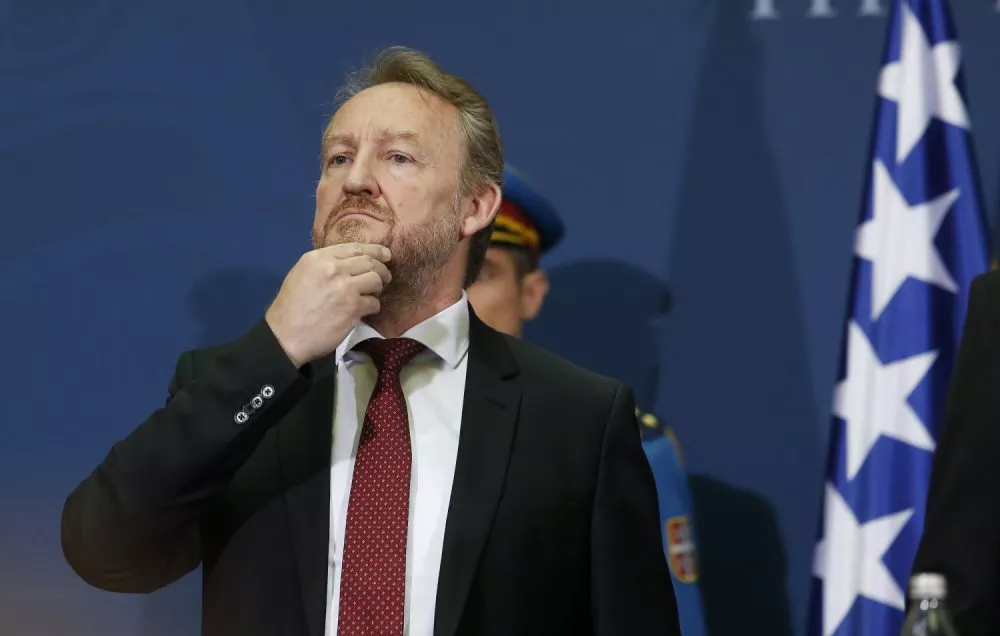
Once again, SDA leader Bakir Izetbegović appears to have started going solo in negotiations on the future of BiH. While state institutions, including the one under Izetbegović's leadership, are not functioning, he went to Dubrovnik to meet with Croatian Prime Minister Andrej Plenković. Without the state flag, he discussed relations with Croatia, and it seems the real reason was solely to seek a solution for the Election Law, in which HDZ presents legitimacy as a key condition for unblocking the Federation of BiH and state institutions.
Izetbegović quickly forgot his own appeals to pro-Bosnian forces to act jointly, which resulted in the stance that the Election Law and constitutional reforms should not be negotiated while the constitutional order of BiH is under attack. In doing so, it was set as an imperative that matters be resolved where they should be, within BiH's institutions.
After the meeting between Plenković and Izetbegović, optimism among HDZ leader Dragan Čović has visibly increased. One can justifiably ask whether the fear of possible sanctions, which have also been announced for representatives of SDA and HDZ, has sparked a readiness for new mutual concessions. Judging by Plenković's statements, the essence is the BiH Presidency, and it is no secret that, besides legitimacy, this is also a matter of personal frustration for Dragan Čović.
It is interesting that these talks come ahead of the announced arrival of US and EU representatives Matthew Palmer and Angelina Eichhorst in BiH to continue discussions on the Election Law. It is important to note that they previously postponed their visit because pro-Bosnian parties, due to the escalation of the crisis in BiH, did not wish to participate in those talks. Since then, the situation has worsened, only deepening the suspicion that Izetbegović and Čović, by reopening the topic of the Election Law, are trying to save their own political survival or that of those close to them.
Better a state in a stump than one's own career or the careers of loyal cadres, could be Izetbegović's logic. His seemingly unprovoked departure from the framework of the agreement with pro-Bosnian parties could be the result of his own assessment of whether he loses more by resisting foreigners or by turning his back first on DF leader Željko Komšić, who bears the burden of cooperation with SDA despite the clear intention to save BiH's interests, and then on the opposition he begged for help.
Izetbegović, like Dragan Čović, wants to return to the presidential chair. Until now, the only obstacle to this could have been pandering to HDZ's interests, which for the public could be equivalent to betraying the state. The fact that Dragan Čović has stopped talking about a third entity does not mean he has given up on it. A concrete step towards this is the legitimate representation he insists on. If Izetbegović has decided to take the risk, then he has concluded that further opposition to talks with mediators who have openly sided with HDZ, seeking points for their own political careers, would be more detrimental to him personally. If so, then Izetbegović has never been too interested in the future of the state.
Until now, Dragan Čović has refrained from criticizing the secessionist policies of SNSD; even HDZ cadres found justifications for it. Even now, he does not call for de-escalation but instead prioritizes an agreement between HDZ and SDA on the Election Law. In doing so, Čović revealed that there have been several online meetings and conferences on amendments to the Election Law at the expert level. Which ones, he did not specify, but he expressed the expectation that before the arrival of Palmer and Eichhorst, a discussion with the Venice Commission will be held on the compliance of existing proposals with what is an acceptable legal stance within the European space.
It seems that Izetbegović has a lot to explain to the public and partners in the pro-Bosnian bloc. Otherwise, it would be clear that Izetbegović never gave up on keeping BiH trapped in ethnonationalism and divisions, without which it would be much harder for him to impose himself as a leader. Now, Croatian-Bosniak friendship is important to supposedly stop Dodik, and when the Election Law legitimizes a third entity, the public will be distracted by the need to establish Serbian-Bosniak friendship, parading at meetings with Serbian President Aleksandar Vučić. Let them stay in power, and the state, such as it is, remains.
Komentari (0)
Prijavite se za komentiranje
PrijavaJos nema komentara. Budite prvi!
Minuta
Sve →Iz drugih kategorija

High Representative Not Elected: Germans, French and British Sabotaged Americans, New Attempt at End of June

ČOVIĆ WITHOUT MERCY: How Those Who Brought Ademović to Office Created a Political Hell for Him



Sunny Saturday, quite warm



Tragedy in Albanian resort: Two minors drown












